



Chốt đục lỗ cho khuôn tiến bộ: Độ chính xác cho dụng cụ chu trình cao
Punch pins for progressive dies must be selected as part of a complete station system, not as isolated hardened components. The operation performed at the station, strip material, feature geometry, cutting clearance, punch support, sự căn chỉnh, điều kiện tháo rời, and maintenance plan all affect punch reliability.
A harder material or premium coating cannot compensate for excessive unsupported length, căn chỉnh kém, giấy phép không đúng, or unstable strip feeding. Để biết thông tin rộng hơn về các loại khuôn, Vật liệu, các mức dung sai, và nguồn cung, xem Hướng dẫn đục lỗ (được suy luận). This guide focuses specifically on selecting, diagnosing, and specifying working punches for progressive tooling.
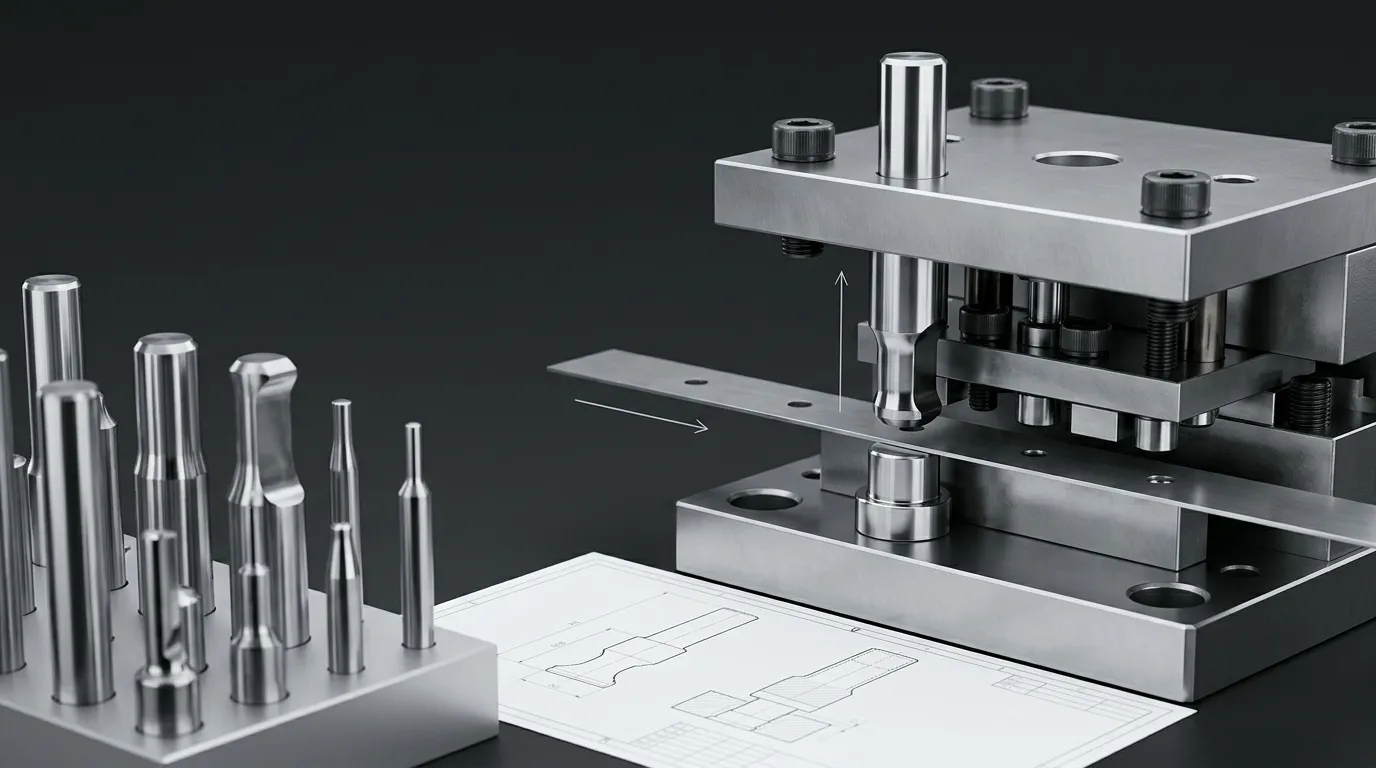
Why Progressive Dies Need Station-Specific Punch Specifications
A progressive die moves strip material through a sequence of stations. Each press stroke may pierce, notch, trim, hình thức, or separate a feature while the feeder and pilots maintain the strip’s position.
This creates several demands that are less significant in a simple single-operation die:
- Errors at one station can affect every station that follows.
- Repeated side loading can gradually deflect a punch even before visible failure occurs.
- Feed or pilot errors can move the strip relative to the punch.
- Stripping force loads the punch during withdrawal from the stock.
- Slugs or loose material can interfere with later operations.
- Regrinding one punch can alter penetration or timing relative to other stations.
“High-cycle” therefore describes an operating condition, not a guaranteed number of strokes. Actual punch life depends on the complete combination of material, hình học, Giải phóng mặt bằng, điều kiện báo chí, sự bôi trơn, hỗ trợ, và bảo trì.
Match the Punch to the Operation at Each Station
The first selection question should be: What does this punch do at its station?
Different operations create different loading patterns.
| Station operation | Main punch demand | Common risks to evaluate |
|---|---|---|
| Xỏ khuyên | Repeated shearing through an enclosed profile | Mài mòn cạnh, small-section breakage, slug pulling, sự phát triển của gờ |
| Notching or trimming | Shearing along a strip edge or partial contour | Asymmetric load, side deflection, uneven wear |
| Cutoff | Final separation of the part or carrier | High separation load, timing sensitivity, sốc |
| Forming | Plastic deformation rather than simple shearing | Side thrust, dòng vật liệu, gây khó chịu, profile wear |
| Piloting | Strip registration rather than feature cutting | Position error, pilot entry damage, feed mismatch |
A small round piercing punch, Ví dụ, may be limited by slenderness and slug behavior. A long trimming profile may be more sensitive to uneven loading across its edge. A forming punch may need greater resistance to lateral force and material pickup.
Working Punches and Pilot Pins Perform Different Jobs
A working punch cuts or forms the strip. A pilot pin enters a previously produced hole or locating feature to refine strip position before critical operations occur.
The terms are sometimes mixed in supplier catalogues, so the drawing and RFQ should state the function clearly. Thuộc tính ISO 8695 punch terminology standard can help distinguish recognized punch types, while pilot design still needs to reflect strip thickness, feed conditions, and the actual locating method.
A pilot should not be selected using the same assumptions as a piercing punch. Its entry shape, Vị trí, Giải phóng mặt bằng, and relationship with the feeder are central to its function.
Specify Geometry, Support, and Alignment as One System
Punch geometry cannot be evaluated only by nominal diameter or overall length. The designer must consider the smallest working section, profile transitions, cán, đầu, chiều dài không được hỗ trợ, phương pháp giữ lại, and mating die opening.
For a reliable specification, Đánh giá:
- working-tip diameter or profile;
- smallest cross-section;
- unsupported length below the guide or holder;
- shank and head dimensions;
- transition radii where the part design allows them;
- straightness and relevant runout;
- concentricity between the working end and shank;
- profile tolerance for non-round punches;
- edge condition and regrind allowance;
- functional datums for replacement inspection.
A punch that is strong in compression can still fail if it is long, slender, poorly guided, or exposed to lateral load.
Profile and Unsupported Length Control Punch Stiffness
As unsupported punch length increases, resistance to deflection decreases. Narrow slots, small diameters, sharp profile changes, and asymmetric cutting edges further increase stress concentration.
Side loading is especially damaging because it can move the punch tip away from the intended axis. This changes the effective clearance around the profile. One side may then carry more cutting load, causing uneven wear or local chipping.
Technical guidance on improving punch life also connects lateral loading with punch-tip deflection and altered cutting clearance. This is why repeated breakage should not automatically lead to a harder punch material. The underlying problem may be geometry, hỗ trợ, feed position, or station loading.
The Holder, Backing Plate, Stripper, and Die Button Must Agree
The punch operates through a stack of supporting components:
| Thành phần | Relationship with the punch | Problems if the relationship is poor |
| Punch holder or retainer | Locates and secures the shank | Position error, sự lỏng lẻo, repeated misalignment |
| Backing plate | Supports the punch head under axial load | Head indentation, chỗ ngồi kém, quá tải cục bộ |
| Stripper plate | Removes stock and may guide the working end | High withdrawal load, tip movement, tính điểm |
| Die button or matrix | Receives the punch and establishes the cutting opening | Uneven clearance, hư hại cạnh, burr variation |
| Trụ dẫn hướng và ống lót | Maintain upper-to-lower die alignment | Off-center entry, mòn một bên, mẻ |
A guided stripper can help maintain the punch tip’s relationship with the die opening. MISUMI’s technical explanation of die structures notes the use of movable strippers for precision and progressive punching, including punch-tip guidance.
The wider roles of holders, backing plates, vũ nữ thoát y, die buttons, and guide systems are covered in the Hướng dẫn thành phần khuôn. For this application, the important point is that changing only the punch may not solve a support or alignment problem.
Control Clearance, Strip Registration, and Slug Movement
The punch and die opening form a working pair. Their relationship affects cutting load, fracture behavior, sự hình thành răng cưa, edge wear, và chuyển động của đạn.
Clearance should be based on the actual:
- vật liệu phôi;
- strip thickness;
- hardness or strength;
- feature geometry;
- điều kiện cạnh yêu cầu;
- punch and die material;
- alignment capability;
- expected wear behavior.
A nominal clearance value is not enough if the punch deflects or the die set is misaligned. The effective clearance may become larger on one side and smaller on the other.
Clearance Must Follow the Material and Feature
There is no single clearance percentage suitable for every progressive-die station.
Research on blanking has shown that clearance can influence punch wear, burr size, and the geometry of the cut feature. Một peer-reviewed study on hardened steel sheet found measurable relationships among blanking clearance, mòn do đục lỗ, and burr development under its tested conditions.
The practical lesson is not to copy the study’s values into an unrelated die. Instead, use the material grade, Độ dày, Sức mạnh, hình học, and quality requirement to establish a starting condition, then verify it through controlled inspection.
Uneven wear around the punch should trigger checks for:
- off-center punch entry;
- worn guide components;
- punch deflection;
- die-button movement;
- feeder or pilot error;
- uneven cutting load;
- local edge damage.
Registration and Slug Control Protect Downstream Stations
Progressive tooling depends on repeatable strip positioning.
A typical sequence is:
- The feeder advances the strip by the intended pitch.
- Pilots refine or confirm strip position.
- The stripper controls the stock near the working area.
- The punch enters the strip and die opening.
- The slug or trimmed material clears the station.
- The stripper removes the stock from the punch during return.
A feed or pilot problem can cause the punch to engage the strip off-center. Excessive stripping force can bend a slender punch or loosen its retention. A returned slug can remain on the punch face, re-enter the strip, or interfere with a later station.
Slug pulling therefore should not be treated only as a waste-removal issue. It can become a punch-damage and strip-progression problem.
Choose Material and Coating by the Dominant Failure Risk
Punch material should be selected after identifying the expected loading and failure mode. Maximum hardness alone is not a reliable selection method.
The main properties to balance are:
- khả năng chống mài mòn;
- sự cứng cáp;
- độ bền nén;
- resistance to plastic deformation;
- dimensional stability after heat treatment;
- resistance to chipping under shock or side load;
- suitability for the intended coating and finish.
Select the Substrate Before the Coating
| Điều kiện ứng dụng | Material direction to evaluate | Main limitation to check |
| Moderate wear with impact or variable loading | Tool steel or high-speed-steel category | May wear faster than a more wear-resistant option |
| Severe abrasive wear with stable alignment | Higher-wear tool steel, powder-metallurgy steel, hoặc cacbua | Phí Tổn, đang mài, mẻ, and support requirements |
| Small punch with repeated lateral load | Tougher steel and improved guidance | Wear may increase if the substrate is too soft |
| Ổn định, high-wear piercing condition | Carbide may be considered | Sensitive to shock, sai lệch, and inadequate support |
| Adhesive wear or pickup | Suitable substrate plus finish, sự bôi trơn, or coating review | Coating cannot correct geometry or clearance errors |
Carbide can provide high wear resistance and compressive strength, but it is not automatically the best choice for every station. A carbide punch exposed to misalignment, sốc, or side loading may chip where a tougher steel would tolerate the same disturbance.
SunshinePro lists SKH51, SKH9, DC53, ASP grades, and carbide among its punch-pin material categories. These are available directions, not proof that one grade is suitable for a specific die. The final choice requires the work material, hình học, hỗ trợ, điều kiện sản xuất, and failure history.
Use Coatings for a Defined Surface Problem
A coating should target a known surface issue such as abrasive wear, mài mòn do keo dán, gây khó chịu, hoặc thu gom vật liệu.
Before selecting one, xác nhận:
- punch substrate and heat treatment;
- surface finish before coating;
- coating adhesion requirements;
- workpiece material and surface condition;
- sự bôi trơn;
- nhiệt độ hoạt động;
- whether the punch will be reground;
- whether the coated surface includes the cutting edge, sidewall, hoặc cả hai.
SunshinePro lists TiN, TiCN, and DLC as custom punch-pin coating options. The appropriate choice depends on the substrate and contact conditions. No coating can correct an off-center punch, hỗ trợ không đủ, weak profile, or incorrect punch-to-die relationship.
Diagnose Wear and Breakage Before Replacing the Punch
The visible damage is not always the root cause. A symptom-based inspection reduces the risk of replacing the punch while leaving the system problem unchanged.
| Triệu chứng | Possible variables | First checks |
| Burr increases gradually | Mài mòn cạnh, die wear, clearance change | Inspect punch edge, Khai trương, feature quality trend |
| Wear appears mainly on one side | Deflection, sai lệch, feed error, uneven clearance | Check guides, pilots, holder position, die-button alignment |
| Edge chips locally | Shock, tải quá mức, hỗ trợ kém, low toughness, tight local clearance | Inspect fracture location, punch support, Khai trương, hướng tải |
| Punch bends or buckles | Chiều dài không được hỗ trợ quá mức, small section, tải bên, quá tải | Check profile, sự hướng dẫn, station operation, strip position |
| Material adheres to the punch | Galling, bôi trơn kém, finish issue, lớp phủ không phù hợp | Inspect pickup pattern, stock surface, sự bôi trơn, sidewall finish |
| Punch head fails | Poor seating, weak backing support, tập trung ứng suất, quá tải | Check holder, backing plate, hình học đầu, mẫu tiếp xúc |
| Slug follows the punch | Độ bám dính, vacuum effect, poor slug relief, điều kiện mặt đục | Inspect slug path, die relief, mặt bị đấm, sự bôi trơn |
| Feature position drifts | Feed, pilot, Hướng dẫn, holder, or punch movement | Check strip pitch, pilot condition, holder fit, die alignment |
Repeated fracture deserves a broader investigation. Hướng dẫn tận tâm về đục lỗ đứt gãy trong khuôn dập covers fracture causes and preventive actions in more depth.
A practical rule is to inspect the mating and supporting components whenever the same punch fails again. Replacing a damaged punch with an identical one will not correct a worn die button, loose holder, unstable feeder, damaged stripper, or misaligned guide system.
Plan Regrinding, Kiểm tra, and Interchangeable Replacement
Regrinding restores the cutting edge, but it also removes punch length. That change can affect penetration, stripper interaction, station timing, and the relationship with other punches.
A maintenance plan should define:
- the condition that triggers sharpening;
- allowable stock removal;
- original and remaining punch length;
- edge geometry after grinding;
- required straightness or runout;
- whether coating must be reapplied;
- inspection of the mating die button;
- timing or penetration adjustment after installation;
- the minimum remaining serviceable length.
Do not wait for severe chipping if the punch is intended to be reground. Grinding away extensive damage removes more material and may make it harder to preserve the original profile.
Replacement punches also need functional datums. A drawing should identify which surfaces control:
- position in the holder;
- working-tip location;
- head seating;
- overall operating length;
- profile orientation;
- relationship with the mating die opening.
SunshinePro states that its quality approach includes incoming inspection, giám sát trong quá trình, kiểm tra cuối cùng, và báo cáo kiểm tra. For an actual order, the buyer should still define which dimensions, ngày, các mức dung sai, and report fields must be verified.
Choose a Standard or Custom Punch Pin
A standard punch may be suitable when the required profile, Kích thước, kiểu đầu, phương pháp giữ lại, Vật chất, and tolerances match an available design.
A custom punch is more likely to be required when the station uses:
- a non-round or proprietary profile;
- an unusual head or retention interface;
- a stepped or reduced working section;
- a special transition between shank and tip;
- an orientation feature;
- tight relationships between several datums;
- replacement dimensions tied to an existing die;
- a specific material, xử lý nhiệt, or coating combination.
| Selection question | Standard punch may fit | Custom punch may be needed |
| Is the working profile common? | Round or established catalogue profile | Special slot, contour, bước, or asymmetric shape |
| Is the holder interface standard? | Common head and shank configuration | Proprietary retention or seating geometry |
| Are replacement datums simple? | Basic diameter and length control | Multiple positional, Tiểu sử, or orientation controls |
| Is the material readily available in the required form? | Standard listed grade | Special grade, carbide form, or treatment requirement |
| Does the punch match an existing die? | Standard dimensions already used | Exact replacement compatibility required |
A worn sample can help identify the component, but it may not preserve the original dimensions. Mặc, đang nghiền lại, sự uốn cong, and edge damage can all distort the sample. A controlled drawing remains the preferred reference.
SunshinePro states that custom punch pins can be produced from drawings, Mẫu, or specifications, with custom dimensions, Hình dạng, head profiles, Vật liệu, và các lớp phủ. Its published processes include CNC machining, mài chính xác, xử lý nhiệt, xử lý nhiệt chân không, and EDM. Feasibility still needs to be confirmed for the specific geometry and tolerance combination.
Prepare the Drawing and RFQ Package
A complete inquiry helps the supplier evaluate material, lộ trình sản xuất, Kiểm tra, and replacement requirements without guessing.
Bao gồm:
- punch drawing and revision;
- station function: sắc bén, việc cắt tỉa, đang hình thành, điểm cắt, or piloting;
- strip material grade;
- strip thickness;
- workpiece hardness or strength where relevant;
- stock coating or surface condition;
- working profile and feature dimensions;
- mating die-button dimensions or intended clearance;
- cán, đầu, sự giữ lại, and orientation details;
- dữ liệu chức năng;
- dimensional and geometric tolerances;
- required surface finish;
- điều kiện cạnh;
- punch material and heat-treatment requirements;
- coating requirement, nếu đã được định nghĩa;
- unsupported length and guidance arrangement;
- press speed or production rate;
- expected production volume;
- điều kiện bôi trơn;
- known failure symptoms;
- regrinding and spare-punch requirements;
- material certificate, kỷ lục xử lý nhiệt, coating record, or inspection-report requirements.
Published tolerance or hardness ranges should not be copied into the RFQ without checking whether they suit the drawing. SunshinePro’s punch pages publish capability ranges up to ±0.002 mm and HRC 58–68, but the achievable combination depends on punch size, Tiểu sử, Vật chất, xử lý nhiệt, Lớp phủ, và phương pháp kiểm tra.
The most useful supplier question is not “How many cycles will this punch last?” without operating data. Ask the supplier to review the station conditions, identify manufacturing or inspection risks, and confirm the proposed material, hình học, and tolerance approach.
For a drawing-based feasibility review or quotation, submit the punch specification, strip information, station function, and known failure history through the Trang liên hệ SunshinePro.
Chia sẻ:


Được viết bởi Sunshine
Tại Sunshine, Chúng tôi là nhà sản xuất và cung cấp chuyên nghiệp các linh kiện khuôn chính xác, cung cấp một loạt sản phẩm đa dạng cho ứng dụng dập và khuôn ép. Trọng tâm chính của chúng tôi bao gồm khuôn đục lỗ, ghim và ống lót đẩy, và cọc hướng dẫn cùng các bushing. Với gia công CNC tiên tiến, Kiểm soát chất lượng nghiêm ngặt, và năng lực sản xuất mạnh mẽ, chúng tôi đảm bảo độ tin cậy, các bộ phận chính xác cao, cùng với các linh kiện tiêu chuẩn có sẵn trong kho để cung cấp nhanh chóng và hiệu quả toàn cầu.
TIN TỨC
NHẬN DỊCH VỤ
Với các bộ phận chất lượng đáp ứng mọi ngân sách và đội ngũ nhân viên thân thiện được đào tạo để giúp chuyến thăm của bạn trở nên hữu ích và thuận tiện.
