



Lựa chọn vật liệu pin giới hạn khuôn để va đập và mài mòn
Mold limit pin material selection should start with the pin’s actual loading conditions, not with the highest available hardness. A material that resists surface wear may still chip under repeated impact, while a tough material may deform if its finished hardness is too low.
Chân giới hạn thuộc loại rộng hơn của Các bộ phận tiêu chuẩn khuôn (được suy luận), but their material requirements depend on a narrow set of factors: mức độ nghiêm trọng tác động, hao mòn tiếp xúc, nhiệt độ hoạt động, phơi nhiễm ăn mòn, pin geometry, and the condition of the mating plate.
For controlled service, a medium-carbon steel such as S45C may be suitable when its heat-treated condition matches the application. Repeated severe impact may justify a shock-resistant tool steel. High temperatures or corrosive conditions can require a different material family. There is no single best material for every mold limit pin.
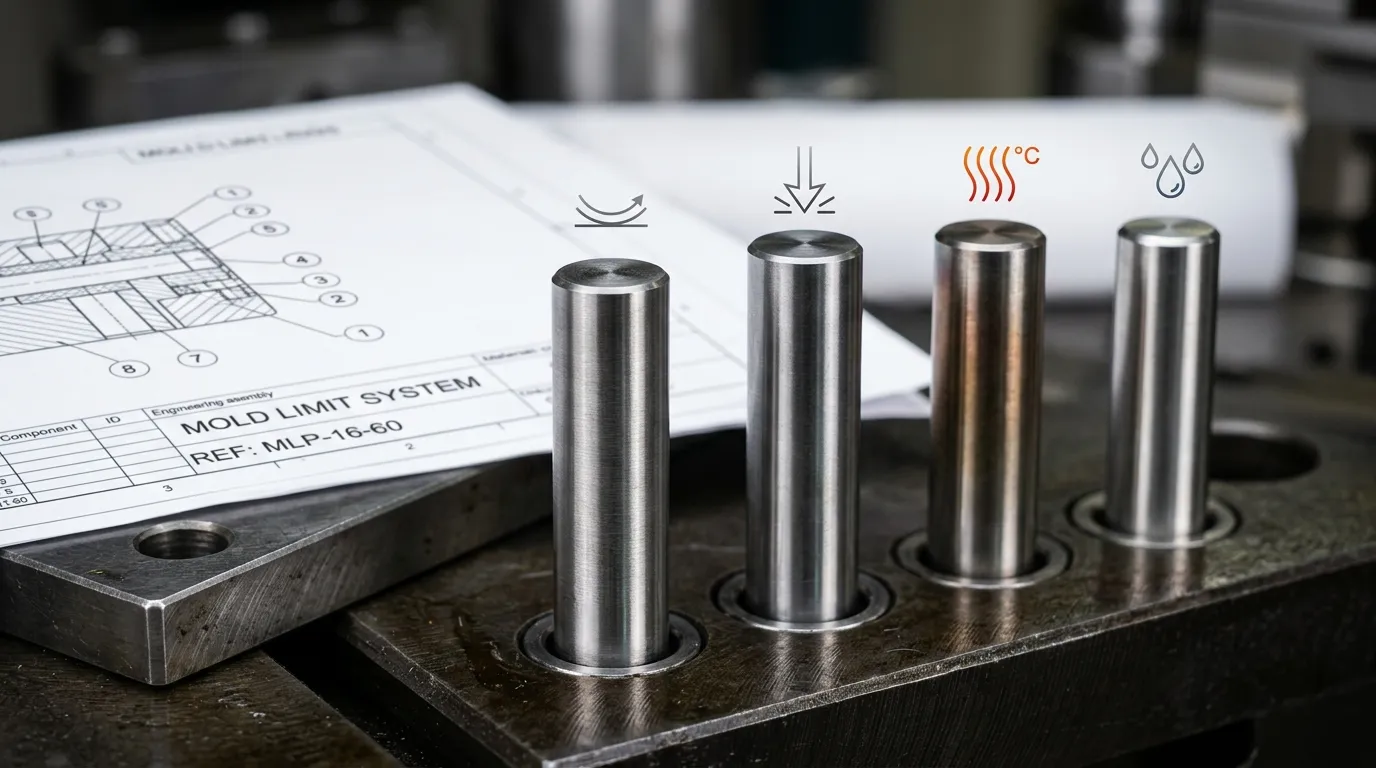
Choose the Material by Service Condition, Not Hardness Alone
The first step is to identify the condition most likely to damage the pin. A pin exposed to abrupt stopping loads needs a different property balance from one experiencing gradual contact wear.
Ma trận lựa chọn vật liệu nhanh chóng
| Điều kiện dịch vụ | Rủi ro chính | Tài sản cần ưu tiên | Danh mục vật liệu cần đánh giá | Điểm giới hạn hoặc xác minh chính |
|---|---|---|---|---|
| Kiểm soát va đập và mài mòn vừa phải | Vết lõm hoặc mòn dần dần | Độ cứng phù hợp với độ dẻo dai hợp lý | Thép cacbon trung bình như S45C | Confirm the finished hardness, hỗ trợ, khu vực tiếp xúc, and expected cycle demand |
| Tác động đột ngột lặp đi lặp lại | Sứt mẻ, tiếng nứt, or impact fracture | Độ dẻo dai và chống sốc | Thép công cụ chống va đập loại S7 | Chỉ riêng độ cứng cao hơn có thể làm giảm khả năng chịu va đập |
| Độ mài mòn tiếp xúc cao với sốc hạn chế | Tổn thất kích thước tại mặt tiếp xúc | Chống mài mòn và cường độ nén | Thép công cụ định hướng mài mòn | Xác minh rằng độ dẻo dai vẫn đủ cho mức độ va đập thực tế |
| Nhiệt độ hoạt động tăng cao | Softening, mỏi nhiệt, hoặc thay đổi kích thước | Độ bền nóng và ổn định nhiệt | Thép công cụ gia công nóng loại H13 | Thường không cần thiết cho dịch vụ ở nhiệt độ bình thường |
| Môi trường ẩm ướt hoặc ăn mòn | Rust, đang làm rỗng, or surface deterioration | Chống ăn mòn | Khuôn không gỉ hoặc thép công cụ | Xác nhận rằng độ cứng và độ dẻo dai của nó cũng đáp ứng tải trọng |
| Điều kiện hỏng hóc hỗn hợp hoặc không rõ ràng | Thiệt hại lặp đi lặp lại không rõ nguyên nhân | Các đặc tính cân bằng và xem xét nguyên nhân gốc rễ | Đánh giá kỹ thuật dành riêng cho ứng dụng | Do not change material before checking alignment, hình học, và các bề mặt giao phối |
This matrix narrows the options, but it does not replace a drawing and application review. Đường kính, chiều dài không được hỗ trợ, contact-face geometry, tải bên, and heat treatment can change how the same steel performs.
Xác nhận rằng thành phần là chốt giới hạn trước khi chọn vật liệu của nó
The term “mold limit pin” is not used consistently across every supplier, catalog, or drawing. It may also appear as a chốt dừng khuôn, chốt giới hạn tấm phun, hoặc, in some assemblies, a Dừng đĩa.
A typical stop or limit pin restricts the movement of an ejector plate or another mold mechanism. Some stop-pin designs are installed between an ejector plate and a rear clamping plate to control the plate’s resting position and prevent uncontrolled metal-to-metal contact. Other drawings may use a limit pin in a slider mechanism.
The drawing should confirm the function before any material is selected.
| Thành phần | Chức năng chính | Mối quan tâm về vật liệu điển hình |
| Giới hạn hoặc dừng pin | Hạn chế cơ chế hoặc hành trình của tấm đẩy | Tác động, hao mòn tiếp xúc, biến dạng, and fracture |
| Chốt dẫn hướng | Căn chỉnh các nửa khuôn chuyển động và đứng yên | Mòn trượt, sự thẳng, vừa vặn, và bôi trơn |
| Chốt đẩy | Đẩy phần đúc ra khỏi khoang | Mòn trượt, sự uốn cong, Nhiệt độ, và hoàn thiện bề mặt |
| Ghim trả lại | Trả lại hoặc định vị hệ thống phóng | Repeated movement, sự căn chỉnh, and compressive loading |
| Chốt chốt | Xác định vị trí chính xác hai thành phần | Shear strength, vừa vặn, and positional accuracy |
Guide pins and bushings belong to a different alignment system. Their fit, Giải phóng mặt bằng, and lubrication requirements are covered separately in the guide to chốt khuôn và ống lót.
Balance Hardness, Độ dẻo dai, Chống va đập, and Wear Resistance
Four properties control most limit-pin material decisions.
Độ cứng helps the contact face resist indentation and some forms of wear. If the surface is too soft for the applied load, the end of the pin can lose its shape or effective height.
Độ dẻo dai is the ability to resist cracking and absorb energy before fracture. It becomes critical when the pin receives abrupt, repeated contact rather than a gradual compressive load.
Chống va đập describes how well the material handles sudden loading. It is affected by toughness, độ cứng, xử lý nhiệt, hình học, and defects such as sharp transitions.
Chống mài mòn helps the pin maintain its dimensions under repeated contact. It depends on more than hardness. Steel composition, cấu trúc cacbua, điều kiện bề mặt, áp lực tiếp xúc, Sự ô nhiễm, and relative movement all affect wear.
A harder steel is not automatically a better limit-pin material. High hardness can reduce plastic deformation, but if the steel lacks sufficient toughness, the failure may change from mushrooming to chipping or cracking.
The material therefore needs enough hardness to retain the contact face and enough toughness to survive the way the load is applied. Hướng dẫn kỹ thuật từ Uddeholm về xử lý nhiệt thép công cụ also shows that final properties depend on alloy design, cấu trúc vi mô, hardening, and tempering rather than the grade name alone.
What Happens When the Pin Is Too Soft?
Possible symptoms include:
- Thụt lề tại mặt tiếp xúc
- Mọc nấm xung quanh đầu bị ảnh hưởng
- Tăng tốc độ mài mòn kích thước
- Reduced effective stop height
- Thay đổi hành trình của đầu phun hoặc cơ chế
- Hư hỏng bề mặt trên cả chốt và tấm giao phối
These symptoms do not always mean the material grade is wrong. Excessive contact stress, a small contact area, off-axis loading, hỗ trợ không đầy đủ, or an incorrect heat-treated condition can produce similar damage.
What Happens When the Pin Is Too Hard or Insufficiently Tough?
An overly brittle pin may develop:
- Chip cạnh nhỏ
- Các vết nứt gần mặt tiếp xúc
- Gãy xương đột ngột
- Thiệt hại khi chuyển đổi đường kính
- Hỏng hóc khi tải nhẹ bên hoặc sai lệch
Increasing hardness without checking toughness can also move the damage elsewhere. The pin may remain intact while the mating plate begins to indent or crack.
So sánh các loại vật liệu cho chốt giới hạn khuôn
A buying decision should compare material families by their property balance and best-fit conditions. The grades below are engineering reference categories. Except for S45C, they should not be treated as confirmed SunshinePro material offerings without direct confirmation.
| Danh mục vật liệu | Điểm mạnh chính | Điều kiện phù hợp nhất | Đánh đổi chính |
| Thép cacbon trung bình S45C / 45 # | Practical machinability, established availability, heat-treatment flexibility | Kiểm soát va đập và mài mòn vừa phải | May be insufficient for severe shock, Nhiệt, or corrosion without an appropriate finished condition |
| Thép chống va đập loại S7 | High toughness, khả năng chống va đập, and balanced wear performance | Lịch sử va đập đột ngột hoặc sứt mẻ lặp đi lặp lại | Yêu cầu xử lý nhiệt có kiểm soát và có thể làm tăng chi phí |
| Thép gia công nóng loại H13 | Hot strength, sự cứng cáp, và ổn định nhiệt | Nhiệt độ cao hoặc chu kỳ nhiệt lặp đi lặp lại | Không cần thiết cho nhiều ứng dụng nhiệt độ bình thường |
| Thép công cụ định hướng mài mòn | Chống mài mòn mạnh và duy trì kích thước | Độ mài mòn tiếp xúc cao với tác động hạn chế | Khả năng chống mài mòn cao hơn có thể đi kèm với khả năng chịu va đập giảm |
| Khuôn không gỉ / thép công cụ | Chống ăn mòn với tính chất cơ học cấp khuôn | Humidity, corrosive cleaning, Lưu trữ, or process exposure | Lựa chọn vật liệu vẫn phải đáp ứng các yêu cầu về va đập và độ cứng |
Thép S45C / 45 # cho dịch vụ tiêu chuẩn hoặc được kiểm soát
Dòng điện của SunshinePro Trang sản phẩm Pin giới hạn khuôn publishes S45C, also described as 45# steel, as the product material.
S45C is a medium-carbon steel designation. It may be a practical option when:
- Tải trọng dừng được kiểm soát
- Tác động không quá nghiêm trọng
- Nhu cầu mặc vừa phải
- Chốt có đường kính và hỗ trợ phù hợp
- Mặt tiếp xúc được căn chỉnh chính xác
- Điều kiện xử lý nhiệt cuối cùng được xác minh
- Yêu cầu thay thế và bảo trì có thể dự đoán được
The material name alone does not establish performance. The buyer still needs to confirm the final hardness, điều kiện xử lý nhiệt, phương pháp kiểm tra, hình học, and loading environment.
International buyers may also encounter SAE 1045 in cross-reference tables. Nippon Steel lists S45C and SAE 1045 together in its Tài liệu cấp thép đặc biệt, but apparent equivalents should not be substituted automatically. The governing standard, chemical composition, delivery condition, and required properties must be checked.
Thép chống va đập loại S7 cho va đập lặp đi lặp lại
An S7-type tool steel is relevant when the pin repeatedly receives abrupt impact or when the current pin shows chipping and cracking rather than gradual wear.
Shock-resistant steel is selected for a different reason from a high-wear steel. Its main advantage is the ability to combine useful hardness with stronger resistance to impact fracture. Uddeholm’s documentation for its Thép Compax Supreme loại AISI S7 highlights toughness, khả năng chống va đập, khả năng chống mài mòn, through-hardening capability, và độ ổn định kích thước.
This category may be worth evaluating when:
- Sự kiện dừng lại diễn ra đột ngột
- Tần số chu kỳ cao
- Các chip nhỏ xuất hiện ở mặt tiếp xúc
- Chốt thỉnh thoảng bị tải bên
- Thép tập trung vào mài mòn cứng hơn đã bị gãy sớm
The trade-offs can include more demanding heat treatment, higher material cost, and different machinability.
Thép gia công nóng loại H13 cho nhiệt độ cao
H13-type hot-work tool steel is relevant when the pin operates at a temperature high enough to affect normal steel hardness, Sức mạnh, or dimensional stability.
Possible use conditions include:
- Nhiệt độ hoạt động của khuôn cao
- Chu kỳ sưởi ấm và làm mát lặp đi lặp lại
- Truyền nhiệt đáng kể từ các vùng nấm mốc gần đó
- Dịch vụ trong đó độ bền nóng quan trọng như độ cứng ở nhiệt độ phòng
Tổng quan kỹ thuật H13 của Uddeholm describes the category in terms of toughness, elevated-temperature resistance, khả năng chống mài mòn, và ổn định nhiệt.
H13 should not be treated as an automatic upgrade. For a normally cooled mold with moderate impact, its thermal properties may provide little practical advantage.
Thép không gỉ hoặc thép định hướng mài mòn cho các điều kiện đặc biệt
Stainless mold steel should be considered when corrosion is a real service risk rather than a theoretical concern. Relevant conditions may include humid storage, condensation, corrosive cleaning agents, or a production environment that repeatedly exposes the pin to moisture.
Một loại thép khuôn không gỉ như loại được đại diện bởi Uddeholm Stavax ESR can combine corrosion resistance with useful wear and hardening characteristics. The final selection still needs to satisfy the impact load.
Wear-oriented tool steel belongs to a different category. It may help where repeated contact gradually removes material but impact remains controlled. A high-wear steel should not be chosen solely because the current pin is wearing. If the contact is also abrupt, insufficient toughness can create a more serious fracture risk.
Specify the Heat-Treated Condition, Not Only the Steel Grade
Two pins made from the same nominal steel can perform differently if their heat treatments are different.
The final condition depends on factors such as:
- Phương pháp làm cứng
- Điều kiện làm nguội
- Tempering
- Kích thước phần
- Kiểm soát khử cacbon bề mặt
- Điều kiện cốt lõi
- Kiểm soát biến dạng
- Mài hoặc hoàn thiện cuối cùng
Through-hardening develops properties through the pin section. Surface-hardening processes modify the outer layer while leaving a different core condition. Neither approach is automatically superior; suitability depends on the required contact hardness and core toughness.
A purchase specification should state more than “hardened steel.” It may need to define:
- Chỉ định vật liệu và tiêu chuẩn quản lý
- Điều kiện xử lý nhiệt cần thiết
- Thang đo độ cứng
- Phạm vi độ cứng chấp nhận được
- Địa điểm thi
- Yêu cầu bề mặt hoặc lõi
- Yêu cầu về kích thước sau khi xử lý nhiệt
- Hồ sơ kiểm tra bắt buộc
Rockwell hardness testing should follow an appropriate recognized method. Tiêu chuẩn ISO 6508-1:2023 specifies regular and superficial Rockwell hardness test methods for metallic materials.
SunshinePro’s product page currently lists both vacuum heat treatment and a hardness of 15–17 HRC. Buyers should request confirmation of how those statements apply to the ordered pin, including the final material condition and hardness-test location. The published value should not be treated as a universal recommendation for all limit-pin applications.
Tại sao lớp phủ hoặc xử lý bề mặt không thể sửa sai chất nền
A surface treatment may improve wear behavior or alter friction, but it cannot give an unsuitable core the toughness needed to survive severe impact.
The complete system includes:
- Thép cơ bản
- Điều kiện xử lý nhiệt lõi
- Xử lý bề mặt
- Hình học liên hệ
- Hỗ trợ ghim
- Vật liệu giao phối
- Hướng tải
A hard surface over a weak or brittle substrate may still crack, uốn cong, or fail below the treated layer.
Sử dụng các triệu chứng hỏng hóc để xác định thuộc tính bị thiếu
Before changing steel grades, inspect how the current pin failed.
| Triệu chứng thất bại | Vấn đề có thể liên quan đến vật liệu | Các điều kiện khác cần kiểm tra |
| Thụt lề | Không đủ độ cứng hoặc cường độ nén | Small contact area, excessive load, soft mating surface |
| Mọc nấm | Biến dạng dẻo quá mức | Off-axis impact, unsupported end, poor contact geometry |
| Mài mòn bề mặt nhanh chóng | Khả năng chống mài mòn hoặc tình trạng bề mặt không đủ | Ô nhiễm, đang lo lắng, sai lệch, bề mặt giao phối thô |
| Sứt mẻ | Không đủ độ dẻo dai hoặc độ giòn quá mức | Sharp edges, impact concentration, Khuyết tật trong xử lý nhiệt |
| Nứt hoặc gãy xương đột ngột | Độ dẻo dai kém hoặc độ cứng hoàn thiện không phù hợp | Tải bên, diameter transition, internal defect, sai lệch |
| Uốn | Cường độ mặt cắt không đủ | Chiều dài không được hỗ trợ quá mức, off-axis force, hỗ trợ kém |
| Ăn mòn hoặc rỗ | Chống ăn mòn không đủ | Độ ẩm, cleaning chemicals, storage conditions |
These symptoms identify areas to investigate, not definitive causes. A pin that bends may need a tougher material, but it may also need a larger diameter, shorter unsupported length, or improved alignment.
Kiểm tra tấm giao phối trước khi tăng độ cứng của chốt
The pin and mating plate form one contact system. Changing only the pin can transfer damage to the other component.
Before increasing hardness, kiểm:
- Vật liệu tấm giao phối và độ cứng
- Độ phẳng mặt tiếp xúc
- Khu vực tiếp xúc
- Căn chỉnh tải
- Hỗ trợ tấm
- Vết lõm hoặc nứt hiện có
- Ô nhiễm bề mặt
The goal is not to make the replaceable pin as hard as possible. The goal is to control wear and deformation across the assembly without creating a brittle failure point.
Cung cấp cho nhà cung cấp các điều kiện kiểm soát việc lựa chọn vật liệu
A supplier cannot make a reliable recommendation from diameter and length alone. The inquiry should include the information that controls loading and failure.
Cung cấp:
- Chức năng chính xác của ghim
- Vị trí lắp đặt
- Bản vẽ và sửa đổi hiện tại
- Đường kính và chiều dài tổng thể
- Unsupported length
- Hình học mặt tiếp xúc
- Mechanism or ejector force, nơi đã biết
- Tần số chu kỳ
- Thời gian phục vụ dự kiến
- Nhiệt độ hoạt động bình thường và cao nhất
- Độ ẩm hoặc tiếp xúc với hóa chất
- Vật liệu thành phần giao phối và độ cứng
- Vật liệu pin hiện tại
- Thông số kỹ thuật xử lý nhiệt hiện có
- Hình ảnh hoặc mô tả các lỗi trước đó
- Vật liệu cần thiết và tài liệu kiểm tra
SunshinePro states that standard and non-standard sizes are available and that non-standard mold parts can be processed from drawings. Its product page also states that material-selection advice is available. These points support a drawing-based review, but they do not confirm that every material category discussed in this guide is available.
Xác minh vật liệu và tình trạng hoàn thiện trước khi phê duyệt đơn hàng
A material recommendation is only useful if the delivered parts can be checked against it.
Before approval, xác nhận:
- Chỉ định vật liệu chính xác
Đơn đặt hàng nên xác định cấp độ và tiêu chuẩn quản lý thay vì dựa vào nhãn rộng như "thép công cụ". - Giấy chứng nhận vật liệu hoặc báo cáo thử nghiệm
Where required, the document should identify the material batch or heat and provide traceable grade information. - Điều kiện xử lý nhiệt
Confirm whether the pin is supplied annealed, normalized, quenched and tempered, through-hardened, or surface treated. - Độ cứng hoàn thiện
State the test scale, required range, and test location. A surface reading may not describe the core condition. - Kiểm tra kích thước sau khi xử lý nhiệt
Heat treatment can influence straightness, đường kính, chiều dài, and contact-face geometry. - Tài liệu xử lý bề mặt
When a coating or treatment is specified, confirm that it applies to the ordered material and finished condition. - Truy xuất nguồn gốc hàng loạt
The delivered parts should be connectable to the relevant material and inspection records.
Hướng dẫn của SunshinePro về Bộ phận khuôn chính xác provides broader context on material, sự khoan dung, Kết thúc, Truy xuất nguồn gốc, và kiểm soát chất lượng nhà cung cấp. The limit-pin order should still define which records are actually required; buyers should not assume that every standard order includes every type of certificate.
Tuyên bố của nhà cung cấp cần thêm bằng chứng
Treat the following statements as incomplete unless the supplier provides supporting details:
- "Độ cứng cao nhất sẽ tồn tại lâu nhất."
- "Thép công cụ này phù hợp với mọi khuôn."
- “These grades are equivalent,” without naming the governing standards.
- “Vacuum heat treated,” without stating the final condition or hardness.
- “High wear resistance,” without defining the contact condition.
- “High impact resistance,” without identifying the grade and heat treatment.
- “Certified material,” without a certificate tied to the delivered batch.
- “Longer service life,” without comparable operating conditions.
Tiêu chuẩn A681-24 reinforces the broader principle that tool-steel selection depends on design, service conditions, and the properties required by the application.
Đánh giá tùy chọn S45C đã xuất bản của SunshinePro so với ứng dụng
SunshinePro’s current Mold Limit Pin page publishes:
- Thép S45C / 45 #
- 15–17 HRC
- Kích thước tiêu chuẩn và không tiêu chuẩn
- Hỗ trợ lựa chọn vật liệu
- Xử lý nhiệt chân không
This information provides a commercial baseline, but suitability still depends on the application.
The published S45C option may be evaluated first where impact is controlled, wear is moderate, temperature is not unusually high, and corrosion is not a major concern.
A custom material or processing review becomes more important when:
- Ghim liên tục bị sứt mẻ hoặc nứt
- Nấm tiếp xúc mặt
- Uốn cong xảy ra
- Khuôn chạy ở nhiệt độ cao
- Ăn mòn có mặt
- Tấm giao phối đang bị hư hỏng
- Cần có độ cứng lõi hoặc bề mặt cụ thể
- Vật liệu hiện tại đã bị lỗi mặc dù đã cài đặt chính xác
Alternative steel categories discussed in this guide should not be assumed to be available from SunshinePro. Their availability, xử lý nhiệt, Tài liệu, and dimensional feasibility need direct confirmation.
Chọn Ghim làm một phần của hệ thống liên hệ
A defensible mold limit pin material selection follows six checks:
- Confirm the component’s exact function.
- Identify whether impact, mặc, Nhiệt, sự ăn mòn, or bending is the dominant risk.
- Select the required balance of hardness and toughness.
- Specify the material’s finished heat-treated condition.
- Check the mating plate, mặt tiếp xúc, hỗ trợ, và sự căn chỉnh.
- Verify the material, độ cứng, Kích thước, and traceability before approval.
For an application that falls outside the published S45C baseline, Gửi bản vẽ chốt giới hạn và điều kiện dịch vụ for review. Include the cycle demand, nhiệt độ hoạt động, Môi trường, mating material, and any existing failure symptoms so the material and finished condition can be evaluated together.
Chia sẻ:


Được viết bởi Sunshine
Tại Sunshine, Chúng tôi là nhà sản xuất và cung cấp chuyên nghiệp các linh kiện khuôn chính xác, cung cấp một loạt sản phẩm đa dạng cho ứng dụng dập và khuôn ép. Trọng tâm chính của chúng tôi bao gồm khuôn đục lỗ, ghim và ống lót đẩy, và cọc hướng dẫn cùng các bushing. Với gia công CNC tiên tiến, Kiểm soát chất lượng nghiêm ngặt, và năng lực sản xuất mạnh mẽ, chúng tôi đảm bảo độ tin cậy, các bộ phận chính xác cao, cùng với các linh kiện tiêu chuẩn có sẵn trong kho để cung cấp nhanh chóng và hiệu quả toàn cầu.
TIN TỨC
NHẬN DỊCH VỤ
Với các bộ phận chất lượng đáp ứng mọi ngân sách và đội ngũ nhân viên thân thiện được đào tạo để giúp chuyến thăm của bạn trở nên hữu ích và thuận tiện.
