



Hướng dẫn lắp đặt chốt giới hạn khuôn: Chỗ ngồi, Lưu giữ, và Truy cập
A mold limit pin must do more than fit inside its mounting hole. It must seat against the correct reference surface, project to the drawing-defined height, remain securely retained, and still be accessible when inspection or replacement is needed.
Chân giới hạn thuộc nhóm rộng hơn Các bộ phận tiêu chuẩn khuôn (được suy luận), but catalog dimensions alone do not determine whether a pin can be installed correctly. The mold assembly drawing, component drawing, bảng kê vật tư, mounting-bore condition, and retention design must agree before installation begins.
This guide covers mechanical limit or stop pins that establish a plate-travel, Liên hệ, or impact-control position. It does not provide universal fit, torque, insertion-force, seat-depth, or hardness values. Those requirements must come from the approved mold documentation.
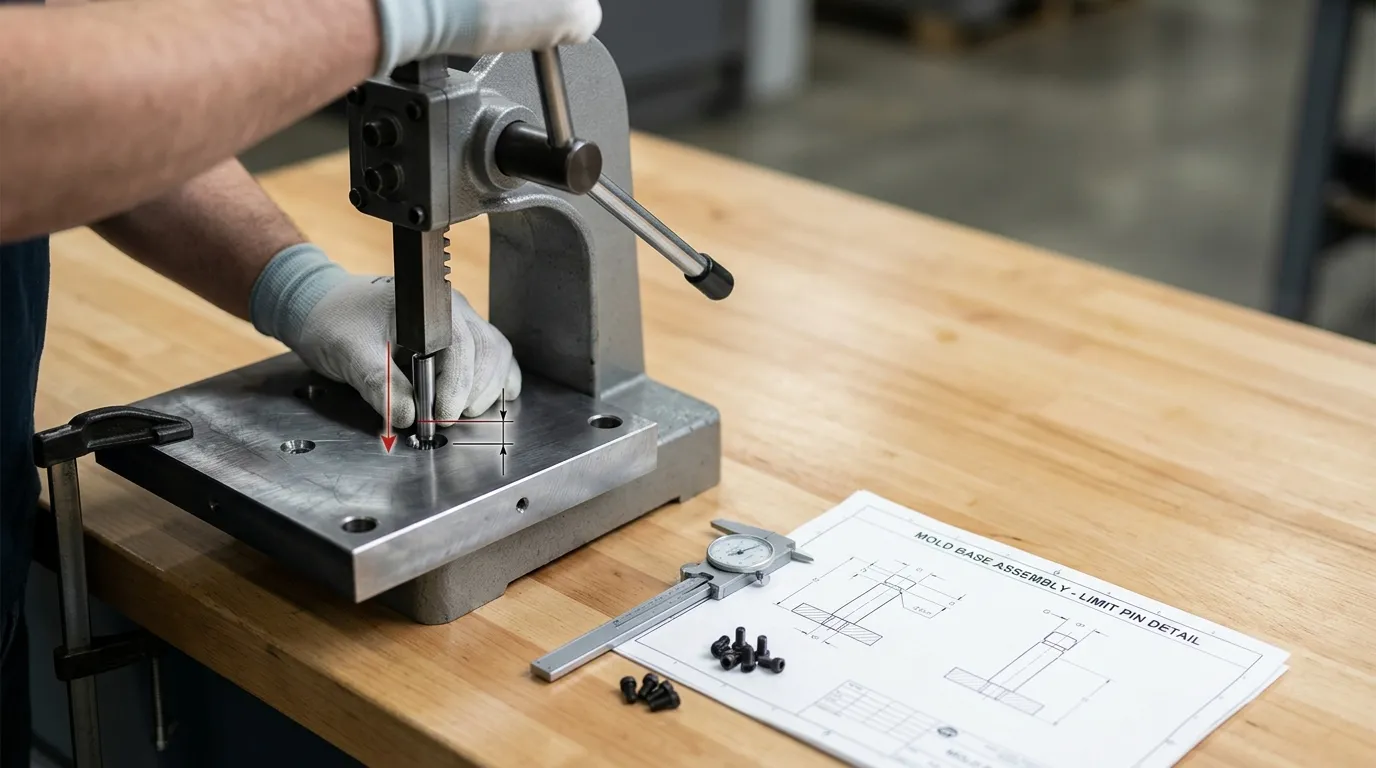
Xác nhận chức năng của pin trước khi cài đặt
The first step is not pressing the pin into the plate. It is confirming what the component is expected to do.
Các thuật ngữ như Chốt giới hạn, dừng pin, Chốt hướng dẫn, chốt chốt, Trả lại mã PIN, và chốt đẩy are sometimes used inconsistently. Two pins may look similar while performing different functions inside the mold.
Distinguish Limit Pins from Guide, Dowel, Return, and Ejector Pins
| Thành phần | Chức năng chính | Mối quan hệ điển hình | Mối quan tâm chính về cài đặt |
|---|---|---|---|
| Giới hạn hoặc dừng pin | Establishes a travel, Liên hệ, or impact-control position | Tiếp xúc hoặc hạn chế chuyển động của tấm hoặc cơ chế | Trình chiếu đã cài đặt, chỗ ngồi, sự giữ lại, and contact height |
| Hướng dẫn hoặc chốt chỉ huy | Căn chỉnh các phần khuôn chuyển động và cố định | Chạy qua ống lót dẫn hướng giao phối | Căn chỉnh, fit with the bushing, sự bôi trơn, và hao mòn |
| Chốt hoặc chốt định vị | Định vị các thành phần tương đối với nhau | Phù hợp giữa các tấm hoặc bộ phận phải duy trì vị trí | Độ chính xác vị trí và khả năng chống chuyển động tương đối |
| Ghim trả lại | Giúp trả lại cơ chế liên quan đến đầu phun | Hoạt động với cụm đầu phun trong quá trình đóng khuôn | Travel, sự can thiệp, and return timing |
| Chốt đẩy | Đẩy phần đúc ra khỏi khoang hoặc lõi | Di chuyển qua hệ thống đầu phun và khu vực đúc | Chiều dài, Giải phóng mặt bằng, motion, and contact with the molded part |
Do not assume that a pin is a limit pin because of its shape or location. Check the assembly drawing and BOM designation. The drawing should show which plate carries the pin, which surface contacts it, and what movement the pin is intended to control.
If the component is part of the mold’s alignment system, refer to the separate guide on chốt khuôn và ống lót rather than applying stop-pin installation logic.
Đọc bản vẽ và BOM dưới dạng hướng dẫn kiểm soát
Before removing an old pin or fitting a replacement, Xác minh:
- Sửa đổi bản vẽ hiện tại
- Số bộ phận thành phần
- Số lượng và địa điểm
- Cài đặt quản lý
- Đường kính cơ thể và chiều dài tổng thể
- Shoulder, đầu, mặt bích, or threaded features
- Chú thích phù hợp với lỗ hoặc trục
- Độ sâu lỗ lắp
- Bề mặt chỗ ngồi tham khảo
- Phép chiếu cài đặt bắt buộc
- Phương pháp lưu giữ
- Truy cập dây buộc
- Phương pháp chiết xuất hoặc loại bỏ
Tổ chức Tiêu chuẩn hóa Quốc tế Hệ thống ISO 286 provides recognized terminology for hole and shaft tolerances. It does not tell the installer which fit is correct for a specific limit pin. The approved drawing must make that decision.
Stop the work if the drawing, BOM, and actual component conflict. Additional force will not correct an incorrect part number, obsolete revision, or mismatched geometry.
Prepare the Mold, Ghim, and Mounting Feature
Preparation determines whether the pin reaches its intended seat without damaging the bore or plate.
The mold must be safely supported, the component must match the documentation, and the mounting feature must be clean and dimensionally suitable before insertion starts.
Cách ly và hỗ trợ nấm mốc một cách an toàn
A mold may contain electrical, thuỷ lực, khí nén, mechanical, gravitational, or spring-loaded energy. Control those hazards under the approved workplace procedure before disassembly or installation.
Nguyên tắc chung phù hợp với các yêu cầu của OSHA đối với Kiểm soát năng lượng nguy hiểm, although the exact legal and procedural requirements depend on the country, máy móc, and workplace.
Before working on the pin:
- Isolate the molding machine and connected systems.
- Release or restrain stored energy.
- Support plates that could shift after a component is removed.
- Position the mold so installation force can be applied in line with the pin axis.
- Confirm that no person is exposed to an unsupported moving plate or ejector assembly.
This is not a substitute for local lockout, bảo trì, or lifting procedures.
Kiểm tra chốt thay thế
Compare the replacement pin with the latest component drawing rather than relying only on the old pin.
Kiểm tra:
- Đường kính cơ thể
- Chiều dài tổng thể
- Kích thước vai hoặc đầu
- Tình trạng mặt tiếp xúc
- Kích thước ren và hư hỏng ren
- Vát mép và tình trạng cạnh
- Chấm điểm bề mặt hoặc ăn mòn
- Độ thẳng và biến dạng có thể nhìn thấy
- Số bộ phận hoặc nhận dạng có thể truy xuất nguồn gốc
SunshinePro’s listed Mold Limit Pin product includes product-specific material, sự khoan dung, độ cứng, threaded-feature, and customization information. Those figures apply only to the listed product configuration. They must not replace the project drawing or be treated as universal installation values.
Questions involving wider material, sự khoan dung, Kết thúc, or incoming-QC requirements belong under the broader topic of Bộ phận khuôn chính xác.
Inspect the Bore, Counterbore, and Seating Face
A correct pin can still install incorrectly when the receiving feature is damaged or contaminated.
Inspect the mounting area for:
- Chips, grease deposits, hardened residue, or corrosion
- Gờ xung quanh lối vào lỗ
- Kim loại nhô lên xung quanh một lỗ khoan
- Ghi điểm hoặc chuyển vật liệu bên trong lỗ khoan
- Biến dạng hoặc hình bầu dục
- Bề mặt ghế bị nứt hoặc hư hỏng
- Độ sâu lỗ không chính xác
- Làm lại chưa được phê duyệt
- Thiệt hại từ các nỗ lực loại bỏ trước đó
Remove contamination using an approved cleaning method, but do not enlarge, đánh bóng, xay, or reshape the bore simply to make the replacement fit.
Manufacturer assembly documentation commonly requires installers to check counterbores, remove burrs, inspect seating surfaces, and confirm component height before final assembly. The same control principle applies here: clean geometry must be verified before force is applied.
Thiết lập chỗ ngồi chính xác và hình chiếu đã cài đặt
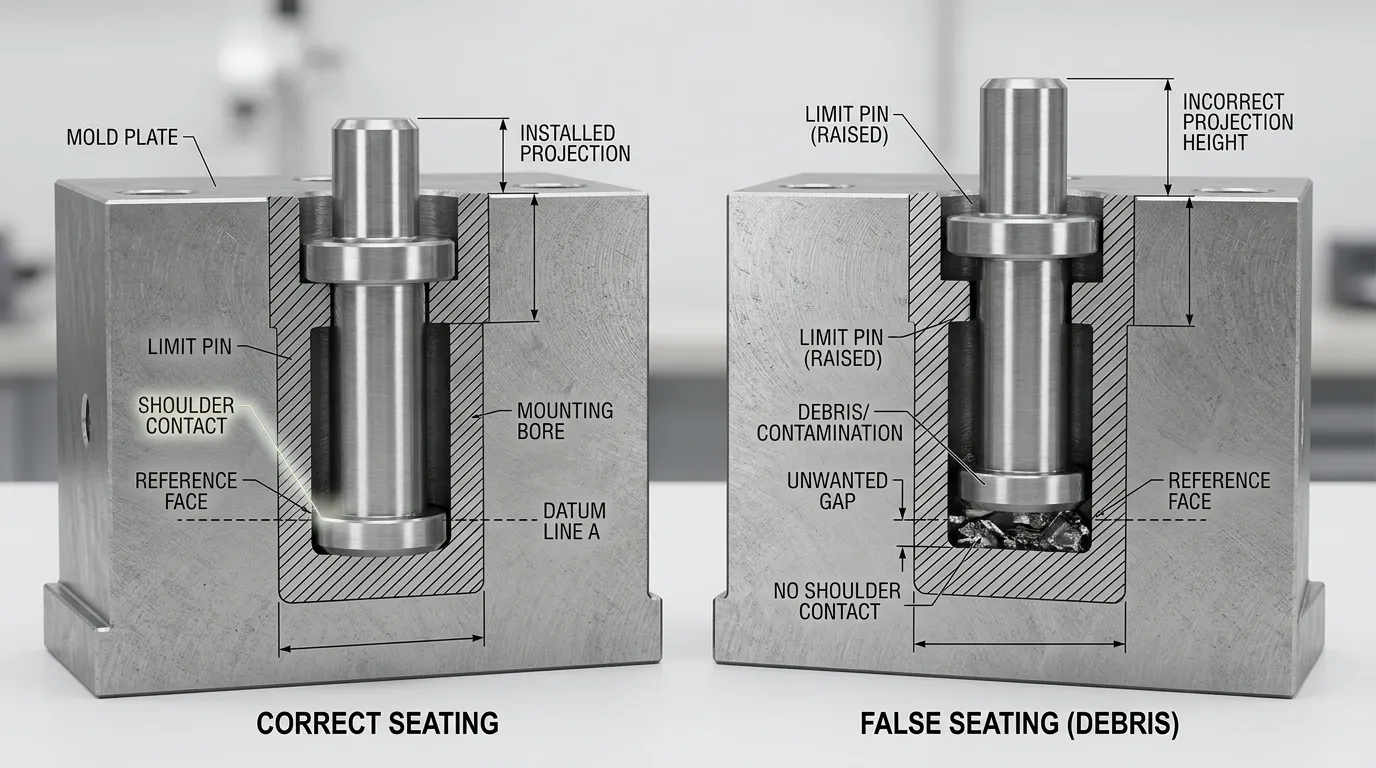
A pin is not acceptable merely because it appears fully inserted.
Its axial position must be established by the intended reference face. Depending on the design, that may be a shoulder, đầu, mặt bích, counterbore, tiền dự phòng, or another drawing-defined surface.
Xác định khuôn mặt tham chiếu và dữ liệu đo lường
The drawing should answer two separate questions:
- Where does the pin stop during installation?
- From which mold surface is its exposed height measured?
These surfaces are not always the same.
Ví dụ, a shoulder may seat inside a counterbore while the installed projection is measured from the outer plate face. A threaded or retained design may establish axial position through a head or clamping component rather than through the bottom of the hole.
Use one controlled datum for all measurements. Record that datum with the measured projection so another technician can repeat the inspection later.
A vague instruction such as “press until fully seated” is inadequate unless the seating surface and final height are defined.
Ngăn chặn chỗ ngồi giả trong lỗ mù
Blind holes require special attention because the pin can contact the hole bottom before its intended shoulder or reference surface reaches the seat.
False seating may result from:
- Độ sâu lỗ không đủ
- Vụn hoặc mảnh vụn ở phía dưới
- Một gờ dưới vai
- Cặn bị mắc kẹt hoặc kim loại bị hư hỏng
- Chiều dài chốt không chính xác
- Hình dạng đầu hoặc vai không khớp
- Sửa đổi lỗ khoan chưa được phê duyệt trước đây
Common warning signs include:
- Chiếu được cài đặt quá mức
- Một khoảng trống có thể nhìn thấy bên dưới vai
- Khả năng chống chèn cao bất ngờ
- Ghim có vẻ nghiêng
- Chiều cao lắp đặt khác nhau giữa các chân giống hệt nhau trên danh nghĩa
Do not apply additional force when these symptoms appear. Remove the pin using the approved method, inspect the hole and component, and compare both with the drawing.
Kiểm tra chiều cao chung khi một số chân chia sẻ tiếp xúc
Several limit pins may form one contact plane. Equal pin lengths do not guarantee equal installed heights because bore depth, điều kiện ghế ngồi, mảnh vụn, plate distortion, and component geometry can vary.
When multiple pins are intended to contact together:
- Measure every pin from the same datum.
- Compare actual installed projections.
- Check the mating plate for rocking.
- Look for one pin contacting before the others.
- Inspect contact surfaces for uneven marking.
- Confirm that no pin is carrying contact because another pin is seated too low.
The drawing or approved engineering specification must provide the allowable variation. Do not invent an acceptance tolerance from a different mold or catalog.
Cài đặt chốt với hỗ trợ trục được kiểm soát
Once the component and mounting feature have been verified, install the pin in the direction specified by the drawing.
- Confirm the required fit and installation direction.
- Support the plate close to the mounting area.
- Align the pin axis with the bore axis.
- Place installation tooling against an approved non-functional surface.
- Apply controlled axial force.
- Monitor the pin for tilt, tính điểm, shaving, or abnormal resistance.
- Stop when the drawing-defined seating condition is reached.
- Measure the installed projection rather than accepting insertion force as proof of completion.
- Inspect the surrounding plate and exposed pin surfaces for damage.
For an interference-fit arrangement, the fit class influences the required assembly force and future removability. That does not justify estimating the force by feel or copying a fit from another component.
Avoid uncontrolled hammer impact. Side loading can cock the pin, damage the hole entrance, deform the plate, or mark the functional contact face.
Heating, làm mát, surface modification, or lubrication should be used only when the approved installation procedure permits it and defines the applicable conditions.
Dừng lại khi chốt không cài đặt sạch sẽ
Stop the operation if you observe:
- Kháng cự đột ngột hoặc không nhất quán
- Nghiêng ghim
- Cạo râu kim loại
- Ghi điểm lỗ khoan
- Biến dạng tấm
- Mặt tiếp xúc bị tổn thương
- Chiếu quá mức
- Một vai không chạm tới chỗ ngồi của nó
- Một sự vừa vặn lỏng lẻo bất ngờ
Recheck the part number, fit callout, đường kính lỗ khoan, hole depth, seat geometry, and component condition. A forced installation can conceal the original mismatch while creating a second problem in the plate.
Phù hợp với bảo mật lưu giữ với quyền truy cập dịch vụ trong tương lai
The pin’s fit and its axial retention are related but not always identical.
Some designs depend mainly on interference. Others use screws, các sợi, blocks, các đĩa, or trapped heads. The correct choice is the one shown in the approved design, not the method that is easiest to apply during maintenance.
So sánh các phương pháp lưu giữ theo bảo mật và khả năng phục vụ
| Phương pháp lưu giữ | Đặc điểm chính | Cân nhắc truy cập dịch vụ | Rủi ro chính cần kiểm tra |
| Phù hợp với nhiễu | Phù hợp xuyên tâm cung cấp khả năng duy trì | Removal may require rear access, pulling equipment, or plate disassembly | Hư hỏng lỗ khoan hoặc mất khả năng giữ lại sau khi loại bỏ nhiều lần |
| Chốt ren hoặc vít giữ | Chốt cơ học điều khiển chuyển động dọc trục | Dây buộc phải vẫn có thể tiếp cận được sau khi lắp ráp | Incorrect torque, damaged threads, or inaccessible fastener |
| Thiết kế kẹp vít | Một vít hoặc kẹp riêng biệt cố định chốt | Có thể sử dụng được nếu kẹp bị lộ | Clamp chuyển động hoặc không đủ quyền truy cập |
| Tấm hoặc khối giữ | Một tấm hoặc khối bẫy chốt | Có thể cho phép loại bỏ có kiểm soát nhưng thêm ốc vít và gia công | Bộ phận giữ được cài đặt sai trình tự |
| Đầu hoặc vai bị mắc kẹt | Các tấm liền kề nắm bắt thành phần | Thường yêu cầu tách tấm để loại bỏ | Bảo trì trong tương lai có thể khó khăn |
| Hợp chất giữ lại | Chất kết dính hỗ trợ khớp hình trụ | Các điều kiện loại bỏ và chữa bệnh phải được lên kế hoạch | Incorrect gap, Sự ô nhiễm, Nhiệt độ, or unapproved use |
Retaining compounds are not a general cure for a loose or damaged bore. Products such as LOCTITE 638 have defined gap, sự chuẩn bị, cure, Nhiệt độ, and material requirements. Use one only when the component design and engineering instructions approve it.
Confirm Front, Rear, and Extraction Access
Before final assembly, confirm how the pin will be inspected and removed later.
Check whether:
- Có thể tiếp cận vít giữ từ phía trước
- Chốt tiếp cận phía sau bị chặn bởi một tấm khác
- Một sợi kéo vẫn lộ ra ngoài
- Một lỗ xuyên cho phép hỗ trợ hoặc loại bỏ có kiểm soát
- Chốt lỗ mù có phương pháp trích xuất xác định
- Một tấm giữ có thể được tháo ra mà không cần tháo dỡ các hệ thống không liên quan
- The pin’s orientation leaves access to flats, các sợi, or fasteners
- Việc loại bỏ trong tương lai sẽ đặt lực lên bề mặt tấm nhạy cảm
A retention method can be mechanically secure and still be a poor maintenance design. Record any plate separation or special tooling required for removal.
Đo lường và xác thực cài đặt
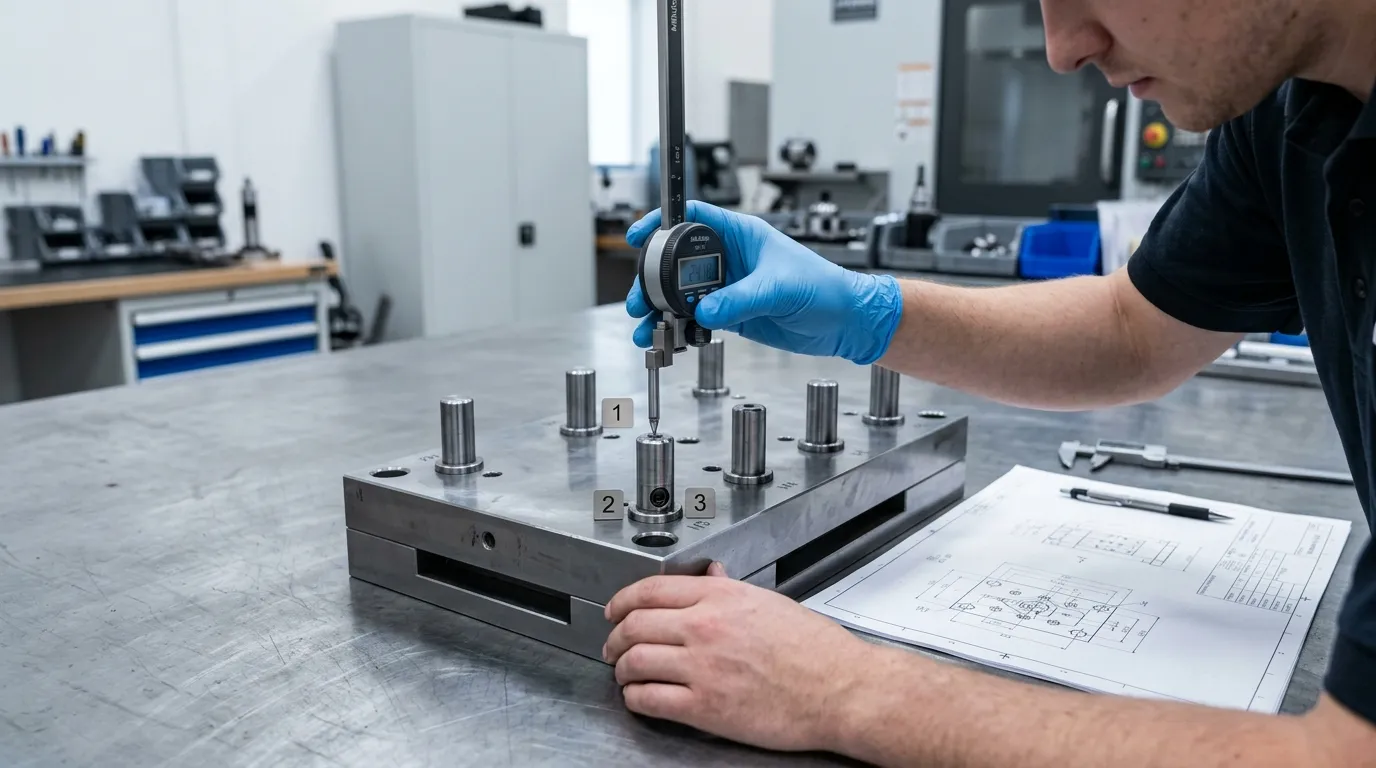
Installation is complete only after dimensional and functional checks confirm that the pin is seated, retained, accessible, and operating as intended.
Use the approved inspection equipment and the same datum established before installation.
- Measure the installed projection.
- Confirm the pin’s orientation.
- Verify the retention feature.
- Check screw or retainer access.
- Compare the heights of all pins that share contact.
- Check the mating plate for rocking or premature contact.
- Confirm clearance from nearby components.
- Perform an approved test fit or controlled dry cycle.
- Record the result.
Hướng dẫn lắp ráp của nhà sản xuất từ Bậc thầy khuôn mẫu illustrate the broader importance of drawing review, seating checks, installed-height measurement, clearance verification, and controlled test fitting. The exact acceptance values for a limit pin still come from its own mold documentation.
Record Installed Height, Lưu giữ, và Truy cập
The installation record should identify:
- Số khuôn hoặc công cụ
- Sửa đổi bản vẽ
- Pin số bộ phận
- Dữ liệu đo lường
- Phép chiếu được lắp đặt thực tế
- Phương pháp lưu giữ
- Trạng thái dây buộc
- Hướng truy cập phía trước hoặc phía sau
- Phương pháp chiết xuất
- Ngày và thanh tra
- Approved deviations, if any
Photographs of the installed pin, chỗ ngồi, and access arrangement may also help future maintenance teams understand the accepted condition.
Sử dụng chu trình thử nghiệm có kiểm soát hoặc khô
Follow the approved machine and mold procedure for any movement test.
Observe:
- Trình tự liên hệ
- Du lịch tấm
- Sức đề kháng bất thường
- Bập bênh
- Sự can thiệp
- Chuyển động dây buộc
- Tiếp xúc chân không đồng đều
- Một cơ chế dừng trước hoặc sau vị trí dự định
Stop the test if the mold does not move or contact as the drawing intends. Do not proceed directly to full-speed production to see whether the problem resolves itself.
Khắc phục sự cố cài đặt chân giới hạn phổ biến
| Triệu chứng | Nguyên nhân có thể | Phản hồi bắt buộc |
| Pin đứng quá cao | Burrs, mảnh vụn, insufficient blind-hole depth, wrong pin length, wrong shoulder geometry, false bottoming | Remove using the approved method, inspect the seat and hole depth, and compare the part with the drawing |
| Ghim nằm quá thấp | Incorrect seat depth, damaged reference face, wrong component, unapproved material removal | Stop and obtain engineering review; do not shim or modify the pin without approval |
| Ghim bị nghiêng | Cocked insertion, đường kính xi-lanh bị hư hại, tải bên, distorted plate, không vừa vặn | Remove and inspect the bore and pin; check axial support and alignment |
| Ghim bị lỏng | Worn or oversized bore, wrong diameter, missing retention, không vừa vặn | Do not rely on additional force or adhesive; assess bore repair, redesign, hoặc thay thế |
| Một chân tiếp xúc đầu tiên | Unequal projection, debris under another pin, mating-surface variation, incorrect component length | Đo từng chân từ một dữ liệu và kiểm tra mặt phẳng tiếp xúc |
| Không thể liên hệ với người giữ | Định hướng không chính xác, blocked fastener, poor assembly sequence, insufficient access planning | Correct before final assembly; document any required plate removal |
| Ghim liên tục nới lỏng | Incorrect retention, đường kính xi-lanh bị hư hại, changing load path, hình học không phù hợp | Nâng cấp để xem xét thiết kế và kỹ thuật |
Installation should stop when:
- The drawing is unavailable or contradictory.
- The replacement component cannot be positively identified.
- The bore is cracked, enlarged, distorted, or heavily damaged.
- The seat no longer provides a stable reference.
- The required projection cannot be achieved.
- The specified retention cannot be installed or accessed.
- Several pins cannot be brought to the intended contact condition.
- The mold movement does not match the drawing after installation.
Do not use generic drilling, đang mài, welding, peening, bonding, or oversizing methods as an automatic repair. Each can change the plate geometry, component fit, serviceability, or contact position.
Quyết định khi nào chốt hoặc tính năng lắp đặt cần thay thế hoặc thiết kế lại
A standard replacement may be suitable when the current drawing remains valid and the bore, chỗ ngồi, vừa vặn, sự giữ lại, and access arrangement are undamaged.
Engineering or supplier review is appropriate when:
- The existing bore is worn or oversized.
- The reference seat is damaged.
- The original drawing does not match the mold.
- A discontinued or altered pin geometry is present.
- The retention method cannot be serviced.
- Required projection cannot be achieved from the existing seat.
- The pin repeatedly loosens.
- Several pins do not share contact correctly.
- A standard component does not match the existing arrangement.
For a replacement review, chuẩn bị:
- Bản vẽ pin hiện tại
- Bản vẽ lắp ráp khuôn
- Kích thước và hình học ghim
- Đường kính và độ sâu lỗ giao phối
- Phép chiếu cài đặt bắt buộc
- Yêu cầu về vật liệu và xử lý nhiệt
- Phương pháp lưu giữ
- Hạn chế truy cập và trích xuất
- Ảnh hoặc mẫu vật lý nếu thích hợp
SunshinePro tuyên bố rằng họ cung cấp một Sản phẩm Pin giới hạn khuôn and can discuss custom mold accessories from drawings or samples. The exact material, sự khoan dung, hình học, retention feature, and production feasibility still require project-specific confirmation.
Danh sách kiểm tra cài đặt pin giới hạn khuôn
Before accepting the installation, xác nhận rằng:
- The component’s actual function has been identified.
- The current drawing and BOM revision have been checked.
- The mold and machine have been safely isolated.
- The pin dimensions and condition match the documentation.
- The mounting bore, counterbore, and seating face are clean and undamaged.
- The correct reference face and measurement datum are known.
- Blind-hole depth and bottom clearance have been checked where applicable.
- The pin was installed with controlled axial support.
- No scoring, shaving, tilt, or plate distortion is present.
- The specified retention method has been completed.
- Fastener and extraction access remain available.
- Installed projection has been measured.
- Multiple-pin contact has been checked where required.
- A controlled test fit or dry cycle has been completed.
- Actual measurements and observations have been recorded.
If the pin, khoan, chỗ ngồi, or retention arrangement does not match the approved documentation, do not force the installation. Send the component drawing, mating-hole dimensions, required projection, and access details through the Trang liên hệ SunshinePro for a project-specific review.
Chia sẻ:


Được viết bởi Sunshine
Tại Sunshine, Chúng tôi là nhà sản xuất và cung cấp chuyên nghiệp các linh kiện khuôn chính xác, cung cấp một loạt sản phẩm đa dạng cho ứng dụng dập và khuôn ép. Trọng tâm chính của chúng tôi bao gồm khuôn đục lỗ, ghim và ống lót đẩy, và cọc hướng dẫn cùng các bushing. Với gia công CNC tiên tiến, Kiểm soát chất lượng nghiêm ngặt, và năng lực sản xuất mạnh mẽ, chúng tôi đảm bảo độ tin cậy, các bộ phận chính xác cao, cùng với các linh kiện tiêu chuẩn có sẵn trong kho để cung cấp nhanh chóng và hiệu quả toàn cầu.
TIN TỨC
NHẬN DỊCH VỤ
Với các bộ phận chất lượng đáp ứng mọi ngân sách và đội ngũ nhân viên thân thiện được đào tạo để giúp chuyến thăm của bạn trở nên hữu ích và thuận tiện.
