



Injection Molding Automotive Parts: Vật liệu, Dung sai, và kiểm tra chất lượng
Injection molding automotive parts requires balancing material strength, dimensional tolerances, cosmetic appearance, and inspection consistency. Automotive manufacturers commonly use PP, ABS, nylon, and PC/ABS blends based on heat exposure, impact resistance, and surface requirements. Reliable production depends on stable tooling, controlled molding conditions, kiểm tra kích thước, and quality-control systems that reduce warpage, assembly-fit issues, and cosmetic defects.
Automotive plastic components do more than reduce vehicle weight. They also affect assembly accuracy, cabin appearance, Độ bền, và hiệu suất lâu dài. A dashboard trim panel and an under-hood bracket may use the same molding process, but they need very different materials, các mức dung sai, and inspection methods. Understanding those differences helps buyers avoid costly production problems before tooling starts.
What automotive parts are commonly made with injection molding?
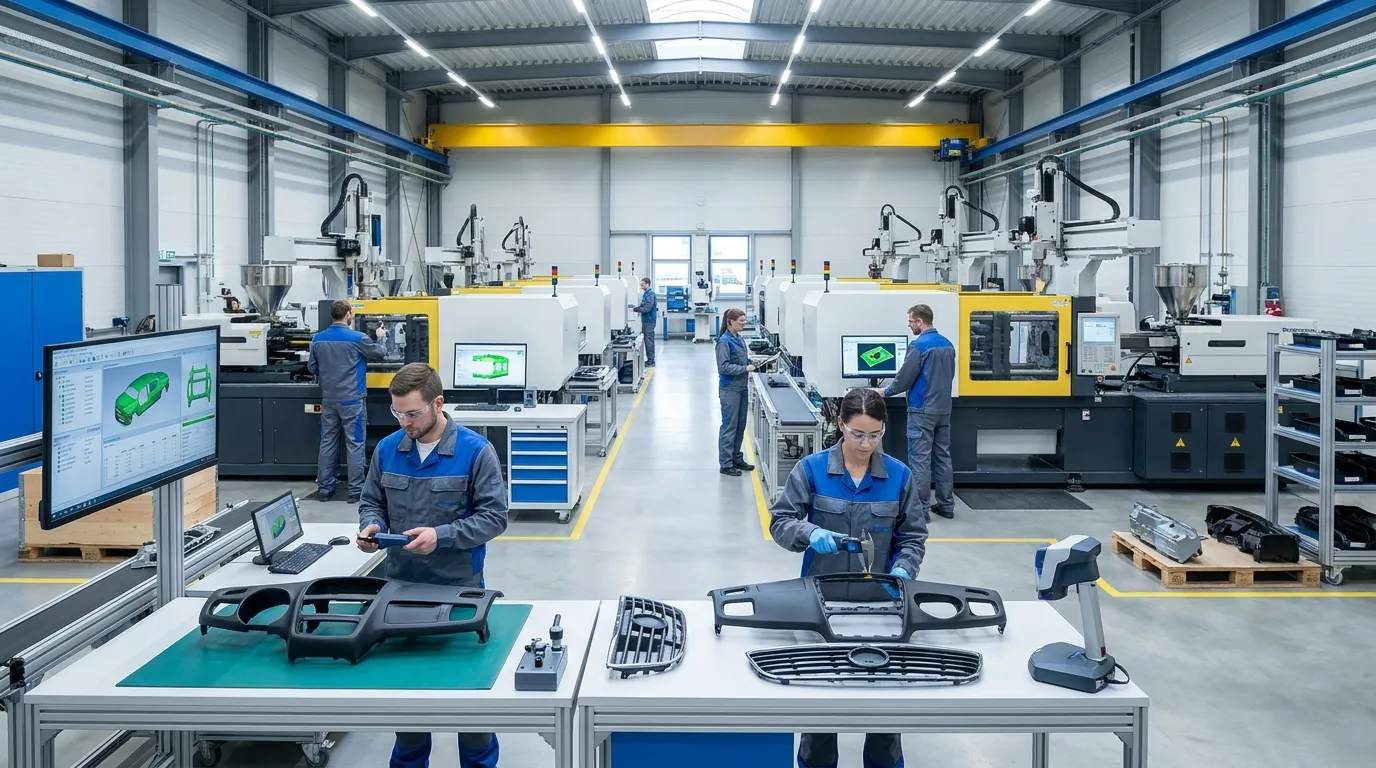
Automotive injection molding is widely used for dashboards, Bếp nướng, vỏ đèn, trims, các đoạn clip, and under-hood components because it supports repeatable high-volume production with tight dimensional control and strong surface consistency.
Automotive manufacturers use injection molding for both visible and functional parts. Interior components often include dashboards, center-console trims, air vent bezels, and door panels. Exterior applications include bumper trims, mirror housings, and front grilles. Under-hood parts may include clips, reservoirs, and electrical housings.
Many of these components require complex geometry and repeatable dimensions. Theo Tổng quan về khuôn ô tô của Fictiv, injection molding is widely used because it supports high production volumes with consistent part quality.
| Loại phần | Ví dụ phổ biến | Ưu tiên chính |
|---|---|---|
| Mỹ phẩm nội thất | Dashboard trim, bezels | Bề mặt hoàn thiện |
| Mỹ phẩm ngoại thất | Grilles, mirror covers | Chống tia cực tím |
| Các bộ phận chức năng | Clips, nhà ở | Phù hợp với kích thước |
| Các bộ phận dưới mui xe | Reservoirs, brackets | Khả năng chịu nhiệt |
Visible parts usually have stricter cosmetic standards than hidden structural parts. A small weld line on an internal clip may pass inspection, but the same defect on a dashboard trim piece can trigger rejection.
Đối với các công ty đánh giá Giải pháp đúc ô tô, it’s important to separate cosmetic and functional requirements early. The molding process may be similar, but quality expectations are not.
Which materials are best for automotive injection molded parts?
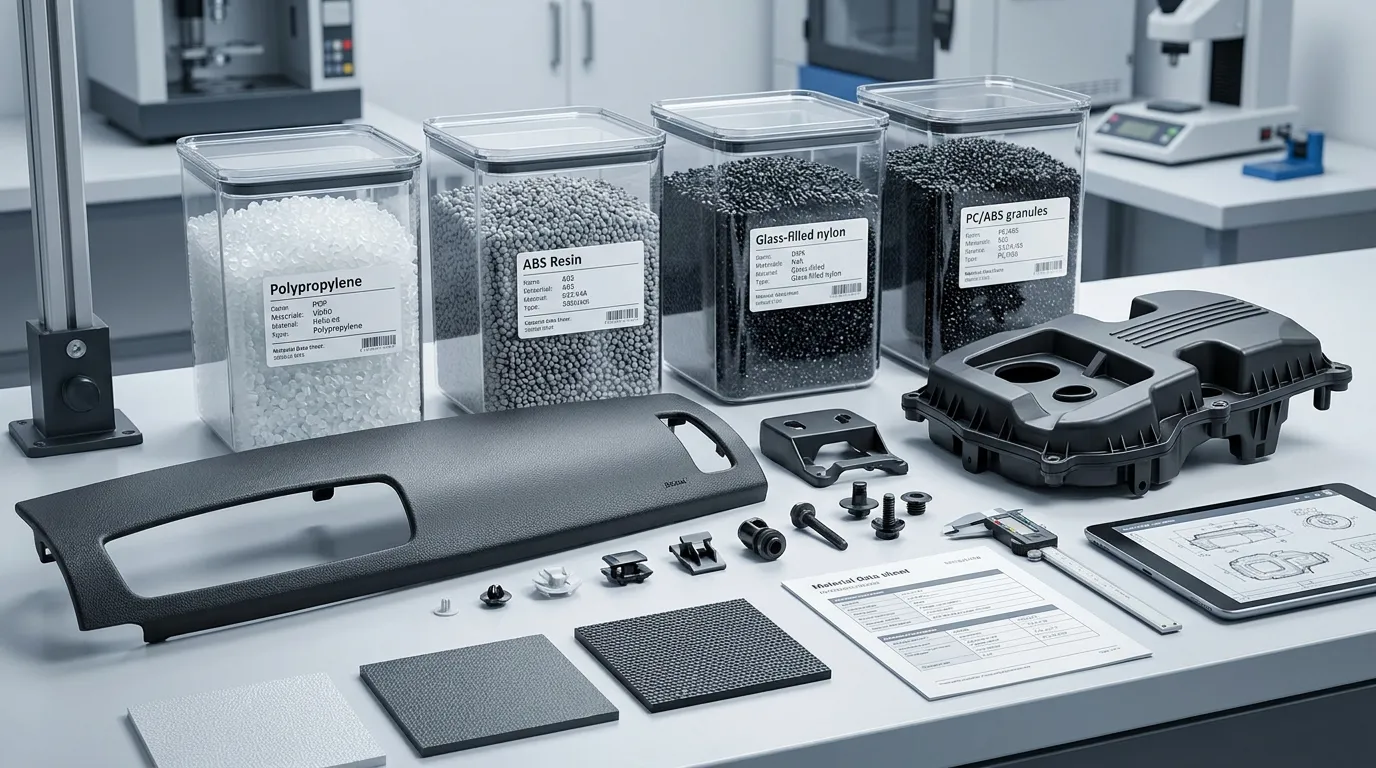
Material selection depends on heat exposure, impact requirements, UV stability, and cosmetic expectations. PP is common for lightweight interior parts, while reinforced nylon and PC/ABS blends are often used where higher strength or appearance quality is required.
Automotive plastics are selected based on operating conditions, not material popularity. A resin that works well for an interior trim piece may fail quickly near engine heat or direct sunlight. Material choice also affects shrinkage, Bề mặt hoàn thiện, and tolerance stability.
Vật liệu nội thất
Polypropylene (PP) is widely used for interior trim because it is lightweight, cost-effective, and easy to process. ABS is also common for interior parts that require better surface appearance and rigidity. For premium visible surfaces, many manufacturers prefer PC/ABS blends because they combine appearance quality with better heat resistance.
ABS is not automatically the best choice for visible automotive parts. It works well in stable interior environments, but PC/ABS blends are often safer when heat exposure and cosmetic stability matter together.
Vật liệu dưới mui xe
Under-hood applications usually require higher heat resistance and structural strength. Ni lông, also called polyamide (PA), is common for brackets, nhà ở, and clips exposed to elevated temperatures. Glass-filled nylon adds stiffness and dimensional stability but may increase mold wear.
Mối quan hệ rộng hơn giữa dụng cụ và hành vi của nhựa được đề cập trong điều này Hướng dẫn khuôn ép nhựa hoàn chỉnh.
| Vật chất | Khả năng chịu nhiệt | Chất lượng mỹ phẩm | Các ứng dụng phổ biến |
|---|---|---|---|
| PP | Trung bình | Tốt | Trang trí nội thất |
| ABS | Trung bình | Rất tốt | Dash panels, bezels |
| Máy tính / ABS | Cao | Thông minh | Các bộ phận có thể nhìn thấy cao cấp |
| PA (Ni lông) | Cao | Trung bình | Các thành phần dưới mui xe |
| Nylon chứa đầy thủy tinh | Rất cao | Thấp hơn | Giá đỡ kết cấu |
Material selection should also account for long-term dimensional stability. A grille exposed to sun and seasonal temperature swings needs different resin behavior than an interior switch bezel.
What tolerances are realistic for automotive injection molded parts?
Automotive injection molded tolerances vary by material, độ dày thành, and geometry. Tight cosmetic and assembly-critical parts often require stricter process control, stable tooling, and validated inspection methods to maintain consistency across production runs.
Automotive tolerances depend on several variables working together. Co ngót nhựa, cân bằng làm mát, mold construction, and part geometry all affect final dimensions. Thin-wall parts with uneven geometry usually create more variation than simple, uniform components.
Tight tolerances are meaningless if the supplier cannot maintain stable processing conditions during production. Tool quality alone does not guarantee consistency. Process monitoring and dimensional inspection are just as important as mold precision.
Các yếu tố ảnh hưởng đến độ ổn định dung sai
Parts with uneven wall thickness tend to cool at different rates, which increases warpage risk. Materials such as glass-filled nylon may hold dimensions more consistently but require tighter process control. Cooling layout also plays a major role in maintaining stable geometry.
A lamp housing is a good example. Even small dimensional changes can create assembly gaps or alignment problems. In many automotive applications, fitment consistency matters more than achieving the smallest possible tolerance number.
| Yếu tố | Tác động đến khả năng chịu đựng |
|---|---|
| Co ngót nhựa | Thay đổi kích thước cuối cùng |
| Cân bằng làm mát | Điều này sẽ ảnh hưởng đến warpage |
| Chất lượng khuôn | Ảnh hưởng đến khả năng lặp lại |
| Độ dày của tường | Tác động đến nguy cơ biến dạng |
| Biến thể quy trình | Nguyên nhân trôi không gian |
For readers who want deeper tooling fundamentals, cái này Tổng quan về thành phần khuôn explains how mold structure influences production stability.
How do automotive suppliers control cosmetic quality and surface finish?
Cosmetic automotive parts require tighter process monitoring because visible defects can lead to rejection even when dimensions are technically acceptable. Surface consistency, Bóng, texture, and color stability are major inspection priorities.
Visible automotive parts often fail because of appearance variation before they fail dimensional inspection. Surface quality affects customer perception immediately, especially on dashboards, trim panels, and exterior grille assemblies.
Common cosmetic defects include sink marks, flow lines, weld lines, silver streaks, and gloss inconsistency. Suppliers reduce these risks by controlling mold temperature, injection speed, cooling uniformity, and material drying conditions.
Các khuyết tật ngoại hình phổ biến
| Nhược điểm | Nguyên nhân điển hình | Tác động chung |
|---|---|---|
| Dấu chìm | Độ dày thành không đồng đều | Chỗ lõm bề mặt |
| Dòng chảy | Mặt trước dòng chảy không nhất quán | Vệt có thể nhìn thấy |
| Đường hàn | Điểm gặp gỡ dòng nguyên liệu | Ngoại hình yếu |
| Biến thể độ bóng | Làm mát không đều | Màu sắc không phù hợp |
| Độ cong vênh | Mất cân bằng co ngót | Phụ kiện kém |
Texture consistency becomes especially important in multi-cavity production. A dashboard trim program with four cavities may produce visible variation if cooling or pressure differs between cavities.
Các công ty quản lý Sản xuất khuôn mẫu ô tô usually inspect cosmetic parts under controlled lighting conditions to identify defects before shipment.
What quality control methods are used for automotive injection molding?
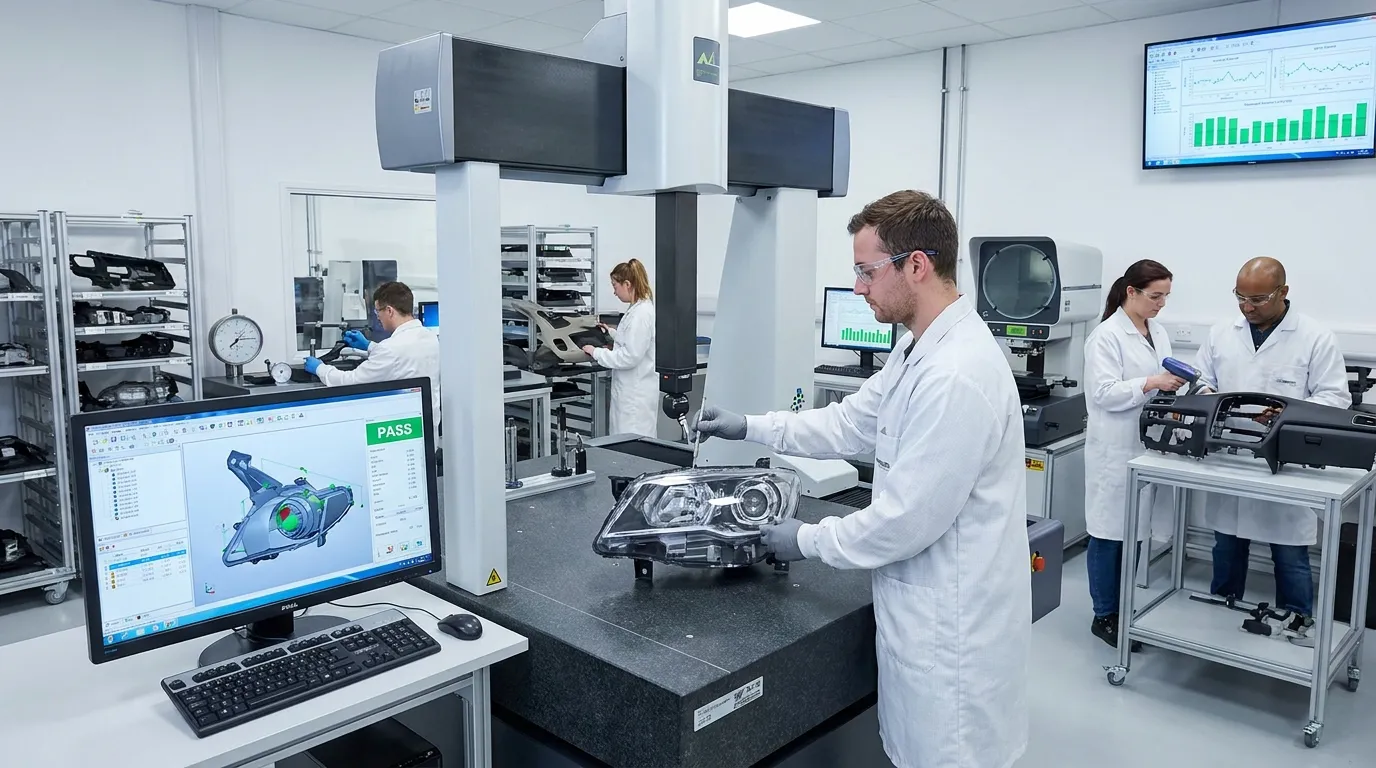
Automotive injection molding quality control combines dimensional inspection, process monitoring, and visual verification to reduce variation and prevent assembly issues during mass production.
Automotive suppliers use multiple inspection stages instead of relying on final checks alone. Quality control often starts with incoming material verification, then continues through sampling, inline monitoring, và kiểm tra cuối cùng.
Kiểm tra nội tuyến so với kiểm tra cuối cùng
Inline inspection checks parts during production to identify variation before large batches are affected. Operators may monitor dimensions, Ngoại hình, gate quality, and flash levels at regular intervals.
Final inspection focuses on dimensional verification and cosmetic review before shipment. Many suppliers also use statistical process control (SPC) to track process drift over time.
Thiết bị đo lường thông thường
| Phương pháp kiểm tra | Mục đích |
|---|---|
| Thước cặp và đồng hồ đo | Kiểm tra kích thước cơ bản |
| Máy đo tọa độ (CMM) | Đo hình học phức tạp |
| Hệ thống thị giác | Kiểm tra mỹ phẩm |
| Đồng hồ đo đi / không đi | Xác minh lắp ráp |
| Phần mềm SPC | Giám sát quy trình |
First article inspection is especially important for assembly-critical components. A lamp housing or snap-fit trim piece may pass individual measurements but still fail vehicle assembly if geometry shifts slightly across production runs.
Kỷ luật kiểm định được sử dụng trong Quy trình đúc chính xác is also valuable in automotive production where repeatability matters.
Quy trình kiểm tra QC ô tô
- Xác minh vật liệu đến
- Thiết lập khuôn và lấy mẫu
- Kiểm tra bài viết đầu tiên
- Kiểm tra kích thước nội tuyến
- Kiểm tra bề mặt mỹ phẩm
- Xác thực kích thước cuối cùng
- Đóng gói và phê duyệt lô hàng
What causes warpage and dimensional inconsistency in automotive parts?
Warpage usually comes from uneven cooling, inconsistent wall thickness, co lại nhựa, or unstable processing conditions. Even small distortion can create assembly gaps, vấn đề căn chỉnh, or stress during installation.
Cooling layout is one of the biggest contributors to dimensional consistency. Research published on Arxiv highlighted how cooling-channel design affects shrinkage and part stability in injection molding applications.
A production run for an exterior grille is a common example. If one side cools faster than the other, the part may twist slightly after ejection. The distortion may appear minor during inspection but still cause visible fitment issues during vehicle assembly.
| Vấn đề | Nguyên nhân có thể | Kết quả |
|---|---|---|
| Xoắn | Làm mát không đều | Căn chỉnh kém |
| Cúi đầu | Mất cân bằng độ dày của tường | Khoảng trống lắp ráp |
| Biến thể thu nhỏ | Nhựa không nhất quán | Thay đổi kích thước |
| Khiếm khuyết bồn rửa | Phần dày | Từ chối mỹ phẩm |
Poor cooling design creates long-term production risks. That’s one reason automotive programs often spend extra time validating tooling before full production begins.
How should buyers evaluate an automotive injection molding supplier?
Automotive suppliers should be evaluated on tooling quality, process stability, khả năng kiểm tra, and production consistency rather than price alone. Poor process control often creates expensive downstream assembly and warranty issues.
A supplier with low pricing but weak process control can create far higher costs later through rejects, assembly delays, or warranty claims. Buyers should focus on production capability, kỷ luật kiểm tra, and communication during tooling validation.
Ask suppliers how they handle dimensional drift, cosmetic inspection, và các biện pháp khắc phục. Their answers usually reveal more than a simple capability list. Experienced automotive molders should also explain how they document sampling, process settings, and inspection records.
Danh sách kiểm tra đánh giá người mua
- Xem xét quy trình kiểm tra bài viết đầu tiên
- Hỏi về giám sát chất lượng nội tuyến
- Xác minh kinh nghiệm với các cụm ô tô
- Kiểm tra khả năng kiểm tra mỹ phẩm
- Xác nhận quy trình bảo trì khuôn
- Xem lại lịch trình phân phối và lấy mẫu
Programs with appearance-sensitive parts need extra supplier scrutiny. A dashboard trim supplier may require stronger cosmetic inspection capability than a supplier producing hidden structural clips.
Các nhà sản xuất có kinh nghiệm trong lĩnh vực Sản xuất tập trung vào kiểm tra often apply tighter documentation and traceability practices that benefit automotive production as well.
Thực hiện bước tiếp theo đúng đắn
Choosing the right partner for injection molding automotive parts goes beyond tooling cost or machine capacity. Material behavior, điều khiển làm mát, độ ổn định kích thước, and cosmetic inspection all affect long-term production performance.
Trước khi phê duyệt nhà cung cấp, review how they handle validation, Kiểm tra, and process monitoring during full production runs. Ask for examples tied to parts similar to yours, especially if appearance or assembly fit is critical.
If your project involves complex geometry, visible surfaces, or tight fitment requirements, investing in stronger QC capability early usually prevents far larger production issues later.
Những câu hỏi thường gặp
What plastics are most common in automotive injection molding?
PP, ABS, nylon, and PC/ABS are among the most common automotive molding materials. Manufacturers select them based on heat resistance, impact performance, độ ổn định kích thước, and cosmetic requirements for each specific component.
What automotive parts are usually injection molded?
Dashboards, Bếp nướng, vỏ đèn, trim panels, các đoạn clip, and interior bezels are commonly injection molded. The process supports high-volume production with repeatable dimensions and consistent surface quality.
What tolerances can automotive injection molding achieve?
Automotive molding tolerances depend on resin shrinkage, chất lượng nấm mốc, cân bằng làm mát, and part geometry. Tight-tolerance parts usually require validated tooling, stable processing conditions, and repeatable inspection methods.
How are automotive plastic parts inspected?
Automotive plastic parts are inspected using dimensional gauges, coordinate measuring machines, visual inspection systems, and inline quality checks. Many suppliers also use SPC tracking to monitor process variation during production.
What causes warpage in injection molded automotive parts?
Warpage is commonly caused by uneven cooling, inconsistent wall thickness, material shrinkage, or unstable molding conditions. Distortion can create fitment problems even when individual dimensions appear acceptable.
How long does automotive injection molding production take?
Thời gian sản xuất thay đổi tùy theo độ phức tạp của dụng cụ, sampling requirements, và sản lượng sản xuất. Tool validation and first article approval often add significant time before full-scale manufacturing begins.
Chia sẻ:


Được viết bởi Sunshine
Tại Sunshine, Chúng tôi là nhà sản xuất và cung cấp chuyên nghiệp các linh kiện khuôn chính xác, cung cấp một loạt sản phẩm đa dạng cho ứng dụng dập và khuôn ép. Trọng tâm chính của chúng tôi bao gồm khuôn đục lỗ, ghim và ống lót đẩy, và cọc hướng dẫn cùng các bushing. Với gia công CNC tiên tiến, Kiểm soát chất lượng nghiêm ngặt, và năng lực sản xuất mạnh mẽ, chúng tôi đảm bảo độ tin cậy, các bộ phận chính xác cao, cùng với các linh kiện tiêu chuẩn có sẵn trong kho để cung cấp nhanh chóng và hiệu quả toàn cầu.
TIN TỨC
NHẬN DỊCH VỤ
Với các bộ phận chất lượng đáp ứng mọi ngân sách và đội ngũ nhân viên thân thiện được đào tạo để giúp chuyến thăm của bạn trở nên hữu ích và thuận tiện.
