



Hướng dẫn thiết kế dập nổi cho máy tính bảng rõ ràng, Dấu hiệu bền
Clear tablet marks begin with simple artwork, balanced feature geometry, enough spacing, and placement that respects the tablet profile. The design must also work with the actual formulation, điều kiện nén, and coating process. A mark that looks correct in a drawing can still pick during compression or lose definition after film coating.
Punch-tip markings are only one part of the tooling system. Để biết thông tin rộng hơn về cú đấm, cái này, tooling families, and press compatibility, Xem Các loại dụng cụ ép viên. This guide stays focused on the design and validation of the mark itself.
There is no universal stroke depth, góc, width, or spacing that works for every product. Published dimensions are starting points. Final geometry must be tested with the intended tablet profile, sự công thức, báo chí, Lớp phủ, and identification requirements.
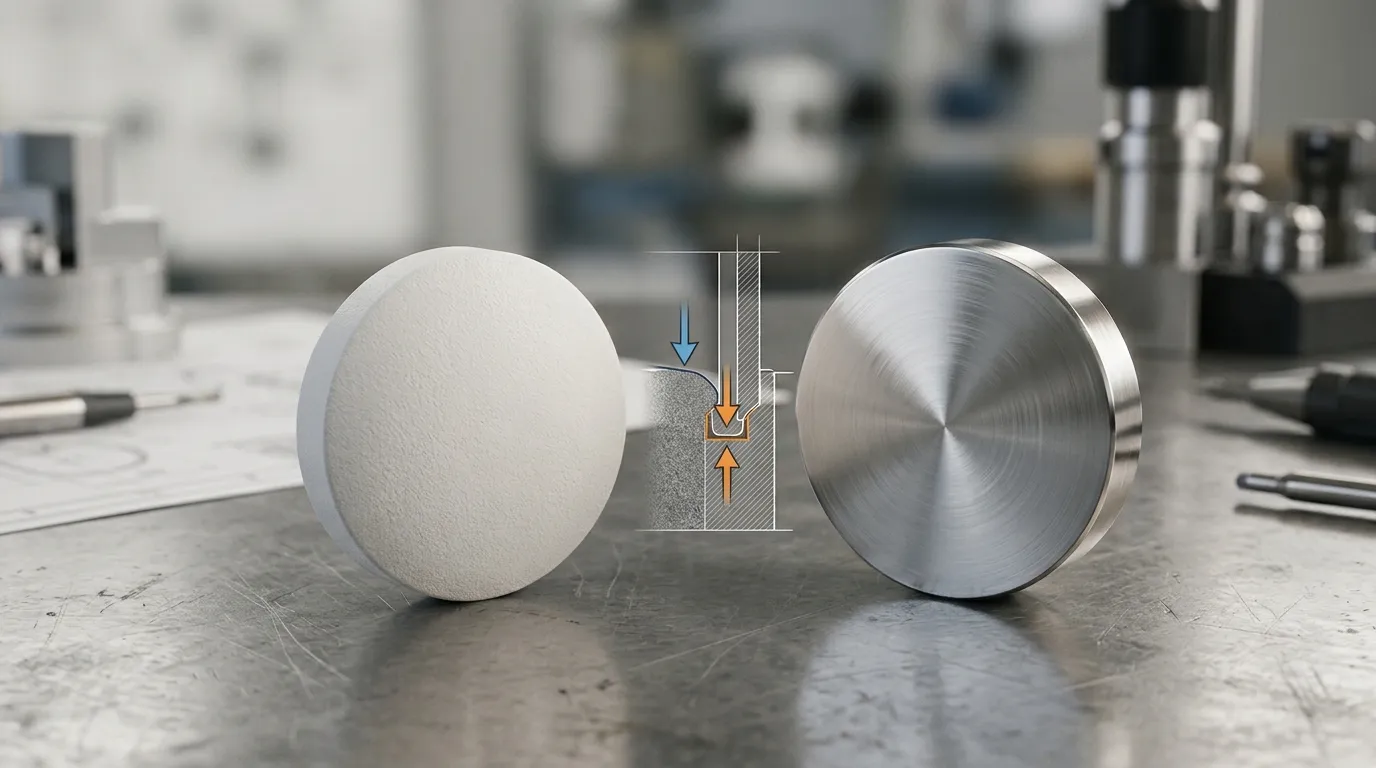
Embossed, Debossed, Engraved, and Imprinted: Define the Mark First
Tablet and tooling teams do not always use embossing terminology in the same way. A controlled drawing should therefore describe both the punch feature and the intended result on the finished tablet.
Under the U.S. definitions in 21 CFR Phần 206, an embossed mark is raised above the surface of the dosage form, while a debossed mark is below the surface. An engraved mark is cut into the dosage form after it has been completed. “Imprinted” is the broader term covering marks made by embossing, debossing, engraving, or printing.
| Thuật ngữ | Kết quả viên nén thành phẩm | Tính năng mặt đục lỗ tương ứng |
|---|---|---|
| Dấu dập nổi | Nâng lên trên bề mặt máy tính bảng | Tính năng lõm trong mặt đục lỗ |
| Dấu dập nổi | Lõm bên dưới bề mặt máy tính bảng | Tính năng nâng lên trên mặt đục lỗ |
| Dấu khắc | Cắt thành dạng bào chế thành phẩm sau khi hình thành | Không nhất thiết phải hình thành trong quá trình nén |
| Dấu ấn | Dấu nhận dạng chung | Có thể được sản xuất bằng một số phương pháp |
The inverse relationship matters. A raised letter on the punch produces a recessed letter on the tablet. A recessed letter in the punch produces a raised tablet feature.
Drawings should not rely on labels such as “emboss logo” alone. They should state:
- whether the finished tablet mark is raised or recessed;
- which punch face carries the feature;
- the intended mark orientation;
- the controlled artwork revision;
- which dimensions apply to the tool and which apply to the finished tablet.
This prevents a supplier, product team, and quality team from approving different interpretations of the same artwork.
Start With the Identification Requirement, Not the Original Artwork
The original logo is rarely the best starting geometry for a tablet punch. Branding artwork may contain thin lines, những góc sắc nhọn, small gaps, or decorative details that cannot be reproduced reliably at tablet scale.
Begin by defining what the mark must communicate:
- product or manufacturer identity;
- dosage strength;
- letters or numerals used for differentiation;
- a logo or symbol;
- a combination of these elements.
Identification should take priority over decorative fidelity. Hoa Kỳ. FDA’s Hướng dẫn thiết kế sản phẩm và phòng ngừa lỗi dùng thuốc recommends clear differentiation among drug products and strengths. Other markets may apply different regulatory requirements, so the final design needs jurisdiction-specific review.
A practical artwork review can divide details into three groups:
| Quyết định | Điều trị điển hình |
| Giữ lại | Essential letters, numerals, strength identifiers, and recognizable logo elements |
| Đơn giản hóa | Fine curves, narrow gaps, decorative terminals, closely spaced elements, and complex enclosed areas |
| Loại bỏ | Thông tin chi tiết không góp phần nhận dạng hoặc vẫn dễ đọc ở thang đo máy tính bảng |
For product families, review the smallest tablet and the most crowded face first. A logo that fits comfortably on a large tablet may fail when scaled down for a lower-strength version. It is also risky to produce several strengths with codes that differ by only one small or easily obscured feature.
Anti-counterfeiting details may support product identification, but extra complexity should not compromise readability, manufacturability, or coating performance.
Chuyển đổi chữ cái và logo thành hình học tính năng có thể sản xuất
A tablet mark is a three-dimensional feature, not flat artwork. Its performance depends on the relationship among stroke width, Độ sâu, wall angle, bán kính, and spacing.
Changing one variable affects the others. A deep feature with narrow strokes may be difficult to release or coat. A wide but very shallow feature may lose definition after spring-back or handling. Closely spaced characters may appear separate on the uncoated core but merge after coating.
| Biến hình học | Chức năng chính | Rủi ro khi cân bằng kém |
| Chiều rộng hành trình | Tạo ra trọng lượng đường có thể nhìn thấy và hỗ trợ cấu trúc | Thin strokes may wear, lấp đầy, or become fragile |
| Độ sâu tính năng | Tạo sự nhẹ nhõm và định nghĩa trực quan | Độ sâu quá cao có thể làm tăng khả năng giữ bột hoặc lấp đầy lớp phủ |
| Góc tường | Hỗ trợ giải phóng từ tính năng đục lỗ | Các bức tường dốc hoặc đột ngột có thể làm tăng khả năng giữ chân cục bộ |
| Bán kính đáy | Loại bỏ chuyển đổi bên trong sắc nét | Đáy sắc nhọn có thể bẫy vật liệu hoặc tập trung ứng suất |
| Khoảng cách ký tự | Giữ các tính năng riêng biệt trực quan | Narrow gaps may pick, bridge, or disappear after coating |
| Bán kính góc | Giảm các chi tiết hình học sắc nét | Các góc nhọn có thể yếu hoặc khó tái tạo |
Nghiên cứu về hình thành đặc điểm nổi trong viên nén dược phẩm shows that stroke angle, pre-pick geometry, điều kiện chất bôi trơn, material density, and elastic recovery can affect feature fidelity. This means the dimensions in the punch drawing will not always appear unchanged on the finished tablet.
Some tooling guides publish recommended angles, depth-to-width relationships, or radius proportions. These can be useful starting points, but they are not universal standards. Feature size, hành vi công thức, tablet curvature, coating requirements, and the measuring convention all influence whether a particular proportion is suitable.
Chọn dạng phông chữ và nét vẽ để có tính đồng nhất
Sans-serif fonts are often easier to adapt because they can use more uniform line widths and fewer decorative terminals. Serif fonts may contain thin ends, narrow transitions, and partially enclosed details that become fragile when reduced.
This does not mean every serif design must be rejected. The practical question is whether the selected font can be modified to maintain:
- consistent stroke weight;
- readable open spaces;
- rounded internal corners;
- adequate separation;
- sufficient feature support;
- recognizable character shapes.
A custom technical font may work better than preserving a standard commercial typeface exactly. The finished tablet needs to remain identifiable; it does not need to reproduce every typographic detail in the source file.
Balance Width, Độ sâu, Góc, Radius, and Spacing
These variables should be reviewed together rather than approved one at a time.
A deeper mark can improve initial visual definition, but it may also create narrow areas that fill during coating. Increasing stroke width may improve durability, but excessive width can close counters or reduce spacing between characters. Rounding the bottom and corners can support release, yet excessive rounding may soften a small character until it becomes difficult to distinguish.
The design should preserve enough contrast for identification without creating isolated, steep-sided, or tightly packed features. Trial tablets are needed to confirm that the chosen balance survives compression, sự đẩy ra, Lớp phủ, và xử lý.
Redesign Counters, Islands, and Peninsulas Before They Cause Picking
Enclosed and partially enclosed character areas are frequent sources of tablet picking.
A Bộ đếm is the enclosed space within a character. The tool feature surrounded by that space is sometimes described as an Đảo. Letters and numerals such as A, B, D, O, P, R, 0, 6, 8, and 9 contain enclosed regions. A Bán đảo is a partially enclosed projection, such as the inner portion of some letters or logos.
These areas can compact and release differently from the surrounding tablet face. Material may remain attached to the punch feature and pull away from the tablet, leaving an incomplete mark.
| Tính năng rủi ro | Vấn đề điển hình | Phản hồi thiết kế có thể có |
| Quầy nhỏ kèm theo | Lưu giữ nguyên liệu cục bộ | Mở hoặc phóng to bộ đếm |
| Hòn đảo biệt lập cao | Chọn xung quanh tính năng kèm theo | Giảm chiều cao hoặc chiều sâu của đối tượng địa lý |
| Bán đảo hẹp | Chuyển đổi yếu và chọn hàng địa phương | Côn hoặc dốc bán đảo |
| Góc bên trong sắc nét | Bẫy bột hoặc tập trung ứng suất | Thêm bán kính thích hợp |
| Hai bộ đếm gần | Tách vật liệu không đầy đủ | Tăng khoảng cách hoặc đơn giản hóa nhân vật |
An open counter removes part of the enclosure while preserving the character’s identity. Pre-picking, sometimes described as a reduced counter, intentionally reduces the vulnerable feature height or depth. A tapered peninsula blends the projecting feature more gradually into the surrounding surface.
These modifications involve trade-offs. An aggressive reduction may improve release but weaken the visual character. A wide opening may prevent picking but make two different letters look similar.
Pre-pick percentages and taper dimensions should therefore be treated as application-specific. The peer-reviewed study on debossed features found that pre-pick geometry and stroke angle influenced feature formation, but it did not establish one design that is correct for every formulation.
Giữ nhãn hiệu bên trong vùng an toàn có thể sử dụng được
The full visible tablet face is not automatically available for artwork. The safe zone is the practical area in which the mark can be placed without crowding the tablet edge, weakening the landed region, or creating difficult punch geometry.
The safe zone depends on:
- tablet size and shape;
- cup curvature;
- land position;
- mark orientation;
- the feature on the opposite face;
- any break line;
- expected coating buildup.
Artwork should not be scaled to the maximum theoretical area. Small changes during manufacturing or coating can make a mark that already sits close to the edge appear crowded or incomplete.
Placement also affects local performance. Moving an identifier away from the exact center may reduce a recurring local picking condition in some designs, but off-center placement is not universally better. It can create new balance, Ngoại hình, or inspection problems.
Use this placement check before approving the face layout:
- Keep critical strokes and character corners clear of the landed edge.
- Leave enough space for coating and visual separation.
- Check the design in its actual orientation, not only as isolated artwork.
- Compare both tablet faces together.
- Confirm that logos, codes, and functional lines cannot be confused.
- Review the smallest tablet in the product family.
A functional score line has different requirements from an identification mark. Where both features share one face, coordinate their spacing and visual hierarchy, then move the splitting analysis to the dedicated thiết kế đường ngắt máy tính bảng Hướng dẫn.
Khớp nhãn hiệu với hồ sơ máy tính bảng và độ sâu cốc
Tablet profile changes both the usable marking area and the compression conditions around the mark.
A shallow cup generally provides a flatter central region, while a deep cup creates greater curvature and can reduce the area available for detailed artwork. Placing a complex mark in a highly curved region may produce inconsistent stroke depth or crowd features near the edge.
| Cân nhắc hồ sơ | Ngụ ý dập nổi |
| Cốc nông | Larger apparent marking area, but tablet performance still requires validation |
| Cốc sâu | Khu vực trung tâm ít sử dụng hơn và độ cong dốc hơn xung quanh vạch |
| Cấu hình bán kính đơn | Độ cong đơn giản nhưng có thể tập trung các ràng buộc thiết kế ở trung tâm |
| Cấu hình bán kính kép hoặc hợp chất | Có thể cung cấp thêm quyền kiểm soát đối với khu vực trung tâm và chuyển đổi cạnh |
| Thay đổi hồ sơ chính | Ảnh hưởng nhiều hơn nhãn hiệu và yêu cầu đánh giá viên đầy đủ |
Cup depth can also influence local compaction. Detailed central features may behave differently if the formulation does not compact uniformly around the punch geometry.
Changing from one profile to another should not be treated as a minor embossing correction. It can affect tablet strength, Xử lý, Lớp phủ, and other product characteristics. The profile should only be changed through the broader product-development and validation process.
Design for the Coated Tablet, Not Only the Uncoated Core
A mark can be sharp immediately after compression and still fail on the final coated tablet.
Film coating adds material to the surface and exposes tablets to movement, Liên hệ, sấy khô, và xử lý. The main imprint-related defects include:
- Bridging: coating spans across a recessed area instead of following its full contour.
- Infill: coating material accumulates within a feature and reduces its visible depth.
- Erosion: edges lose definition through movement or abrasion.
- Sứt mẻ: local tablet material breaks away around a feature.
- làm mềm: fine details remain present but become visually indistinct.
Narrow gaps and deep recesses are particularly vulnerable to infill. Sharp transitions may not coat evenly. Very fine raised features may lose definition through contact or abrasion.
| Triệu chứng giai đoạn lớp phủ | Đóng góp thiết kế có thể | Kiểm tra thiết kế đầu tiên |
| Hợp nhất nhân vật | Khoảng cách không đủ | Tăng sự tách biệt hoặc đơn giản hóa tác phẩm nghệ thuật |
| Giờ giải lao trông đầy ắp | Độ sâu quá mức hoặc khoang hẹp | Review depth, width, góc, and bottom radius |
| Nếp nhăn biến mất | Nét quá hẹp | Tăng trọng lượng dòng mà không cần đóng các khoảng trống gần đó |
| Các cạnh trông tròn | Chi tiết quá nhỏ so với hệ thống sơn phủ | Đơn giản hóa tính năng |
| Đánh dấu chip trong quá trình xử lý | Hình dạng máy tính bảng cục bộ yếu | Review feature location, Tiểu sử, và tính toàn vẹn của máy tính bảng |
Coating thickness and operating parameters vary by product. They should not be estimated from a general article. The correct test is to run the intended coating process and inspect the final tablet under the defined production and quality conditions.
Core-tablet approval alone is insufficient when the marketed product will be coated.
Chẩn đoán gắp và dính trước khi thay đổi thiết kế
Picking and sticking are related but not identical.
Picking is usually localized. Material is removed from a specific tablet area and remains attached to a punch feature, often around a letter, numeral, Đảo, or peninsula. Sticking is broader adhesion of the formulation to the punch face. Filming develops when a deposit gradually builds across part of the tool.
Thuộc tính Đánh giá của IQ Consortium về việc dán và chọn describes these as multifactorial problems involving formulation, Dụng cụ, and manufacturing conditions. Geometry may contribute, but it is not the only possible cause.
| Mẫu quan sát | Nguyên nhân thiết kế có thể | Nguyên nhân không thiết kế có thể xảy ra | Bước xác minh đầu tiên |
| Lỗi lặp lại trong một bộ đếm | Hòn đảo khép kín hoặc đặc điểm địa phương dốc | Sát thương cú đấm cục bộ | Kiểm tra tính năng chính xác và bề mặt dụng cụ |
| Vật liệu thu thập trong một số nét hẹp | Không đủ khoảng cách hoặc hình học sắc nét | Độ bám dính công thức cao | So sánh các khu vực được đánh dấu và không được đánh dấu |
| Độ bám dính bao phủ phần lớn cú đấm | Không có khả năng chỉ là một nhân vật | Độ ẩm, sự bôi trơn, Độ ẩm, điều kiện nén | Xem xét dữ liệu công thức và quy trình |
| Khiếm khuyết trở nên tồi tệ hơn trong quá trình chạy | Tiền gửi thúc đẩy việc duy trì hơn nữa | Nhiệt độ, Độ ẩm, filming, tình trạng dụng cụ | Theo dõi thời gian và điều kiện hoạt động |
| Vấn đề chỉ xuất hiện sau khi sơn | Hình học có thể bẫy lớp phủ | Công thức sơn phủ hoặc biến thể quy trình | So sánh viên nén lõi và viên nén tráng |
Tool steel and surface coatings may be relevant after the root cause is understood. They should not be the automatic first response to every mark defect.
Dấu hiệu hình học đánh dấu đang đóng góp
Geometry is a stronger suspect when:
- the defect always appears in the same letter, numeral, Bộ đếm, or peninsula;
- the failure follows one narrow gap or sharp corner;
- surrounding unmarked areas remain clean;
- the problem is consistent across otherwise stable operating conditions;
- a controlled geometry revision changes the local defect pattern.
This evidence does not prove that geometry is the only cause, but it helps narrow the investigation.
Dấu hiệu nguyên nhân gốc rễ có thể ở nơi khác
Look beyond the mark design when:
- deposits appear across broad unmarked regions;
- severity changes with humidity, formulation moisture, or run time;
- the defect changes after adjusting compression conditions;
- lubricant level or distribution is inconsistent;
- scratches or damage are visible on the punch surface;
- multiple unrelated characters fail at the same time.
Several causes may operate together. A narrow counter can be marginal under normal conditions and begin picking only after humidity or formulation moisture increases.
Xác nhận thiết kế trước khi phát hành công cụ sản xuất
Artwork approval is not production validation. The mark must be evaluated with the intended formulation, tablet profile, điều kiện báo chí, quy trình phủ, and final inspection requirements.
A practical validation sequence is:
- Confirm the identification requirement.
Record the required letters, numerals, strength information, logo elements, and market-specific constraints. - Freeze the artwork revision.
Use one controlled source file and document all simplifications. - Define the finished-tablet result.
State whether each feature must be raised or recessed and identify the corresponding punch-face geometry. - Review manufacturability.
Check stroke width, Độ sâu, góc, bán kính, khoảng cách, counters, peninsulas, safe-zone clearance, Tiểu sử, and score-line interaction. - Produce and test trial tooling where appropriate.
Evaluate mark fidelity, việc hái, dính, tablet integrity, and tool condition under representative compression conditions. - Inspect after the intended coating process.
Check for bridging, infill, erosion, merging, and loss of identification. - Control acceptance and future revisions.
Record the approved artwork, tool drawing, phương pháp kiểm tra, visual standard, and replacement-tool revision.
Thông tin cần đưa vào gói thiết kế
A useful supplier or internal design package should contain:
- controlled artwork and revision number;
- intended finished-tablet appearance;
- kích thước máy tính bảng, Hình dạng, và hồ sơ;
- mark assignment to the upper or lower face;
- break-line position, nếu có;
- formulation behavior relevant to sticking or spring-back;
- yêu cầu về lớp phủ;
- press and tooling-system context;
- visual and dimensional acceptance criteria;
- product-family or strength-differentiation requirements;
- required material, Kiểm tra, and traceability documentation.
Do not assume that a supplier will interpret a flat logo file, tablet sketch, and phrase such as “engrave this” in the same way as the product team.
Inspect the Core, Coated Tablet, and Replacement Tooling
Inspection should cover three stages:
| Sân khấu | Những gì cần xác nhận |
| Lõi không tráng | Feature completeness, local picking, tablet integrity, and consistency during the run |
| Viên nén tráng | Final legibility, bridging, infill, erosion, and visual differentiation |
| Dụng cụ thay thế | Sửa đổi bản vẽ, feature dimensions, định hướng, and consistency with the approved result |
Khi có thể, retain approved visual samples or controlled reference images. These can help distinguish acceptable normal variation from a true loss of legibility.
Replacement tooling should reproduce the approved design revision rather than an uncontrolled copy of a worn tool or an outdated artwork file.
Danh sách kiểm tra đánh giá thiết kế dập nổi máy tính bảng
Before releasing the design, xác nhận rằng:
- the terminology clearly separates the punch feature from the finished-tablet mark;
- essential identification content has priority over decorative detail;
- the artwork has been simplified for tablet scale;
- the font uses workable stroke forms and spacing;
- counters, islands, and peninsulas have been reviewed;
- Độ sâu, width, góc, bán kính, and spacing are balanced;
- critical features remain inside the usable safe zone;
- the mark does not conflict visually or physically with a break line;
- the tablet profile provides enough usable marking area;
- coating bridging, infill, and erosion have been considered;
- formulation and process causes have been checked before redesign;
- trial-compression and post-coating inspections are defined;
- visual and dimensional acceptance criteria are documented;
- artwork and tooling revisions are controlled.
Sunshine’s website states that it supplies general custom mold components and accepts drawing-based custom-part inquiries. It does not currently provide enough public evidence to claim pharmaceutical tablet-tooling or imprint-validation capability. Teams with a relevant custom-component requirement can liên hệ với Sunshine to confirm whether the requested part falls within its actual manufacturing scope.
Chia sẻ:


Được viết bởi Sunshine
Tại Sunshine, Chúng tôi là nhà sản xuất và cung cấp chuyên nghiệp các linh kiện khuôn chính xác, cung cấp một loạt sản phẩm đa dạng cho ứng dụng dập và khuôn ép. Trọng tâm chính của chúng tôi bao gồm khuôn đục lỗ, ghim và ống lót đẩy, và cọc hướng dẫn cùng các bushing. Với gia công CNC tiên tiến, Kiểm soát chất lượng nghiêm ngặt, và năng lực sản xuất mạnh mẽ, chúng tôi đảm bảo độ tin cậy, các bộ phận chính xác cao, cùng với các linh kiện tiêu chuẩn có sẵn trong kho để cung cấp nhanh chóng và hiệu quả toàn cầu.
TIN TỨC
NHẬN DỊCH VỤ
Với các bộ phận chất lượng đáp ứng mọi ngân sách và đội ngũ nhân viên thân thiện được đào tạo để giúp chuyến thăm của bạn trở nên hữu ích và thuận tiện.
