



Giải pháp Dụng cụ Nắp Tablet: Cái này, giày bẹp đầu, và Sống
Tablet capping tooling solutions can help when crown separation is linked to insufficient consolidation time, trapped air, worn dies, excessive die-wall friction, or ejection stress. They will not correct every capping problem. Poor formulation bonding, inappropriate lubrication, moisture variation, excessive fines, or unsuitable compression settings may produce the same visible defect.
Cú đấm và khuôn dập là một phần của một hệ thống rộng lớn hơn Các loại dụng cụ ép viên, but this guide focuses only on tooling decisions related to capping. The objective is to prove the likely failure mechanism before changing a die, extending a punch head flat, or adjusting the compression cycle.
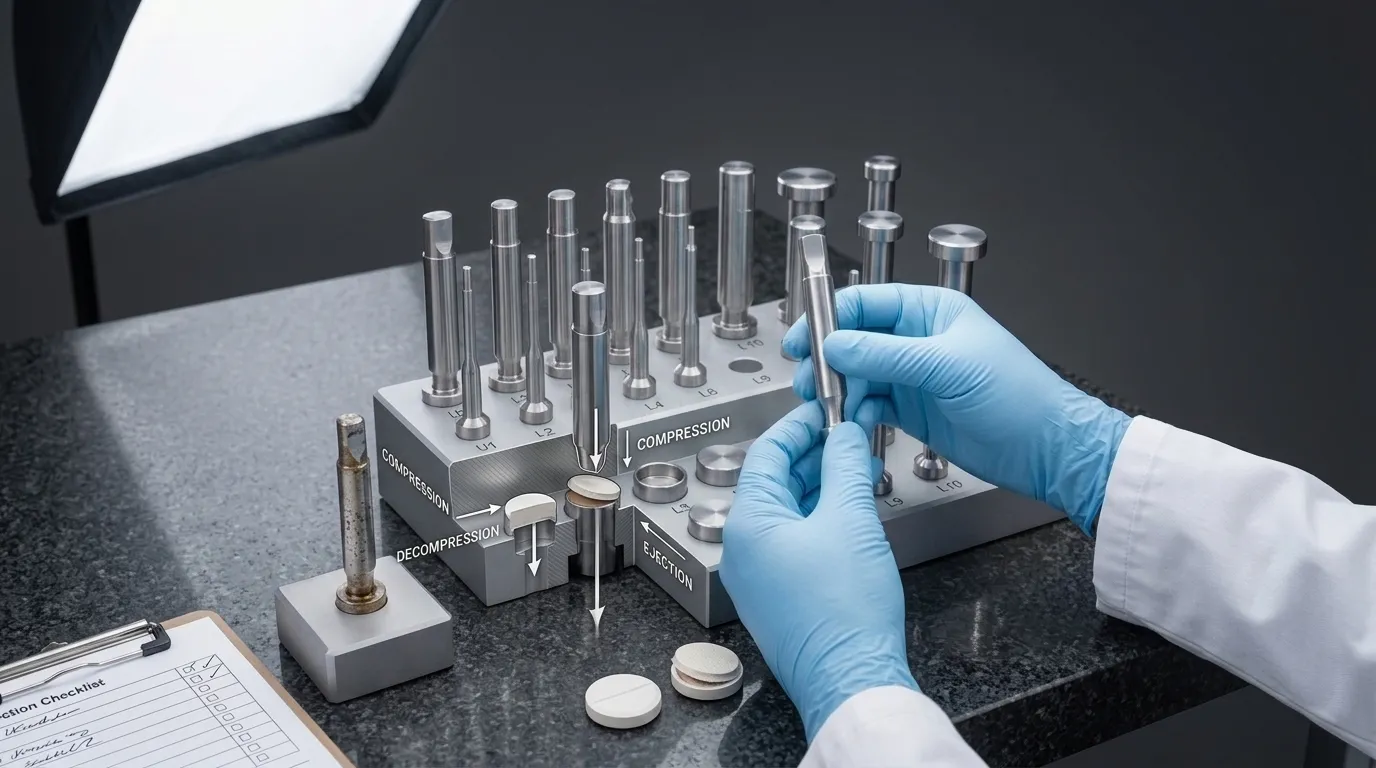
Xác nhận khiếm khuyết trước khi thay đổi dụng cụ
Capping occurs when the upper or lower crown separates horizontally from the main tablet body. The separation may become visible during decompression, sự đẩy ra, dedusting, handling, Đóng gói, or mechanical testing.
It must first be distinguished from other defects that need different corrective actions.
| Khiếm khuyết quan sát được | Ngoại hình điển hình | Điều tra ban đầu |
|---|---|---|
| Giới hạn | Núm vặn trên hoặc dưới tách ra khỏi thân máy tính bảng | Consolidation, trapped air, decompression, hình học đục lỗ, Tình trạng, và đẩy ra |
| Cán màng | Máy tính bảng tách thành hai hoặc nhiều lớp ngang | Air entrapment, tính chất công thức, compression profile, and elastic recovery |
| Sứt mẻ | Các mảnh nhỏ vỡ ra khỏi mép máy tính bảng | Cup or land geometry, handling, tooling damage, granulation, and tablet strength |
| Nứt | Các vết nứt có thể nhìn thấy hình thành mà không cần tách hoàn toàn vương miện | Stress distribution, cốc sâu, formulation elasticity, và điều kiện nén |
| Hái | Vật liệu dính vào mặt đục lỗ và được lấy ra khỏi bề mặt viên nén | Tình trạng mặt đục lỗ, formulation adhesion, Ẩm, Dập nổi, và bôi trơn |
Document exactly when and where the defect occurs. Record whether it affects:
- the upper crown, lower crown, or both;
- every tooling station or only selected stations;
- low-speed and high-speed production equally;
- tablets immediately after compression or only after handling;
- a complete batch or intermittent production periods.
A defect concentrated at one or two tooling stations is more likely to involve local punch or die condition than a defect occurring uniformly across the turret. Uniform capping across all stations may still involve tooling design, but formulation and process variables require equal attention.
Decide Whether the Root Cause Is Formulation, Quy trình, Press, or Tooling
“Improper tooling” is not a complete diagnosis. Before ordering modified punches or dies, separate four possible source groups.
Bằng chứng liên quan đến công thức may include poor tabletability, weak binder performance, excessive elastic recovery, inconsistent moisture, unsuitable particle-size distribution, high fines content, or excessive lubrication. A formulation that cannot develop adequate interparticle bonds may continue to cap even when dwell is increased.
Bằng chứng liên quan đến quy trình may include ineffective precompression, a rapid loading profile, unsuitable main-compression conditions, inconsistent die fill, or changing feed behaviour. Simply increasing compression force may make capping worse if the formulation experiences excessive elastic recovery after unloading.
Bằng chứng liên quan đến báo chí may appear during scale-up. A formulation may run successfully on a development press but fail on a production rotary press because punch velocity, turret geometry, compression-roller geometry, and available dwell differ.
Bằng chứng liên quan đến dụng cụ includes die-bore wear, tính điểm, abnormal clearance, damaged punch features, local contamination, unusually high ejection resistance, or a defect limited to specific stations.
The investigation should ask a simple question: What changed when the capping changed? If the defect follows a formulation batch, it may not be a tooling problem. If it follows an individual die around the turret, tooling becomes a stronger suspect.
Bằng chứng cho thấy vấn đề có thể liên quan đến dụng cụ
A tooling investigation is justified when one or more of these conditions are present:
- Capping repeatedly occurs at the same station.
- Affected dies show scoring, độ thô ráp, tiền gửi, sự ăn mòn, or a visible wear ring.
- Punch-tip or die-bore measurements differ between good and defective stations.
- The tablet shows heavy belly-band marks or damage during ejection.
- Ejection resistance rises as the run continues.
- Controlled reduction in turret speed improves the defect without other changes.
- Increasing available dwell improves tablet strength or reduces crown separation.
- Replacement with an inspected punch or die removes the station-specific defect.
These observations do not prove the final solution, but they narrow the investigation enough to justify dimensional inspection or a controlled tooling trial.
Làm thế nào Punch Head Flats thay đổi thời gian dừng
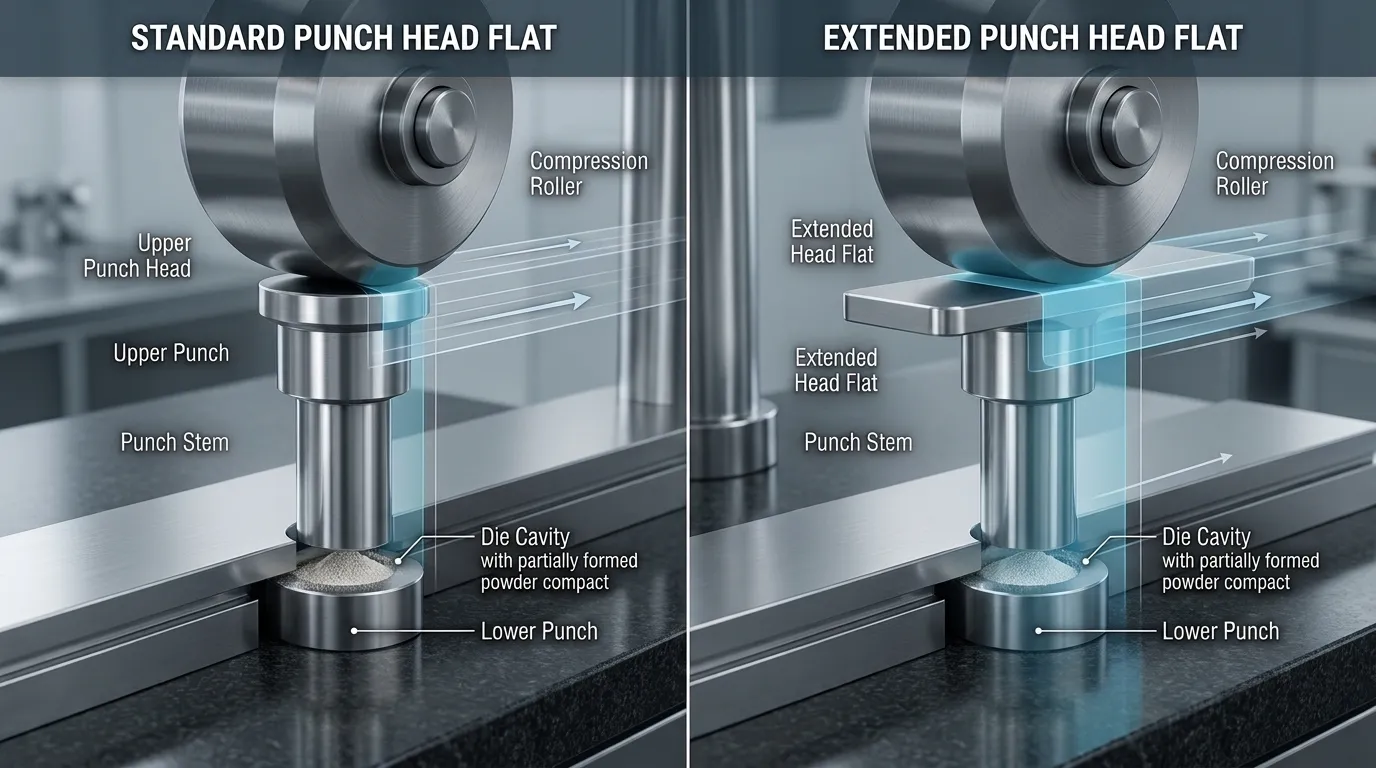
The punch head contacts the compression roller as the tooling moves through the compression zone. The flat region of the head affects the period during which the punch remains at or near its maximum penetration.
That period is commonly described as dwell time. It gives the powder bed additional time for particle rearrangement, biến dạng, fragmentation, and bond formation under compression.
Dwell is not determined by turret revolutions per minute alone. It is influenced by:
- punch-head profile;
- head-flat dimensions;
- tốc độ tháp pháo;
- pitch-circle diameter;
- compression-roller geometry;
- punch velocity through the compression zone.
Two presses running at the same turret speed may therefore expose the formulation to different loading rates and dwell conditions.
A formulation with strong strain-rate sensitivity may form acceptable tablets when compressed slowly but lose tensile strength as punch velocity increases. Trong trường hợp đó, a longer head flat may extend the high-compression portion of the cycle and provide more consolidation time.
Một nghiên cứu được bình duyệt về Thiết kế đầu đục lỗ và chất lượng viên nén metformin found that changing the head design affected dwell and the resulting physical properties of the tablets under the studied conditions. The result supports the mechanism, but it does not establish one ideal head-flat size for every formulation or press.
Khi đầu phẳng kéo dài có thể hữu ích
An extended head flat deserves evaluation when:
- capping appears or becomes worse as turret speed increases;
- the formulation performs better at slower compression rates;
- tablet strength declines when moving from a development press to a faster rotary press;
- a controlled lower-speed trial improves the defect;
- die inspection does not reveal a more direct mechanical cause;
- the formulation has demonstrated strain-rate sensitivity.
The modified head must still be compatible with the press, các con lăn, tháp pháo, các hướng dẫn viên, and tooling standard. Increasing the flat is not simply a matter of adding more material. The profile must pass through the complete machine cycle without interference or excessive mechanical loading.
Production consequences must also be considered. Reducing turret speed may prove that additional dwell helps, but it may not be an acceptable permanent solution because output falls. A compatible extended-head-flat design may preserve more output, but only after the mechanism and machine limitations are confirmed.
Khi Longer Dwell không có khả năng giải quyết giới hạn
Longer dwell is a weak solution when:
- the formulation has poor inherent bonding;
- binder, Ẩm, granulation, or lubricant conditions are outside the suitable range;
- the defect does not change during controlled speed trials;
- dies have severe wear or scoring;
- tablets are damaged mainly during ejection;
- excessive elastic recovery remains after dwell changes;
- increasing consolidation time improves hardness but creates friability, dissolution, or other quality problems.
There is no universal ideal dwell time. The relevant measure is whether a controlled dwell change produces a repeatable improvement while other variables remain stable.
Inspect the Dies, Giải phóng mặt bằng, and Bore Condition
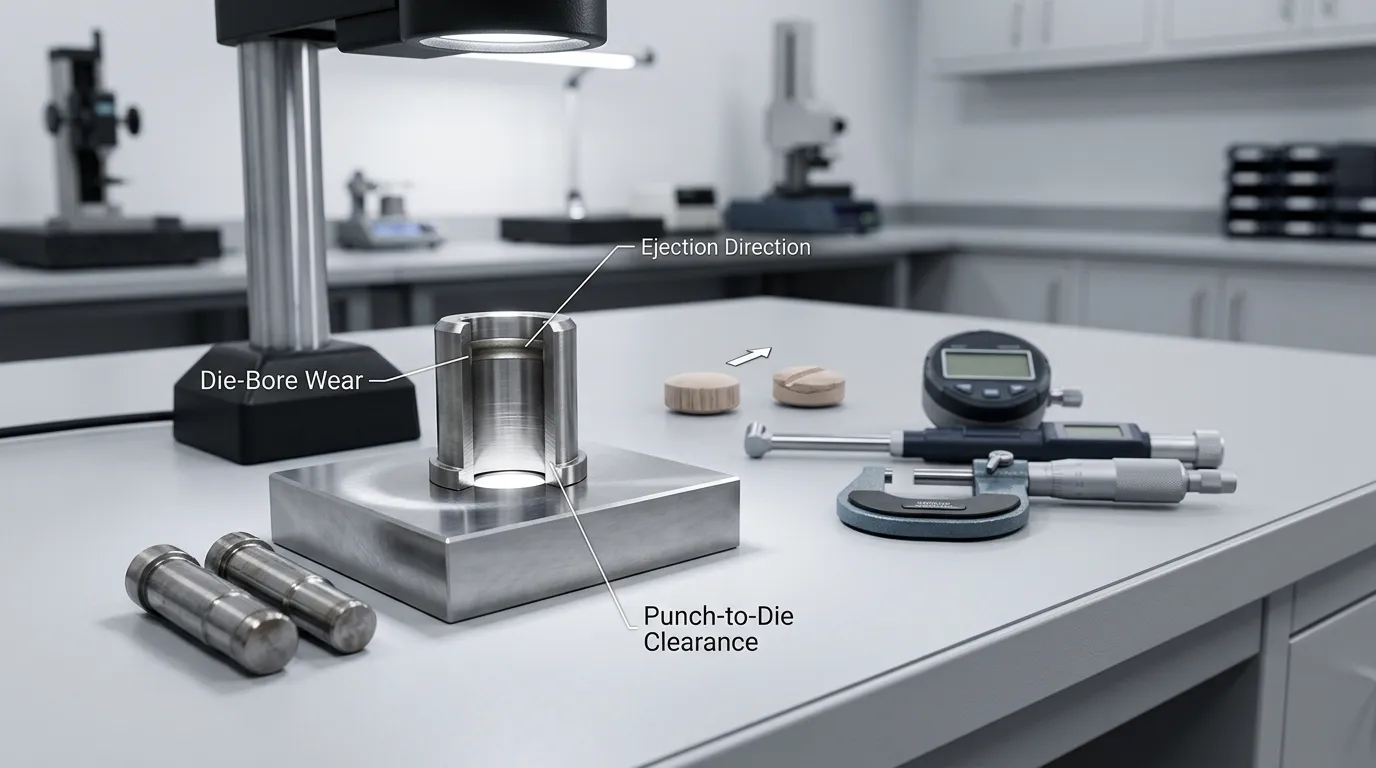
The die controls the powder bed during filling, sự nén, decompression, và đẩy ra. Its bore condition can influence friction, ứng suất dư, tablet movement, and surface damage.
Clean the die before inspection. Deposits can hide wear or create a false impression of bore damage. Then examine and measure the following:
- Bore surface: Tìm kiếm điểm số, độ thô ráp, sự ăn mòn, adhered material, and polishing differences.
- Wear-ring area: Check for localized enlargement where maximum compression repeatedly occurs.
- Bore profile: Compare measurements at several heights rather than relying on one diameter reading.
- Punch-tip-to-die clearance: Compare good and problematic stations against the approved tooling drawing.
- Tình trạng đầu đục lỗ: Inspect edges, Cốc, đất đai, and relief areas for wear or damage.
- Station pattern: Determine whether defects follow a specific die, punch, or turret position.
- Ejection marks: Inspect the tablet belly band for scratches, vết kéo, or localized damage.
A wear ring may increase resistance as the tablet moves from an enlarged compression zone into a narrower part of the bore. Roughness and scoring can also raise die-wall friction. Both conditions can increase ejection stress and expose a tablet that already has weak internal bonding.
There is no universal wear or clearance limit that applies to every tablet size, tiêu chuẩn dụng cụ, sự công thức, and press. Acceptance should be based on approved drawings, inspection methods, historical performance, and application-specific engineering review.
SunshinePro của trang dụng cụ báo chí máy tính bảng states that tablet punches and dies can be processed from drawings or samples. Its stated tolerance accuracy should be treated as a general product-page claim, not as an automatic guarantee for every feature of every tooling order.
Khuôn thẳng so với khuôn côn
A straight die maintains its specified bore profile through the working section. A tapered die includes a deliberately changing diameter in a defined area.
| Tùy chọn | Lý do tiềm năng để đánh giá nó | Bằng chứng cần thiết | Hạn chế chính |
| Khuôn thẳng | Điều kiện nén và đẩy tiêu chuẩn | Stable compression, acceptable friction, and no air-release problem linked to geometry | Không giải quyết mọi cơ chế kẹt hoặc đẩy không khí |
| Khuôn côn | Application-specific support for air release, decompression, or ejection | Bằng chứng có thể tái tạo liên kết giới hạn với một trong những cơ chế đó | Taper direction, số tiền, chiều dài, and location are not universal |
| Khuôn thay thế với lỗ khoan đã được sửa chữa | Existing die is worn, scored, or dimensionally unsuitable | Bore measurements, station pattern, and ejection evidence | Thay thế sẽ không sửa lỗi công thức |
A tapered die should not be selected merely because capping exists. The intended mechanism must be identified first. Taper designed to influence air release is a different engineering decision from taper intended to change tablet release or ejection behaviour.
SunshinePro’s website does not specifically confirm tapered tablet-die capability. Any such requirement would need written feasibility confirmation based on the exact drawing and application.
Account for Trapped Air, Nén trước, and Decompression
Powder contains air within the spaces between particles. As the punches enter the die and reduce the powder-bed volume, that air must escape or be redistributed.
If compression occurs too rapidly, internal air pressure can rise before sufficient venting and consolidation take place. Nghiên cứu về phát triển áp suất không khí trong lớp bột nén connects this internal pressure with defects including cracking, bubbling, and capping.
Precompression can help by applying an earlier, lower compression event before main compression. Its purpose may include:
- removing part of the entrapped air;
- beginning particle rearrangement;
- forming a weak initial compact;
- reducing the abruptness of the main-compression event.
More precompression is not automatically better. Its effectiveness depends on penetration, loading rate, formulation behaviour, and the relationship between the precompression and main-compression stages. A study of Nén trước và nén chính trong viên nén ibuprofen showed that these settings can materially affect resulting tablet properties under the tested conditions.
During decompression, the applied load is removed and the compact recovers elastically. If interparticle bonds are too weak, or internal air and residual stresses are too high, the crown may begin separating at this stage.
Tooling geometry, press settings, and formulation behaviour must therefore be evaluated together. A modified die cannot compensate for every air-management problem, and additional dwell cannot always overcome poor bonding.
Kiểm tra ma sát tường và ứng suất đẩy
After compression, the lower punch pushes the tablet upward through the die. The tablet remains in contact with the bore, and its resistance to movement depends on surface condition, sự bôi trơn, áp suất hướng tâm, tính chất vật liệu, và kích thước dụng cụ.
High die-wall friction may be associated with:
- rough or scored die surfaces;
- a wear ring;
- adhered product;
- bôi trơn không đủ;
- inconsistent lubricant distribution;
- unsuitable punch-tip-to-die clearance;
- high residual radial pressure;
- an abrasive formulation.
Warning signs include heavy belly-band marks, delayed crown separation, rising ejection resistance, station-specific defects, or tablets breaking as they leave the die.
Ejection-force trends are generally more informative than one isolated reading. A gradual rise during production may indicate increasing deposits, temperature-related changes, or lubrication problems. A sharp difference at one station may point toward local die or punch condition.
No universal ejection-force threshold can be applied to every product. The measurement must be interpreted against tablet size, sự công thức, press setup, kích thước dụng cụ, historical performance, and the validated process.
Sử dụng trình tự khắc phục sự cố có kiểm soát
Changing speed, lực, quá trình nén trước, sự bôi trơn, and tooling at the same time may reduce the defect, but it will not reveal which change worked. Use a controlled sequence instead.
- Confirm the defect. Record whether the failure is capping, lamination, mẻ, or another defect.
- Record when it appears. Note compression, decompression, sự đẩy ra, dedusting, handling, or delayed testing.
- Map affected stations. Determine whether capping follows individual punches, cái này, or turret positions.
- Hold the formulation stable. Avoid comparing unrelated batches when testing tooling hypotheses.
- Inspect punches and dies. Clean, measure, and compare good and defective stations.
- Run a controlled speed trial. Change turret speed while holding other practical variables constant.
- Evaluate precompression separately. Adjust one relevant condition at a time and document the response.
- Review ejection behaviour. Check tablet surfaces, Tình trạng, and available force trends.
- Trial one tooling change. Do not test a new die, extended flat, different cup, and new material simultaneously.
- Define success before the trial. Specify acceptable visual defects, tensile strength or breaking force, Độ dày, friability, output, and relevant process limits.
Thuộc tính Hướng dẫn kiểm tra dạng bào chế của FDA discusses the need to maintain tablet punches and dies and to use appropriate in-process controls. A troubleshooting trial should therefore consider more than the visual disappearance of capping. The resulting tablet must still meet its broader quality requirements.
Khớp bằng chứng với phản hồi của công cụ
| Quan sát | Cơ chế có khả năng điều tra | Kiểm tra xác nhận | Phản ứng có thể | Hạn chế |
| Giới hạn tăng theo tốc độ và cải thiện khi tốc độ giảm | Độ nhạy dừng hoặc tốc độ biến dạng không đủ | So sánh tốc độ được kiểm soát | Đánh giá dụng cụ phẳng đầu mở rộng tương thích | Sẽ không sửa chữa liên kết vốn có kém |
| Khiếm khuyết theo một vị trí chết | Local wear, độ thô ráp, Sự ô nhiễm, or dimensional change | Clean, Kiểm tra, measure, and swap positions where permitted | Sửa chữa hoặc thay thế sau khi đánh giá kỹ thuật | Thay thế không khắc phục lỗi công thức trên toàn lô |
| Giới hạn thay đổi với nén trước | Giải phóng không khí hoặc vấn đề hợp nhất sớm | Thử nghiệm trước nén có kiểm soát | Optimize process; evaluate tooling geometry only if evidence supports it | Nén trước quá mức có thể tạo ra các vấn đề khác |
| Khả năng chống đẩy cao và tổn thương băng bụng | Ma sát tường chết hoặc tình trạng lỗ khoan | Xem xét xu hướng lực và kiểm tra bề mặt khuôn | Correct lubrication, surface, Giải phóng mặt bằng, hoặc dụng cụ bị hỏng | Không áp dụng giới hạn lực phổ quát |
| Giới hạn vẫn tồn tại trên các tốc độ và trạm dụng cụ | Công thức hoặc giới hạn quy trình rộng hơn | Đánh giá nén và công thức | Quay trở lại công thức hoặc phát triển quy trình | Dụng cụ mới có thể làm tăng chi phí mà không cần điều chỉnh cơ chế |
| Hình học vương miện xuất hiện căng thẳng cao | Thiết kế cốc hoặc đất có thể đóng góp | So sánh các thiết kế đã được phê duyệt và kết quả cơ học | Xem lại hình học mặt đục lỗ | Thuộc thẩm định thiết kế riêng |
Xem xét độ sâu của cốc mà không biến nó thành bản sửa lỗi mặc định
Cup depth and punch-face edge geometry affect tablet shape, Âm lượng, crown thickness, and stress distribution. Deep cups or unsuitable edge geometry may create mechanical conditions that contribute to cracking or cap separation in some products.
Changing the cup can also alter tablet appearance, weight-volume relationships, edge strength, packaging behaviour, and compression response. It should not be treated as a simple secondary adjustment after dwell or die changes fail.
Lựa chọn chi tiết thuộc về hướng dẫn thiết kế chiều sâu cốc đục lỗ máy tính bảng. For a capping investigation, cup depth should remain one possible contributing factor rather than the default explanation.
Chuẩn bị dữ liệu mà nhà cung cấp dụng cụ cần
A supplier cannot responsibly evaluate “anti-capping tooling” from the defect name alone. Prepare a technical data package that includes:
- tablet press manufacturer and model;
- tooling standard and approved drawings;
- turret speed and number of stations;
- available press geometry or dwell information;
- current punch-head profile and dimensions;
- upper- and lower-punch drawings;
- die-bore dimensions and inspection results;
- tablet diameter, Hình dạng, Trọng lượng, Độ dày, độ sâu cốc, and land;
- formulation and granulation route;
- evidence of speed sensitivity;
- precompression and main-compression conditions;
- defect photographs;
- affected station numbers;
- khoan, punch-tip, and clearance measurements;
- ejection observations or force trends;
- results from controlled trials;
- required material and inspection documentation;
- measurable trial-acceptance criteria.
This information lets the supplier evaluate compatibility and determine whether a replacement die, modified head profile, or another intervention is technically reasonable.
It also prevents an expensive mistake: ordering a complete tooling set before proving that the current tooling caused the defect.
Những gì SunshinePro có thể và không thể tuyên bố cung cấp
SunshinePro’s published tablet-tooling information supports a limited set of company-specific statements.
| Xác nhận trên trang web | Yêu cầu xác nhận trực tiếp |
| Máy ép viên đục lỗ và khuôn | Đục lỗ máy tính bảng phẳng đầu mở rộng |
| Thép tốc độ cao cao cấp được liệt kê cho sản phẩm | Khuôn viên nén côn được thiết kế để đóng nắp |
| Xử lý tùy chỉnh từ bản vẽ hoặc mẫu | Tính toán thời gian dừng hoặc mô hình chu kỳ nén |
| Tùy chỉnh kích thước tiêu chuẩn và không chuẩn | Mô phỏng nén hoặc thử nghiệm tốc độ biến dạng |
| Tùy chỉnh đầu đục lỗ chung | Được đặt tên là TSM hoặc khả năng tương thích tiêu chuẩn công cụ của EU |
| Tư vấn lựa chọn vật liệu | Kiểm tra lực đẩy |
| Báo cáo kiểm tra vật liệu được nêu là có sẵn | Đảm bảo loại bỏ hoặc giảm giới hạn |
| Product-page tolerance claim of ±0.002 mm | Áp dụng dung sai đó cho mọi tính năng và đơn đặt hàng |
The appropriate commercial step is therefore a technical feasibility review, not an assumption that every capping-related modification is already available.
Submit approved drawings, samples where appropriate, inspection data, press details, and trial results through the Trang sản phẩm dụng cụ báo chí máy tính bảng or the company’s enquiry channel.
Chọn hành động tiếp theo dựa trên bằng chứng
Use the dominant evidence to decide where the investigation should go next:
- Formulation evidence dominates: return the problem to formulation or process development.
- Speed-sensitive capping improves with controlled dwell changes: evaluate press-compatible head-flat options.
- Air-management evidence dominates: optimize the compression sequence before redesigning the die.
- Die wear or scoring is confirmed: assess repair or replacement against approved dimensions.
- Ejection stress dominates: investigate bore condition, sự bôi trơn, Giải phóng mặt bằng, and lower-punch behaviour.
- Cup geometry remains a credible factor: conduct a separate punch-face design review.
- Evidence remains mixed: continue controlled testing rather than ordering a full tooling set.
When the results point to a tooling-related mechanism, send the press information, những bức vẽ, defect records, inspection findings, and trial data through SunshinePro’s Trang liên hệ. The objective should be an application-specific feasibility review of the punches or dies—not a generic request for a guaranteed capping cure.
Chia sẻ:


Được viết bởi Sunshine
Tại Sunshine, Chúng tôi là nhà sản xuất và cung cấp chuyên nghiệp các linh kiện khuôn chính xác, cung cấp một loạt sản phẩm đa dạng cho ứng dụng dập và khuôn ép. Trọng tâm chính của chúng tôi bao gồm khuôn đục lỗ, ghim và ống lót đẩy, và cọc hướng dẫn cùng các bushing. Với gia công CNC tiên tiến, Kiểm soát chất lượng nghiêm ngặt, và năng lực sản xuất mạnh mẽ, chúng tôi đảm bảo độ tin cậy, các bộ phận chính xác cao, cùng với các linh kiện tiêu chuẩn có sẵn trong kho để cung cấp nhanh chóng và hiệu quả toàn cầu.
TIN TỨC
NHẬN DỊCH VỤ
Với các bộ phận chất lượng đáp ứng mọi ngân sách và đội ngũ nhân viên thân thiện được đào tạo để giúp chuyến thăm của bạn trở nên hữu ích và thuận tiện.
