



Chốt đục lỗ cho dập thép chịu lực cao: Độ bền và hao mòn
Punch pins for high tensile steel stamping must resist two competing problems: progressive wear and sudden fracture. Choosing the hardest available material may slow edge wear, but it can also leave a slender or heavily loaded punch more vulnerable to chipping. Choosing a tougher material may reduce breakage while allowing faster abrasive wear.
The correct specification starts with the exact sheet grade and the observed failure mode. Punch material, xử lý nhiệt, hình học, Giải phóng mặt bằng, sự căn chỉnh, Bề mặt hoàn thiện, Lớp phủ, sự bôi trơn, and stripping conditions must work as one system. Để biết thông tin rộng hơn về các loại khuôn, Vật liệu, and punch-to-die relationships, xem Hướng dẫn đục lỗ (được suy luận).
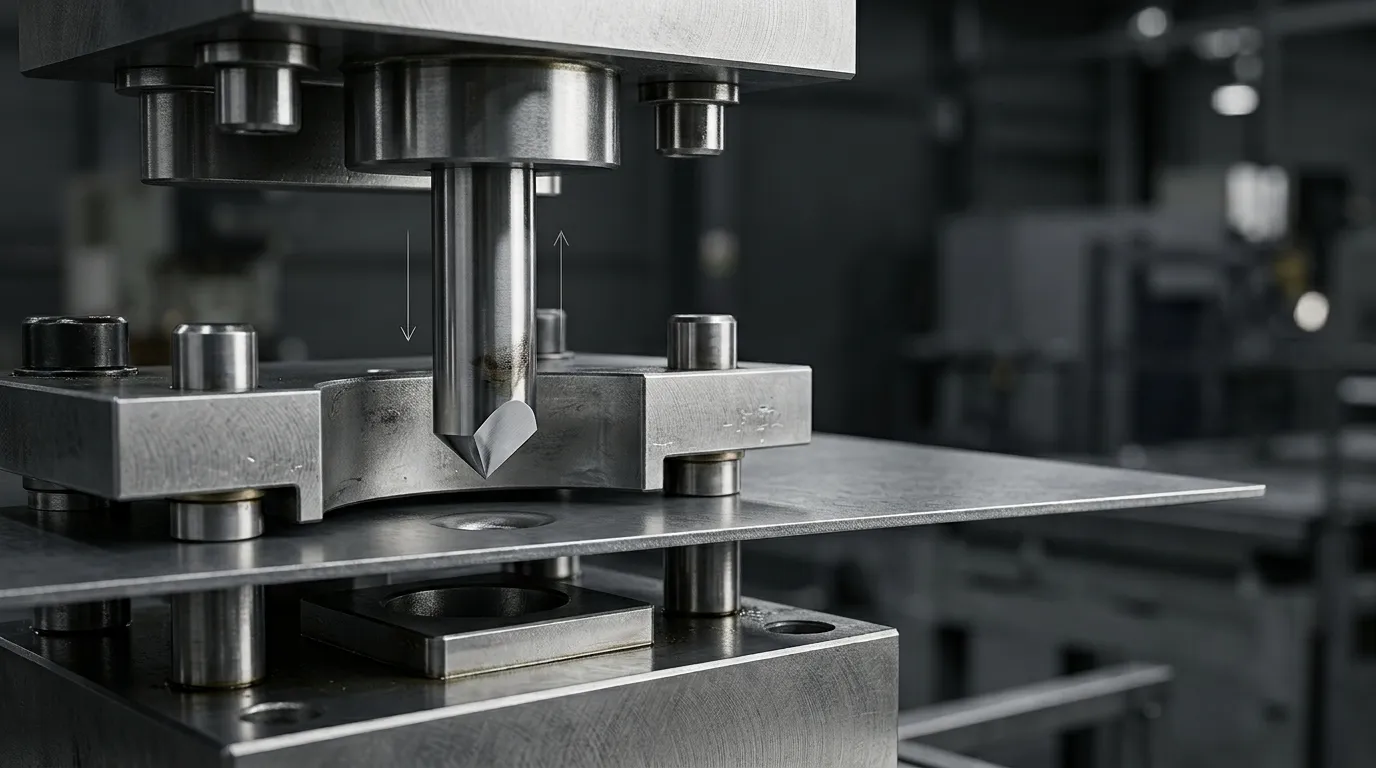
Tại sao thép cường độ cao thay đổi yêu cầu của chốt đục lỗ
Higher-strength sheet places greater demands on the punch, Nút bấm, vũ nữ thoát y, hệ thống dẫn hướng, và báo chí. The punch must penetrate the sheet without deforming, survive the sudden release of stored energy as the material fractures, and withdraw without excessive adhesion or side loading.
The workpiece description should include more than “high-tensile steel.” Important inputs include:
- Lớp thép chính xác
- Năng suất và độ bền kéo
- Độ dày tấm
- Lớp phủ hoặc mạ bề mặt
- Điều kiện bôi trơn
- Kích thước và hình dạng lỗ
- Chất lượng cạnh yêu cầu
- Tốc độ sản xuất và chiều dài chạy
These factors influence cutting load, mài mòn, ma sát, gây khó chịu, sự hình thành răng cưa, and stripping force. Two steels with similar tensile-strength ratings can behave differently because their microstructures and surface conditions are not identical.
High-Tensile Steel, AHSS, and UHSS Are Not Interchangeable Specifications
“High-tensile steel” is a broad commercial term. Advanced high-strength steel, or AHSS, includes several material families such as dual-phase, complex-phase, and martensitic steels. UHSS generally refers to the higher-strength portion of this wider group, although terminology can vary by supplier and industry.
The label alone is not enough to select a punch. A tooling supplier needs the complete grade designation, mechanical properties, Độ dày, và điều kiện bề mặt. Technical overviews of Phân loại thép cường độ cao tiên tiến also show why strength numbers should be considered alongside the steel’s metallurgical type.
Tải trọng cao hơn có thể tạo ra mài mòn và gãy cùng một lúc
A punch used on higher-strength sheet may experience more than one failure mechanism.
A hard, wear-resistant edge can still chip if it receives uneven loading. A tougher punch may survive impact but lose dimensional accuracy through abrasive wear. Material pickup can increase friction during withdrawal, adding bending stress to a small-diameter punch.
This is why punch life cannot be predicted from hardness alone. Hardness and compressive strength help resist deformation and wear. Toughness and ductility help the tool tolerate impact, sự uốn cong, stress concentrations, and crack propagation.
Chẩn đoán chế độ lỗi trước khi thay đổi vật liệu đục lỗ
Before upgrading the punch material, inspect the failed tool and the parts it produced. Look at the cutting edge, flank, thân thể, đầu, vật liệu dính, scoring direction, burr trend, and the location of any cracks.
The following table provides a practical starting point.
| Điều kiện quan sát được | Cơ chế có thể xảy ra | First checks | Thuộc tính hoặc hướng sửa chữa |
|---|---|---|---|
| Cạnh tròn dần và tăng gờ | Abrasive wear | Sheet grade, Giải phóng mặt bằng, điều kiện bề mặt, chiều dài chạy | Greater wear resistance, improved finish, revised clearance or coating |
| Vật liệu gia công gắn vào cú đấm | Mòn hoặc mài mòn chất kết dính | Bôi trơn, sheet coating, punch finish, withdrawal condition | Ma sát thấp hơn, better surface finish, suitable coating or process correction |
| Các mảnh nhỏ bị thiếu trên lưỡi cắt | Sứt mẻ cạnh | Căn chỉnh, Giải phóng mặt bằng, hình học cạnh, xử lý nhiệt | Greater toughness, lower stress concentration, hỗ trợ cải thiện |
| Nứt lớn hoặc gãy hoàn toàn | Nứt hoặc vỡ thô | Tải bên hông, chiều dài không được hỗ trợ, sự hướng dẫn, độ cứng, hình học đục lỗ | Khả năng chống đứt gãy lớn hơn cộng với hiệu chỉnh hệ thống |
| Edge rolls, mushrooms, or changes shape | Biến dạng dẻo | Cutting load, substrate hardness, xử lý nhiệt, độ bền nén | Cường độ nén lớn hơn hoặc xử lý nhiệt hiệu chỉnh |
| Một bên mòn hoặc sứt mẻ nhanh hơn | Tải không đồng đều | Die-button position, trang phục hướng dẫn, sự lệch hướng bằng áp lực, tính đồng tâm | Khôi phục sự liên kết và thậm chí khe hở trước khi thay đổi vật liệu |
Thuộc tính Thảo luận về Hướng dẫn AHSS về dụng cụ và khuôn mòn separates abrasive wear, mài mòn do keo dán, mẻ, tiếng nứt, and plastic deformation because they do not have the same cause or corrective action.
mài mòn, mài mòn do keo dán, and Galling
Abrasive wear removes punch material progressively. Common signs include edge rounding, tính điểm, tổn hao kích thước, and a gradual increase in burr height. Hard phases in the workpiece, thang đo, surface contamination, and repeated contact can contribute to this type of deterioration.
Adhesive wear involves material transfer between the sheet and punch. The workpiece may stick to the punch surface, creating pickup, smearing, hoặc ghi điểm. Severe adhesion can develop into galling, where rough transferred material increases friction and damages both surfaces.
Before specifying a harder substrate, kiểm:
- Bề mặt đục lỗ hoàn thiện
- Loại chất bôi trơn và tính nhất quán
- Lớp phủ tấm
- Khe hở đục lỗ
- Hướng mài
- Điều kiện tước
- Hư hỏng lớp phủ hiện có
A coating may reduce friction or pickup, but it cannot compensate for severe misalignment, unstable geometry, or an unsuitable base material.
Edge Chipping, Gross Cracking, and Plastic Deformation
Edge chipping is a localized fracture. It may result from inadequate toughness, excessive edge stress, khoảng cách không đều, a sharp stress concentration, hỗ trợ kém, or an unsuitable heat-treatment condition.
Gross cracking affects a larger section of the punch and may lead to complete separation. Tải bên, chiều dài không hỗ trợ quá mức, sai lệch, poor transitions between sections, or an excessively brittle substrate can contribute. Broader fracture causes are covered in đục lỗ đứt gãy trong khuôn dập.
Plastic deformation is different. Instead of cracking, the punch permanently changes shape because the applied stress exceeds the material’s compressive capability. The edge may roll or mushroom. A tougher material is not necessarily the answer; the punch may need greater hardness, độ bền nén, improved heat treatment, or reduced loading.
Kết hợp họ vật liệu đục lỗ với rủi ro chi phối
Material selection should begin with the property that is missing, not with a familiar grade name. The practical question is whether the application primarily needs more wear resistance, sự cứng cáp, độ bền nén, galling resistance, or a balanced combination.
| Gia đình vật liệu | Hướng lựa chọn điển hình | Ưu điểm chính | Hạn chế chính |
| Thép công cụ gia công nguội thông thường | Nhu cầu mài mòn từ trung bình đến cao với tải ổn định | Xử lý được thiết lập và khả năng chống mài mòn hữu ích | Một số loại có thể bị sứt mẻ khi va đập mạnh hoặc uốn cong |
| Thép tốc độ cao | Combined hardness, khả năng chống mài mòn, and improved toughness | Hiệu suất cân bằng cho nhiều ứng dụng đột dập | Hiệu suất vẫn phụ thuộc nhiều vào xử lý nhiệt và hình học |
| Thép công cụ luyện kim bột hoặc PM-HSS | Các ứng dụng đòi hỏi khắt khe với rủi ro mài mòn và đứt gãy kết hợp | Phân bố cacbua đồng đều hơn và kết hợp tính chất rộng hơn | Chi phí vật liệu cao hơn phải được chứng minh bởi ứng dụng |
| Cacbua | Severe abrasive wear under rigid, well-aligned conditions | Khả năng chống mài mòn và nén cao | Nhạy cảm hơn với tác động, sự uốn cong, hỗ trợ kém, và sự lệch hướng |
No family is universally superior. A stable, well-supported application with gradual abrasive wear may justify a different material from a small punch that repeatedly chips under side load.
Thép công cụ thông thường và thép tốc độ cao
Conventional cold-work tool steels can provide strong wear resistance, but their toughness varies widely. A D2- or SKD11-type material may be appropriate in a stable application where abrasive wear dominates, yet it may not be the best direction for a slender punch experiencing impact or uneven loading.
High-speed steels such as M2- or SKH51-type grades are commonly considered when the application needs a stronger balance of hardness, khả năng chống mài mòn, and toughness. This does not make HSS automatically better. Xử lý nhiệt, punch diameter, bán kính chuyển tiếp, sự hướng dẫn, and operating conditions can have more influence than the grade label alone.
SunshinePro liệt kê SKH51, SKH9, and DC53 among its punch-pin material options. These are available choices, not universal recommendations for every AHSS or UHSS operation.
Thép công cụ luyện kim bột cho nhu cầu mài mòn và đứt gãy kết hợp
Powder-metallurgy production can create a more uniform distribution of alloy carbides than conventional ingot processing. This may allow tool-steel grades to combine high wear resistance with better resistance to chipping or fatigue.
PM materials still have different priorities. Technical guidance may position one grade toward wear resistance and another toward toughness. Ví dụ, PM-M4 is often discussed as a wear-focused option, while PM-3V is commonly considered where resistance to chipping and impact carries more weight. These are directional comparisons, not interchangeable specifications.
SunshinePro lists ASP materials among its available punch-pin options. The appropriate ASP grade and heat-treatment condition would still need to be selected from the actual workpiece, hình học, điều kiện sản xuất, và lịch sử thất bại.
Khi cacbua giúp ích — và khi nó tạo ra rủi ro mới
Carbide offers high abrasive-wear resistance and compressive strength. It can be useful when the die is rigid, the punch is well supported, alignment is controlled, and progressive wear is the main problem.
Its limitations become important in shock-loaded or unstable conditions. Carbide is less tolerant of bending, edge impact, sai lệch, and weak support than tougher tool-steel systems. Một dài, narrow carbide punch can fail quickly if the underlying geometry and guidance are not suitable.
Production volume alone is not enough to justify carbide. The decision should also consider:
- Đường kính đục lỗ và chiều dài không được hỗ trợ
- Điều kiện va đập và chụp qua
- Độ cứng
- Điều kiện hệ thống dẫn hướng
- Hình học cạnh
- Yêu cầu mài lại
- Hậu quả của gãy xương đột ngột
Kiểm tra khoảng cách, Căn chỉnh, and Geometry Before Blaming the Punch Material
A premium punch material will not correct an unstable die system. Giải phóng mặt bằng, sự căn chỉnh, sự hướng dẫn, sự cứng nhắc, hình học, and stripping conditions should be checked before a substrate change is approved.
Khe hở và căn chỉnh Thay đổi tải trọng trên lưỡi cắt
Punch-to-die clearance affects cutting force, fracture development, sự hình thành răng cưa, tải trọng cạnh, and tool wear. The correct value depends on the exact sheet grade, Độ dày, edge-quality target, tình trạng dụng cụ, and operation. A single clearance percentage should not be applied to all high-tensile steels.
Uneven clearance can be more damaging than an imperfect nominal value. If one side of the punch contacts earlier, that section receives concentrated load and may wear or chip first.
Nguyên nhân có thể bao gồm:
- Trụ dẫn hướng hoặc ống lót bị mòn
- Vị trí nút chết không chính xác
- Chuyển động của giá đỡ đục lỗ
- Độ lệch của máy ép hoặc khuôn
- Lỗi lắp ráp
- Mòn nút khuôn cục bộ
Thuộc tính Hướng dẫn thành phần khuôn giải thích cách đấm, Các nút bấm, vũ nữ thoát y, các cột chỉ dẫn, and bushings interact within the wider die system.
Đường kính, Độ dài không được hỗ trợ, Tháo rời, and Lubrication Affect Survival
Small-diameter punches are sensitive to bending because their cross-sectional area is limited. Risk increases when the unsupported length is excessive, guidance is weak, or material pickup creates lateral force during withdrawal.
Punch geometry should therefore be reviewed as carefully as the substrate. Important details include:
- Mối quan hệ đường kính với chiều dài
- Thiết kế đầu và chuôi
- Bán kính chuyển tiếp
- Chuẩn bị tiên tiến
- Giảm nhẹ hoặc giảm dần
- Hướng dẫn gần kết thúc làm việc
- Hỗ trợ vũ nữ thoát y
Stripping can also become a major load event. Material adhered to the punch increases withdrawal force. If the stripper does not support the sheet evenly, the punch may bend as it retracts.
Lubrication and surface finish influence this relationship. They should be evaluated together with the workpiece coating and punch finish rather than treated as general maintenance details.
Treat Heat Treatment, Bề mặt hoàn thiện, and Coating as One System
A material grade does not arrive with fixed performance. Heat treatment establishes the final hardness, sự cứng cáp, độ bền nén, stress condition, và độ ổn định kích thước. Grinding and surface finishing then influence geometry, ma sát, and the quality of the cutting edge.
Coating is the final surface intervention, not a replacement for a correctly processed substrate.
Xử lý nhiệt thiết lập các đặc tính đục lỗ thực sự
The same tool-steel grade can perform differently when its heat-treatment condition changes. Excessive hardness may improve wear resistance while reducing tolerance for impact or stress concentration. Insufficient hardness may allow deformation, edge rolling, or rapid wear.
A responsible specification should define:
- Lớp vật liệu
- Điều kiện xử lý nhiệt cần thiết
- Phạm vi độ cứng chấp nhận được
- Kích thước quan trọng sau khi xử lý nhiệt
- Tình trạng bề mặt
- Phương pháp kiểm tra
- Bất kỳ yêu cầu mài sau xử lý nào
SunshinePro lists vacuum heat treatment and precision grinding among its punch-pin processes. The final treatment and inspection requirements should still be agreed for the specific material and drawing.
Lớp phủ có thể làm giảm hư hỏng bề mặt nhưng không thể sửa chữa thiết kế yếu
PVD coatings can modify friction, adhesive behavior, and wear at the punch surface. They may be useful where galling, xe bán tải, or progressive surface wear dominates.
They cannot correct:
- Sai lệch
- Chiều dài không được hỗ trợ quá mức
- Chuyển đổi phần yếu
- Độ dẻo dai của chất nền không đủ
- Biến dạng dẻo bên dưới lớp phủ
- Giải phóng mặt bằng không chính xác
- Chuẩn bị cạnh kém
SunshinePro lists TiN and TiCN as optional punch-pin coatings. Selecting between them requires application-specific review rather than a generic life comparison.
Coating thickness must also be included in dimensional planning. Regrinding may remove the coating from the working area, requiring a decision about recoating, dimensional restoration, hoặc thay thế.
Sử dụng quy trình lựa chọn cú đấm đầu tiên ở chế độ thất bại
A practical selection process should follow this order:
- Identify the workpiece completely.
Record the grade, yield and tensile strength, Độ dày, surface coating, hardness data where available, and lubrication condition. - Document the punch and die geometry.
Include hole size, punch diameter, dạng đầu, chiều dài tổng thể, chiều dài không được hỗ trợ, die-button opening, intended clearance, and stripper arrangement. - Phân loại lỗi.
Determine whether the main problem is abrasive wear, gây khó chịu, mẻ, tiếng nứt, biến dạng, or uneven loading. - Correct system problems first.
Check alignment, trang phục hướng dẫn, die-button condition, Giải phóng mặt bằng, sự lệch hướng bằng áp lực, việc lột đồ, và bôi trơn. - Choose the required property direction.
Decide whether the application needs more wear resistance, sự cứng cáp, độ bền nén, ma sát thấp hơn, or a balanced combination. - Select the substrate and heat-treatment condition together.
Do not choose a grade without defining how it will be processed. - Add finish and coating only where they address the failure mechanism.
Surface treatment should support the substrate and process, not hide an unresolved design problem. - Validate under controlled production conditions.
Monitor burr growth, thu gom vật liệu, thay đổi kích thước, mẻ, khoảng thời gian bảo trì, and the condition of the die button.
Consider three common patterns:
- A small punch with repeated edge chipping usually requires alignment and unsupported-length checks before simply increasing hardness.
- A punch with material pickup on coated sheet may need better lubrication, Kết thúc, or coating rather than a tougher core material.
- A stable high-volume operation showing gradual edge rounding may justify greater abrasive-wear resistance once clearance and alignment are confirmed.
The best option is the one that controls the actual failure at an acceptable cost per accepted part, not necessarily the punch with the highest initial material cost or hardness.
Chuẩn bị dữ liệu ứng dụng trước khi yêu cầu chốt đục lỗ tùy chỉnh
A drawing provides dimensions, but it may not explain why the existing punch is failing. A useful technical review should include workpiece data, tooling details, process conditions, bằng chứng thất bại, and acceptance requirements.
Dữ liệu để gửi với bản vẽ hoặc mẫu đục lỗ không thành công
Cung cấp:
Thông tin phôi
- Lớp thép chính xác
- Năng suất và độ bền kéo
- Độ dày tấm
- Surface coating
- Chất bôi trơn và phương pháp thi công
Thông tin đục lỗ và khuôn
- Đường kính và cấu hình đục lỗ
- Chiều dài tổng thể và không được hỗ trợ
- Hình học đầu và chuôi
- Mở nút chết
- Giải phóng mặt bằng dự kiến
- Vũ nữ thoát y và sắp xếp hướng dẫn
- Vật liệu đục lỗ và độ cứng hiện có
- Lớp phủ hiện tại và bề mặt hoàn thiện
Thông tin sản xuất
- Loại báo chí và các điều kiện hoạt động liên quan
- Số lần truy cập mỗi phút
- Số lần truy cập mỗi lần chạy
- Khối lượng sản xuất dự kiến
- Lịch sử mài lại
- Khoảng thời gian bảo trì theo kế hoạch
Bằng chứng thất bại
- Ảnh rõ nét
- Vị trí vết nứt hoặc chip
- Lấy hoặc chấm điểm vật liệu
- Xu hướng gờ
- Mất kích thước
- Tần suất thất bại
- Cho dù thiệt hại xảy ra trong quá trình thâm nhập hoặc rút lui
SunshinePro states that punch diameter, chiều dài, hình dạng đầu, Vật chất, and coating can be customized. Nó Trang sản phẩm đục lỗ also lists SKH51, SKH9, DC53, ASP, carbide, mài chính xác, xử lý nhiệt chân không, TiN, and TiCN among available options.
Tài liệu và xác nhận để xác nhận trước khi sản xuất
Trước khi phê duyệt sản xuất, define which records and acceptance criteria are required. These may include:
- Danh tính hoặc giấy chứng nhận vật liệu
- Phạm vi độ cứng đã thỏa thuận
- Kiểm tra kích thước quan trọng
- Yêu cầu hoàn thiện bề mặt
- Loại lớp phủ và độ dày
- Kích thước sau khi phủ
- Sửa đổi bản vẽ
- Quy trình phê duyệt mẫu
- Giới hạn chất lượng gờ và cạnh
- Mài lại và sơn lại kỳ vọng
SunshinePro’s product page lists dimensional capability up to ±0.002 mm and a hardness range of HRC 58–68. These should be treated as listed capability ranges, not universal specifications. Achievable tolerances and hardness depend on the selected material, hình học, xử lý nhiệt, Lớp phủ, bức vẽ, and inspection agreement.
For an application review, send the drawing together with the sheet specification, điều kiện vận hành, and failure evidence through the Trang liên hệ SunshinePro. This gives the supplier enough context to evaluate the punch material, hình học, xử lý nhiệt, Kết thúc, and coating as one system rather than recommending a grade from the workpiece name alone.
Chia sẻ:


Được viết bởi Sunshine
Tại Sunshine, Chúng tôi là nhà sản xuất và cung cấp chuyên nghiệp các linh kiện khuôn chính xác, cung cấp một loạt sản phẩm đa dạng cho ứng dụng dập và khuôn ép. Trọng tâm chính của chúng tôi bao gồm khuôn đục lỗ, ghim và ống lót đẩy, và cọc hướng dẫn cùng các bushing. Với gia công CNC tiên tiến, Kiểm soát chất lượng nghiêm ngặt, và năng lực sản xuất mạnh mẽ, chúng tôi đảm bảo độ tin cậy, các bộ phận chính xác cao, cùng với các linh kiện tiêu chuẩn có sẵn trong kho để cung cấp nhanh chóng và hiệu quả toàn cầu.
TIN TỨC
NHẬN DỊCH VỤ
Với các bộ phận chất lượng đáp ứng mọi ngân sách và đội ngũ nhân viên thân thiện được đào tạo để giúp chuyến thăm của bạn trở nên hữu ích và thuận tiện.
