



Vật liệu chốt định vị khuôn và lựa chọn độ cứng
Mold positioning pin material and hardness should be selected as a complete specification, not as a steel name followed by the highest available HRC value. The correct choice depends on contact frequency, tải bên, rủi ro va chạm, sự ăn mòn, sự bôi trơn, đường kính chốt, Bề mặt hoàn thiện, and the material of the mating bushing.
Hardness improves resistance to indentation and wear, but excessive hardness or an unsuitable heat-treatment condition can reduce toughness and increase the risk of chipping or cracking. For wider context on alignment, vừa vặn, sự bôi trơn, and system wear, Xem chốt khuôn và ống lót (được suy luận). This guide focuses specifically on selecting and purchasing the pin’s material and hardness condition.
Trước tiên, xác nhận vai trò định vị của ghim
Manufacturers do not always use positioning pin terminology consistently. A positioning pin may also be described as a locating pin or centring pin, while some suppliers use guide pin or leader pin for a related component.
| Thuật ngữ thành phần | Vai trò tiêu biểu | Ý nghĩa lựa chọn vật liệu |
|---|---|---|
| Định vị hoặc định vị pin | Thiết lập vị trí cuối cùng có thể lặp lại giữa các thành phần khuôn | Độ chính xác, hao mòn tiếp xúc, tác động, and mating-bushing properties are critical |
| Chốt dẫn hướng hoặc chốt dẫn | Hướng dẫn chuyển động của khuôn trên một khoảng cách tham gia dài hơn | Độ thẳng, sliding wear, sự bôi trơn, and bushing engagement become more prominent |
| Chốt chốt chung | Thiết lập vị trí thành phần cố định trong một cụm | Có thể không gặp phải cùng một điều kiện trượt hoặc va đập lặp đi lặp lại |
| Ejector, lõi, or punch pin | Performs ejection, đang hình thành, cắt, or cavity-related work | Yêu cầu một quy trình lựa chọn vật liệu khác |
A component can perform both guiding and final positioning functions, but the designer should confirm its actual loading before specifying the steel. A long guide pin exposed to sliding friction may need different properties from a short locating pin that receives repeated impact during mold closure.
For a broader explanation of guiding components, use the dedicated guide to chốt hướng dẫn khuôn. The material decisions below assume a pin used for repeatable mold positioning through engagement with a matching hole, chèn vào, or bushing.
Start With the Operating Conditions, Không phải loại thép
Before comparing materials, define how the pin will operate. A supplier cannot reliably select a material from diameter and length alone.
Review these conditions first:
- Contact frequency and production demand: Repeated engagement increases accumulated wear, even when each individual cycle produces only moderate contact stress.
- Tác động và tải bên: Sai lệch, heavy mold sections, or abrupt engagement may require more core toughness than a lightly loaded precision locator.
- Pin diameter and section size: A steel that hardens effectively in a small pin may not produce the same through-section properties in a larger component.
- Required repeatability: Higher positioning accuracy increases the importance of dimensional stability, độ tròn, Kết thúc, and controlled wear.
- Mating-bushing design: The pin and bushing should be selected as a material pair rather than as isolated parts.
- Bôi trơn: Limited lubrication increases friction and the risk of adhesive wear, gây khó chịu, or seizure.
- Ô nhiễm: Bụi, metal particles, and molding residue can create abrasive wear.
- Corrosive exposure: Độ ẩm, sự ngưng tụ, washdown, or chemical exposure may justify hardened stainless steel or a qualified protective treatment.
- Nhiệt độ: Elevated operating temperatures can affect hardness retention, lubricant performance, and coating suitability.
- Standard or custom sourcing: A catalog component may be adequate for common conditions, while unusual loading, kích cỡ, or documentation requirements may require a drawing-defined part.
Material selection cannot correct poor alignment, khoảng cách không phù hợp, or an unstable layout. Those issues should be resolved separately before increasing pin hardness.
So sánh các chiến lược vật liệu chính
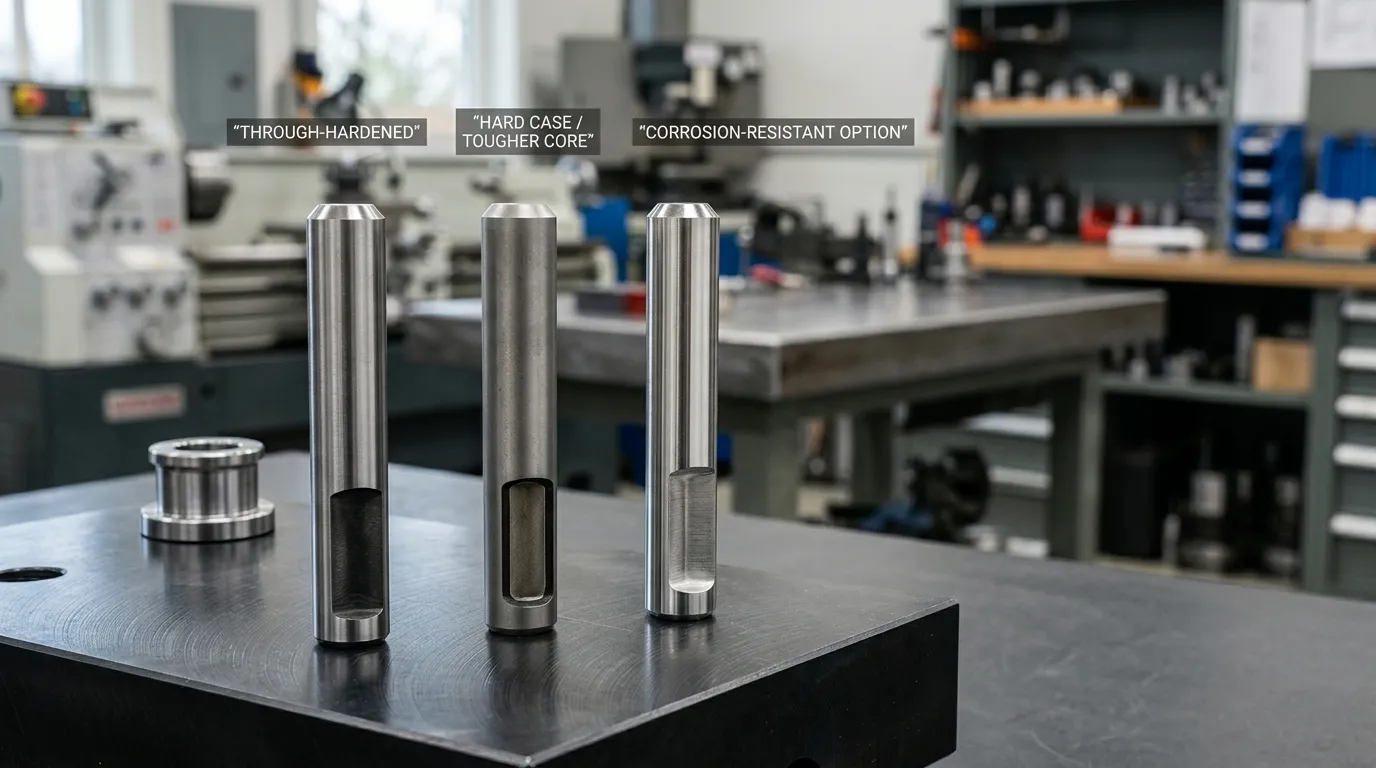
The useful comparison is not simply “steel versus stainless steel.” Buyers should compare material families together with their final heat-treatment condition.
| Chiến lược vật liệu | Ưu điểm chính | Hạn chế chính | Logic lựa chọn điển hình |
| Thép chịu lực cứng xuyên qua | Độ cứng cao qua phần lớn mặt cắt và khả năng mài mòn mạnh | May be less forgiving under impact or severe misalignment; corrosion protection may be needed | Repeated, controlled contact with good alignment and lubrication |
| Thép hợp kim cứng vỏ | Bề mặt cứng chống mài mòn với lõi hỗ trợ cứng hơn | Độ sâu vỏ, sự biến dạng, and final grinding must be controlled | Repeated contact combined with shock, tải bên, or impact risk |
| Thép công cụ cứng | Khả năng chống mài mòn tốt và ổn định kích thước tiềm năng khi được xử lý chính xác | Hiệu suất thay đổi đáng kể theo cấp độ và xử lý nhiệt | Hình dạng tùy chỉnh hoặc điều kiện mài mòn đòi hỏi giải pháp thép công cụ xác định |
| Thép không gỉ cứng | Chống ăn mòn tốt hơn so với thép hợp kim hoặc carbon cứng thông thường | Độ cứng có thể đạt được, galling behavior, sự cứng cáp, and cost must be assessed | Humid, washed, condensed, or corrosion-prone environments |
Thép chịu lực làm cứng
Through-hardening bearing steels can provide high hardness, Sức mạnh, and wear resistance across a meaningful portion of the pin section. Ovako describes 100Cr6 as a through-hardening bearing steel intended for applications requiring high hardness and high-cycle fatigue performance.
This strategy can suit a well-aligned positioning system with repeated contact and controlled lubrication. Tuy nhiên, the grade name alone does not define the finished pin. The drawing still needs a final hardness range, điều kiện xử lý nhiệt, dimensional requirements, và phương pháp kiểm tra.
Regional designations such as SUJ2, GCr15, 100Cr6, and AISI 52100 may be treated as related bearing-steel families in commercial discussions, but they should not be substituted automatically. The governing material standard, Hóa học, cleanliness requirements, and approved heat-treatment condition should be confirmed.
Thép hợp kim làm cứng vỏ
Case-hardening steels are selected when the designer wants a hard contact surface supported by a tougher core. During carburizing, carbon is introduced into the surface before hardening, creating a wear-resistant case while retaining a different core condition.
Mô tả kỹ thuật của Bodycote về Làm cứng vỏ và thấm cacbon explains how this approach can combine surface hardness with core toughness. That balance is useful when a positioning pin experiences repeated engagement, tác động, hoặc tải bên.
A case-hardened specification should not stop at surface HRC. It may also need:
- Yêu cầu về độ cứng lõi
- Độ sâu trường hợp hiệu quả
- Địa điểm thi
- Phụ cấp mài sau xử lý
- Độ thẳng và đường kính sau khi hoàn thiện cuối cùng
A very hard but shallow case may wear through prematurely. A deep case may be unnecessary or may complicate processing. The required depth should therefore be based on load, expected wear, hình học chốt, and the chosen steel.
Thép công cụ cứng và tùy chọn không gỉ
Hardened tool steels can be appropriate where wear resistance and dimensional control are important, but their performance depends heavily on the exact grade, độ cứng, điều kiện tôi luyện, and section size. “Tool steel” is not a complete purchase specification.
Hardened stainless steel is more relevant when corrosion exposure could damage a conventional hardened steel pin. A stainless option should still be evaluated for:
- Độ cứng có thể đạt được
- Sức mạnh cốt lõi
- Xu hướng galling
- Bề mặt hoàn thiện
- Vật liệu ống lót giao phối
- Mức độ nghiêm trọng của môi trường
A stainless pin with inadequate hardness may resist rust but wear too quickly. A highly hardened stainless pin may still gall against an unsuitable mating material when lubrication is poor.
SunshinePro lists SUJ2, GCr15, SKD11, and alloy steel on its Xác định vị trí Pin Guide Bushing page. Those are stated specifications for that bushing product and should not be interpreted as universal material options for every positioning pin.
Choose the Hardness Architecture, Not Just the Highest HRC
Two pins with the same measured surface hardness can behave differently because their hardness profiles and core conditions are different.
A through-hardened pin aims to develop hardness across the section, subject to the steel’s hardenability and the pin diameter. A case-hardened pin concentrates high hardness near the surface while maintaining a different core condition. Nitriding creates a hard surface layer through nitrogen diffusion and is sometimes chosen where wear, scuffing, sự kháng cự dữ dội, or lower process distortion is important.
Bodycote lưu ý rằng thấm nitơ khí can improve resistance to wear, scuffing, gây khó chịu, and seizure. Its suitability still depends on the base steel and the required layer characteristics.
| Yếu tố lựa chọn | Thông qua quá trình làm cứng | Case hardening | Thấm nitơ |
| Phân bố độ cứng | Kéo dài qua phần lớn phần | Bề mặt cứng trên một lõi khác | Lớp khuếch tán cứng gần bề mặt |
| Tiềm năng cốt lõi cứng rắn | Phụ thuộc vào cấp độ và độ cứng cuối cùng | Lợi thế thiết kế trung tâm | Phụ thuộc chủ yếu vào vật liệu cơ bản được xử lý trước |
| Yêu cầu về độ sâu trường hợp | Thường không áp dụng theo cách tương tự | Thường cần thiết | Có thể được yêu cầu khi độ sâu lớp ảnh hưởng đến hiệu suất |
| Kiểm soát biến dạng | Depends on grade, sự làm nguội, và hình học | Yêu cầu phụ cấp cho quá trình thấm cacbon và làm nguội | Thường được chọn khi độ méo thấp hơn có giá trị |
| Sử dụng tốt nhất | Tiếp xúc mài mòn cao được kiểm soát | Mòn kết hợp với sốc hoặc va đập | Kiểm soát mài mòn bề mặt hoặc mài mòn trên thép cơ bản phù hợp |
No process is universally superior. Hình học, đang tải, distortion tolerance, final grinding, vật liệu giao phối, and supplier capability all affect the decision.
độ cứng bề mặt, Core Hardness, and Effective Case Depth
A complete specification may need three separate properties:
- Độ cứng bề mặt: The hardness at or near the working surface. It strongly influences resistance to indentation and contact wear.
- Core hardness: The hardness beneath the treated layer. It affects support, Sức mạnh, và sự cứng rắn.
- Độ sâu trường hợp hiệu quả: The depth at which the material still meets a defined hardness criterion.
These values answer different questions. Surface hardness indicates how the contact area resists wear. Core hardness indicates whether the pin can support the surface under load. Effective case depth indicates how much usable hardened material exists before wear reaches a softer region.
For a through-hardened pin, a surface measurement may still be insufficient if section hardness is important. For a carburized pin, surface HRC without case-depth evidence does not fully describe the treated condition.
Chỉ định độ cứng để nhà cung cấp có thể xác minh
A requirement such as “hardened to HRC 60” leaves several questions unanswered:
- Is 60 a target, tối thiểu, or nominal value?
- What range is acceptable?
- Where should the test be taken?
- Does it apply to the surface, lõi, hoặc cả hai?
- Which test method should be used?
- Is case depth required?
- Is the result measured directly or converted from another scale?
A stronger drawing or RFQ requirement should identify:
- Cấp vật liệu và tiêu chuẩn quản lý
- Lộ trình xử lý nhiệt
- Phạm vi độ cứng chấp nhận được
- Thang đo độ cứng
- Địa điểm thi
- Khả năng áp dụng bề mặt hoặc cốt lõi
- Độ sâu trường hợp hiệu quả khi cần thiết
- Báo cáo kiểm tra hoặc thử nghiệm bắt buộc
For hardened steels, Rockwell C is commonly used. Tiêu chuẩn ISO 6508-1:2023 defines the Rockwell hardness-test method, trong khi ISO 6508-2:2023 addresses verification and calibration of Rockwell testing equipment and indenters.
Vickers testing may be more useful for localized measurements, thin treated zones, or a hardness profile across a section. The relevant method is defined in ISO 6507-1:2023.
Hardness conversions should be handled cautiously. Tiêu chuẩn ISO 18265 provides conversion principles, but a converted value is not automatically equivalent to a direct measurement under the required method. Loại vật liệu, treatment condition, and measurement range can affect the relationship.
An incomplete requirement might state:
Hardened alloy steel, HRC 60.
A more usable requirement would define the material standard, điều trị, acceptable HRC range, vị trí đo lường, core condition, case depth if applicable, and reporting expectations. The exact values must come from the application rather than a generic template.
Phù hợp với chốt và ống lót như một hệ thống mài mòn
The positioning pin and its mating bushing form one contact system. Selecting each component independently can create avoidable wear or seizure.
A common design approach is to make the replaceable bushing the preferred wear component. That may involve selecting a pin that is harder than the bushing, but there is no universal hardness difference that suits every material pair and load condition.
Check the following together:
- Vật liệu ghim và độ cứng
- Vật liệu ống lót và độ cứng
- Bề mặt hoàn thiện trên cả hai thành phần
- Thời lượng tương tác
- Giải phóng mặt bằng và căn chỉnh
- Phương pháp bôi trơn
- Tiếp xúc với ô nhiễm
- Rủi ro ăn mòn
- Độ dày lớp phủ hoặc xử lý
- Chiến lược thay thế
Two hard surfaces can still gall if their material pairing, Kết thúc, or lubrication is unsuitable. A rough or misaligned bushing can also damage a correctly hardened pin. Coatings and diffusion treatments may alter final dimensions, so diameter and fit should be verified after all relevant processing is complete.
SunshinePro’s locating-pin guide-bushing page states HRC 58–62, a precision-ground finish, and standard or custom sizes for that specific product. Those details may help when evaluating a matching bushing, but the final pin-and-bushing combination still needs project-specific review.
Chọn theo rủi ro ứng dụng
The table below provides selection directions rather than fixed material prescriptions.
| Điều kiện hoạt động | Nguyên liệu ban đầu hoặc hướng điều trị | Kiểm tra chính |
| Tiếp xúc chu kỳ cao với sự liên kết và bôi trơn tốt | Thép chịu lực cứng hoặc một chiến lược thép có độ cứng cao khác | Section hardness, Kết thúc, bushing pairing, độ ổn định kích thước |
| Tác động lặp đi lặp lại hoặc tải bên | Thép hợp kim cứng vỏ với vỏ cứng và lõi được kiểm soát | Core toughness, case depth, sự biến dạng, final grinding |
| Humid, condensed, or frequently cleaned environment | Thép không gỉ cứng hoặc chiến lược chống ăn mòn đủ tiêu chuẩn | Độ cứng có thể đạt được, gây khó chịu, phơi nhiễm hóa học, vật liệu giao phối |
| Bôi trơn hạn chế | Suitable material pair, fine finish, and possible nitriding or other qualified surface treatment | Galling, seizure, treatment compatibility, final dimensions |
| Ô nhiễm mài mòn | Khả năng chống mài mòn bề mặt cao cộng với kiểm soát ô nhiễm | Kết thúc, sealing or cleaning strategy, case depth, bushing replacement |
| Đường kính chân lớn | Thép có độ cứng thích hợp hoặc chiến lược làm cứng vỏ | Through-section properties, core condition, heat-treatment uniformity |
| Kiểm soát kích thước chặt chẽ sau khi xử lý nhiệt | Vật liệu và quy trình được lựa chọn để nghiền cuối cùng ổn định | Grinding allowance, sự thẳng, độ tròn, inspection after treatment |
These directions should be confirmed against the actual pin geometry, Tải, cấu trúc khuôn, and supplier process. Material selection should reduce risk, not replace engineering validation.
Đặt yêu cầu đầy đủ vào bản vẽ hoặc RFQ
A useful RFQ gives the supplier enough information to evaluate material availability, xử lý nhiệt, Kiểm tra, và khả năng sản xuất.
Bao gồm:
- Chức năng bộ phận và sửa đổi bản vẽ
- Đường kính pin, chiều dài, hình học, and engagement area
- Cấp vật liệu chính xác và tiêu chuẩn quản lý
- Các lớp thay thế đã được phê duyệt hoặc bị cấm
- Lộ trình xử lý nhiệt và điều kiện cuối cùng
- Phạm vi và thang đo độ cứng bề mặt
- Yêu cầu về độ cứng lõi khi cần thiết
- Độ sâu trường hợp hiệu quả khi cần thiết
- Vị trí và phương pháp kiểm tra độ cứng
- Bề mặt hoàn thiện
- Dung sai đường kính
- Yêu cầu về độ thẳng và độ tròn
- Lớp phủ hoặc xử lý bề mặt
- Kích thước cho phép độ dày lớp phủ
- Vật liệu ống lót giao phối và độ cứng
- Giấy chứng nhận vật liệu bắt buộc
- Hồ sơ hoặc giấy chứng nhận xử lý nhiệt
- Báo cáo kiểm tra độ cứng
- Báo cáo độ sâu trường hợp nếu có
- Báo cáo kiểm tra kích thước cuối cùng
- Truy xuất nguồn gốc và kỳ vọng lấy mẫu
Standard catalog components may already have fixed material and hardness conditions. A custom pin needs clearer drawing control because the buyer is defining the final properties. The guide to Các bộ phận tiêu chuẩn khuôn provides additional context on deciding between standard and customized mold components.
Cờ đỏ của nhà cung cấp
Review the quotation carefully when it contains any of these problems:
- "Thép cứng" không có cấp hoặc tiêu chuẩn
- Một số độ cứng không có thang đo hoặc phạm vi
- Không có điều kiện xử lý nhiệt
- Độ cứng bề mặt được trình bày như bằng chứng về độ cứng lõi
- Không yêu cầu độ sâu vỏ cho thiết kế cứng vỏ
- Thay thế điểm không chính thức mà không có sự chấp thuận
- Các giá trị độ cứng được chuyển đổi được sử dụng làm bằng chứng duy nhất
- Không xác định vị trí kiểm tra
- Lớp phủ được chỉ định mà không cần xác minh kích thước cuối cùng
- Service-life claims without load, vừa vặn, sự bôi trơn, and environmental conditions
A lower-cost quotation is not comparable if it omits material traceability, treatment details, or inspection requirements included in another supplier’s offer.
Bối cảnh SunshinePro cho các yêu cầu tiêu chuẩn và tùy chỉnh
SunshinePro’s website lists guide pins and bushings, Bài dẫn hướng và ống lót, Các thành phần khuôn tiêu chuẩn, and custom mold accessories. It also states that non-standard accessories can be produced from customer drawings or samples and that material-selection support is available.
Its Locating Pin Guide Bushing page lists SUJ2, GCr15, SKD11, thép hợp kim, HRC 58–62, a precision-ground finish, and standard or custom sizes. These are product-specific bushing details. They should not be applied automatically to every positioning-pin design or treated as proof that every material, điều trị, or inspection method is available for every custom part.
A technical enquiry should therefore include the complete drawing and specification rather than only a requested diameter and hardness.
Danh sách kiểm tra lựa chọn vật liệu và độ cứng
Before approving a mold positioning pin specification, confirm that you have:
- Identified whether the component performs final positioning, general guidance, hoặc cả hai.
- Defined contact frequency, tác động, tải bên, sự bôi trơn, Sự ô nhiễm, and corrosion exposure.
- Reviewed the mating-bushing material, độ cứng, Kết thúc, and replacement strategy.
- Selected a material family based on the operating risks.
- Chosen through hardening, case hardening, or another qualified treatment route.
- Defined surface hardness and core requirements separately where needed.
- Added effective case depth for a case-hardened or nitrided design when relevant.
- Specified the hardness scale, Phạm vi, phương pháp kiểm tra, và vị trí thử nghiệm.
- Controlled final finish, đường kính, sự thẳng, độ tròn, and coating allowance.
- Requested the material, xử lý nhiệt, độ cứng, case-depth, and dimensional records appropriate to the project.
Once these requirements are defined, submit the drawing and technical conditions through SunshinePro’s Trang liên hệ for feasibility review or a quotation. The enquiry should make clear which requirements are mandatory and where qualified alternatives may be considered.
Chia sẻ:


Được viết bởi Sunshine
Tại Sunshine, Chúng tôi là nhà sản xuất và cung cấp chuyên nghiệp các linh kiện khuôn chính xác, cung cấp một loạt sản phẩm đa dạng cho ứng dụng dập và khuôn ép. Trọng tâm chính của chúng tôi bao gồm khuôn đục lỗ, ghim và ống lót đẩy, và cọc hướng dẫn cùng các bushing. Với gia công CNC tiên tiến, Kiểm soát chất lượng nghiêm ngặt, và năng lực sản xuất mạnh mẽ, chúng tôi đảm bảo độ tin cậy, các bộ phận chính xác cao, cùng với các linh kiện tiêu chuẩn có sẵn trong kho để cung cấp nhanh chóng và hiệu quả toàn cầu.
TIN TỨC
NHẬN DỊCH VỤ
Với các bộ phận chất lượng đáp ứng mọi ngân sách và đội ngũ nhân viên thân thiện được đào tạo để giúp chuyến thăm của bạn trở nên hữu ích và thuận tiện.
