



Plastic Injection Mold Components: Standard Parts Buyers Should Know
Plastic injection mold components include the core, khoang, hệ thống runner, các kênh làm mát, Hệ thống đẩy, vents, and alignment parts that control part quality and mold performance. Buyers should focus on component precision, khả năng chống mài mòn, cooling efficiency, and maintenance accessibility because these factors directly affect mold lifespan, thời gian ngừng hoạt động, tỷ lệ khuyết tật, and long-term tooling cost.
A mold can look well-built from the outside and still create expensive production problems. Most tooling issues start with component quality, sự căn chỉnh, cân bằng làm mát, or wear resistance. If you're sourcing a new mold, understanding how each component affects maintenance and production stability helps you avoid downtime, rejected parts, and early tooling replacement. This guide breaks down the standard parts buyers should evaluate before approving a mold build.
What are the main plastic injection mold components?
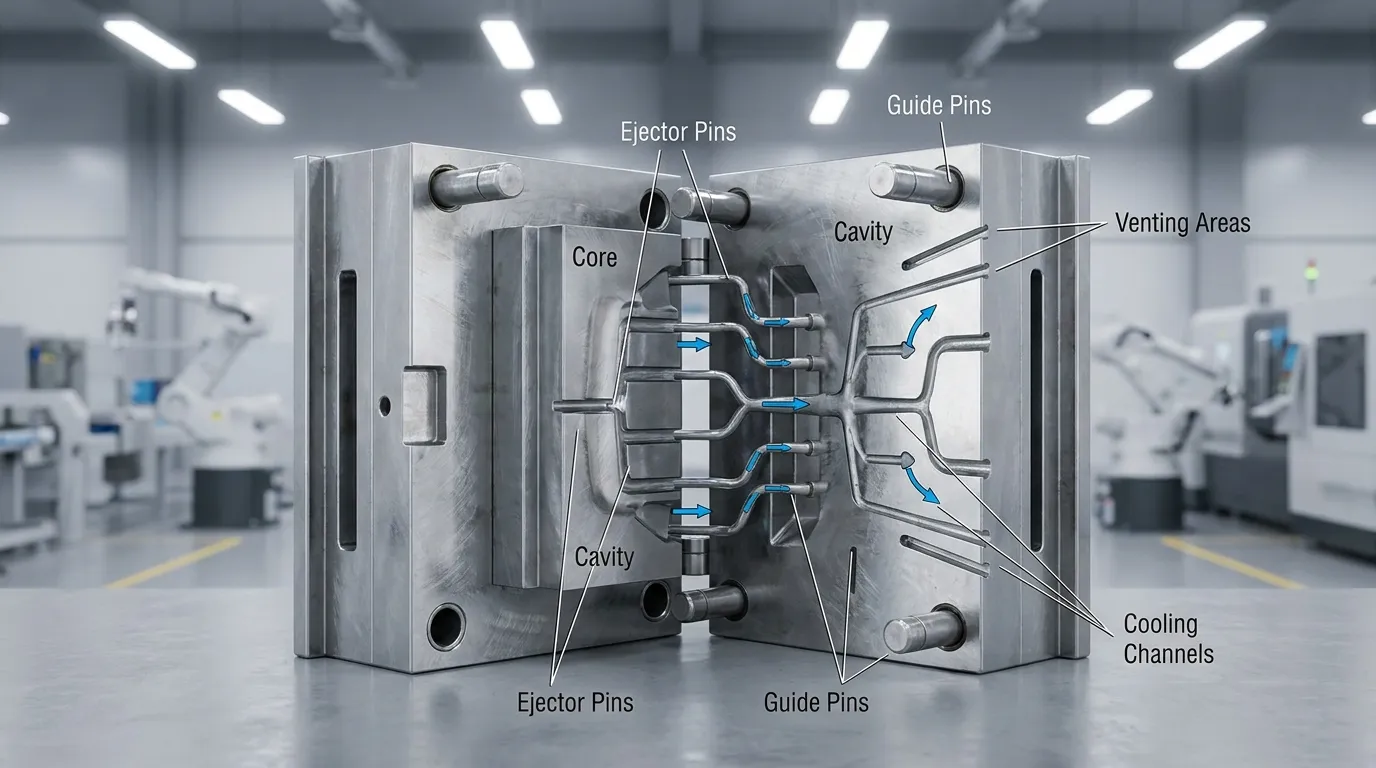
Plastic injection mold components include the mold base, lõi và khoang, hệ thống runner, Hệ thống đẩy, các kênh làm mát, vents, and alignment parts. Each component affects part quality, thời gian chu kỳ, Tần suất bảo trì, and overall mold lifespan.
Most injection molds use the same core systems, even when the finished products are very different. The mold base supports the structure, while the core and cavity shape the plastic part itself. The runner system moves molten plastic into the cavity, and the ejector system pushes the finished part out after cooling.
Cooling channels remove heat during production. Venting systems release trapped air that could otherwise create burn marks or incomplete filling. Guide pins and bushings keep both mold halves aligned during every cycle.
If you need a broader overview of how these systems fit together, Sunshine Pro của Hướng dẫn thành phần khuôn hoàn chỉnh explains the full mold structure and production workflow.
Các thành phần định hình phần nhựa
The core and cavity are the most critical shaping components. Their machining accuracy directly affects dimensions, Bề mặt hoàn thiện, and part consistency. Gates and runners also influence filling pressure and material flow.
Theo Hướng dẫn thành phần khuôn ép của First Mold, these systems work together to control how material enters and forms inside the mold.
Components that control cooling, sự đẩy ra, and alignment
Cooling channels manage temperature during production. Ejector pins remove the finished part after solidification. Guide pins and bushings maintain alignment between moving mold halves.
Bạn có thể khám phá chi tiết hơn Hệ thống thành phần khuôn if you're comparing tooling configurations across suppliers.
| Thành phần | Chức năng chính | Mối quan tâm của người mua |
|---|---|---|
| Lõi và khoang | Định hình sản phẩm | Chống mài mòn |
| Hệ thống người chạy | Cung cấp nhựa nóng chảy | Cân bằng dòng chảy |
| Kênh làm mát | Loại bỏ nhiệt | Tính nhất quán của chu kỳ |
| Chốt đẩy | Phát hành các bộ phận đã hoàn thành | Tần suất mặc |
| Chốt dẫn hướng | Duy trì sự liên kết | Độ chính xác lâu dài |
| Hệ thống thông gió | Giải phóng không khí bị mắc kẹt | Phòng chống khiếm khuyết |
Which mold components affect mold life and part quality the most?
Core and cavity precision, cooling efficiency, venting quality, and guide alignment have the biggest impact on mold life and part consistency. Poor-quality components increase flash, những cú bắn ngắn, mặc, and unplanned maintenance.
Not every mold component deserves the same level of investment. Buyers should prioritize the systems that directly affect dimensional accuracy, heat control, and repeated mechanical movement.
The core and cavity usually see the highest pressure and repeated thermal cycling. Poor steel quality or weak machining tolerance in these areas can shorten mold life quickly. Even small alignment errors may lead to flash defects, uneven wear, or part inconsistency.
Cooling design also has a bigger impact than many buyers expect. A mold with balanced cooling often performs better over time than one with expensive cosmetic finishes but weak thermal control. That matters in high-volume production where cycle stability affects output every day.
Phân tích thành phần khuôn của RapidDirect highlights how cooling, xả khí, and alignment systems affect molding stability and defect prevention.
| Khu vực thành phần | Tác động sản xuất | Rủi ro thường gặp |
|---|---|---|
| Lõi và khoang | Kích thước bộ phận | Mòn sớm |
| Kênh làm mát | Tính nhất quán của chu kỳ | Cong vênh |
| Hệ thống thông gió | Giải phóng không khí | Vết bỏng |
| Chốt dẫn hướng | Căn chỉnh | Lỗi flash |
| Hệ thống phun | Phát hành một phần | Dính hoặc hư hỏng |
Cheap wear components often create more long-term downtime than buyers expect. Saving money on guide systems or ejector hardware may reduce upfront tooling cost, but recurring maintenance usually costs far more during production.
If you're evaluating higher-grade tooling systems, Sunshine Pro của Bộ phận khuôn chính xác page covers common precision component configurations.
What does each major mold component actually do?
Every major mold component controls a specific production task. Some manage material flow, while others handle cooling, sự căn chỉnh, or part release after molding.
Các thành phần thức ăn và người chạy
The runner system moves molten plastic from the injection machine into the mold cavity. Gates control how material enters the cavity and affect filling speed, Áp lực, and surface finish.
Sprue bushings connect the machine nozzle to the runner system. Poor gate or runner design can create uneven filling, trapped air, or cosmetic defects.
Cooling, xả khí, and ejection components
Cooling channels remove heat from the mold after injection. Uneven cooling often causes shrinkage variation or warped parts. Venting systems release trapped gas during filling to prevent burn marks and incomplete shots.
Ejector pins push the finished part out after cooling. Weak ejector alignment can damage parts or create sticking during high-cycle production.
Guide pins and bushings keep both mold halves aligned during every cycle. Worn alignment systems commonly lead to flash defects near parting lines.
Hướng dẫn thành phần khuôn ép của MoldPartner explains how these systems work together during production.
Người mua so sánh bố cục công cụ có thể xem xét thêm Bộ phận khuôn ép to better understand standard component configurations.
Which injection mold components usually wear out first?
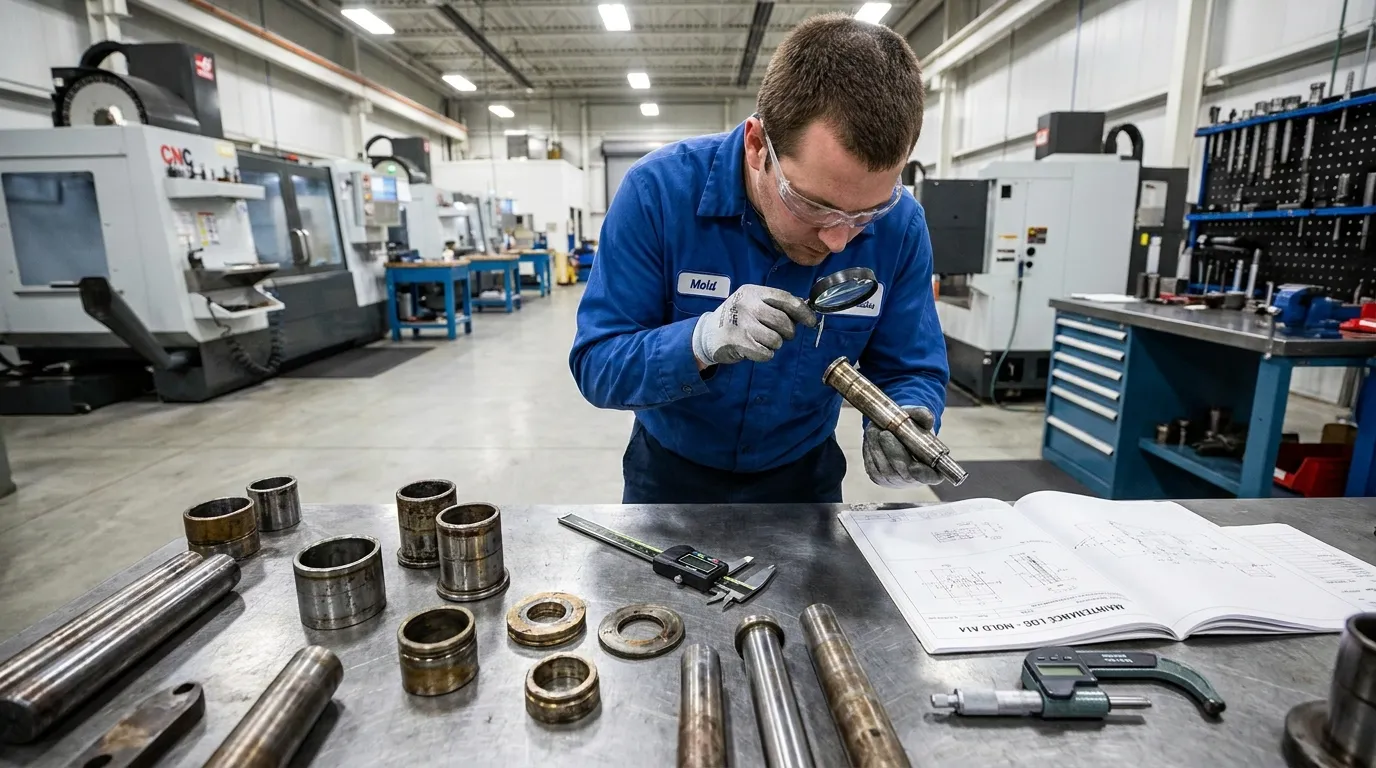
Chốt đẩy, các cổng, slides, các vòng đệm, and high-friction inserts usually wear first because they face repeated movement, Áp lực, and heat exposure. These components often determine maintenance frequency and unexpected production downtime.
Wear rates depend on resin type, khối lượng sản xuất, and mold design. Abrasive materials such as glass-filled plastics can accelerate wear on ejector systems, các cổng, and inserts much faster than standard resins.
A high-volume consumer electronics mold using abrasive resin may wear ejector pins within months if low-grade steel was selected. Trong nhiều trường hợp, the issue is not the mold design itself. The problem starts with material hardness and repeated friction during cycling.
Hướng dẫn ép phun của Escatec notes that maintenance planning and component quality heavily influence mold longevity.
Bảng rủi ro mài mòn thành phần khuôn
| Thành phần | Nguyên nhân hao mòn thường gặp | Các triệu chứng thất bại | Tần số thay thế | Rủi ro thời gian ngừng hoạt động |
|---|---|---|---|---|
| Chốt đẩy | Ma sát và nhiệt | Một phần dính | Cao | Trung bình |
| Cổng | Lưu lượng áp suất cao | Nhấp nháy hoặc lấp đầy không đồng đều | Trung bình | Trung bình |
| Ống lót | Chuyển động căn chỉnh lặp đi lặp lại | Sai lệch | Trung bình | Cao |
| Trang trình bày và chèn | Ma sát chuyển động bên | Mài mòn bề mặt | Cao | Cao |
| Kênh làm mát | Xây dựng quy mô | Làm mát không đều | Thấp | Trung bình |
Low-cost inserts are not always a bad choice. They can work well for short-run tooling or prototype programs where production cycles remain limited. For long production schedules, hardened components usually provide better long-term value.
Bạn có thể so sánh các bộ phận mài mòn khuôn when evaluating maintenance planning and spare inventory needs.
Why do cooling and venting systems matter so much?
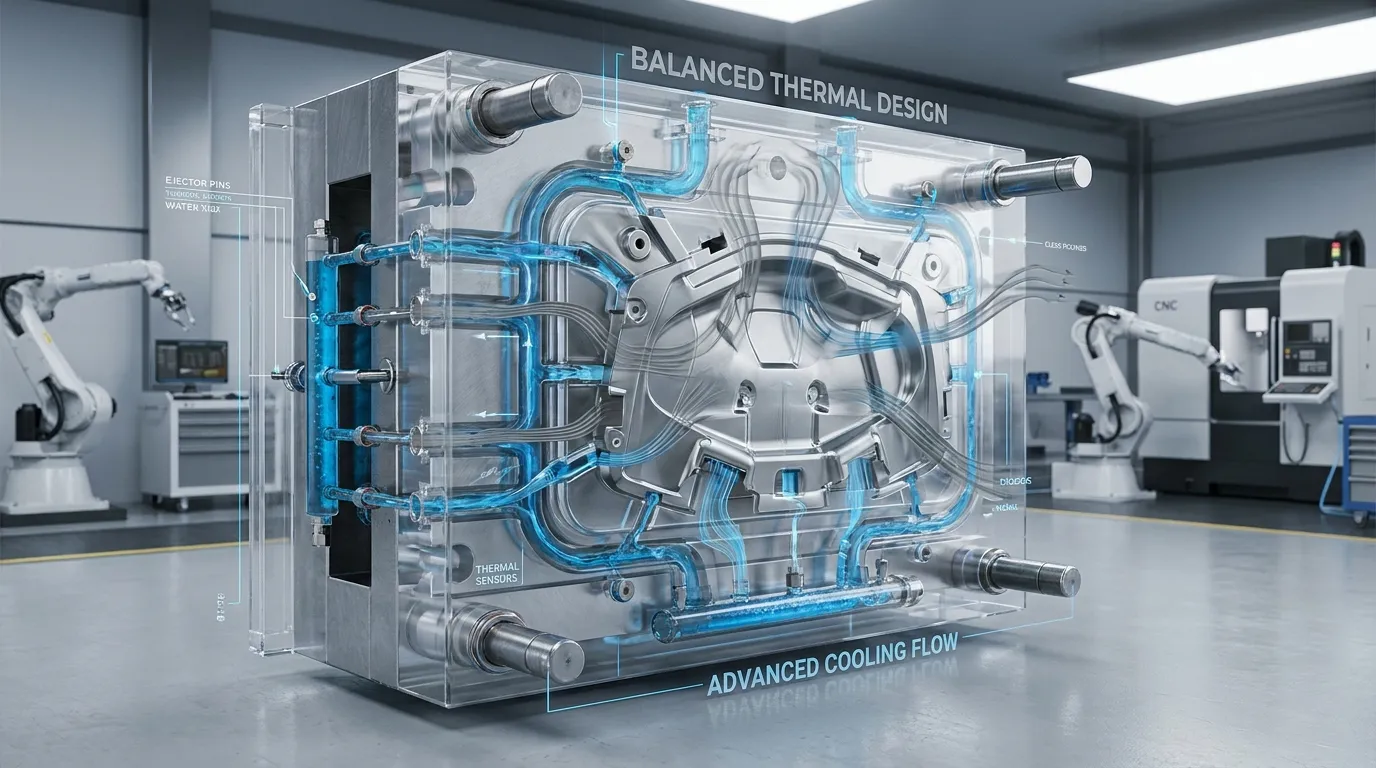
Cooling channels and venting systems directly affect cycle time, độ ổn định kích thước, and defect rates. Poor cooling creates warping and uneven shrinkage, while weak venting can trap air and cause burns or incomplete filling.
Cooling systems control how quickly heat leaves the mold after injection. Balanced cooling helps maintain consistent dimensions and stable production cycles. When cooling paths are uneven, one side of the part may shrink faster than the other.
That problem becomes expensive during long production runs. A medical molding supplier reduced cycle variation after redesigning cooling channels for more balanced heat removal. The mold itself did not change significantly, but cooling consistency improved part quality and reduced rejection rates.
Venting systems solve a different problem. Air trapped inside the cavity must escape during filling. Không có thông gió đúng cách, pressure builds inside the mold and creates burn marks, những cú bắn ngắn, or trapped gas defects.
Hướng dẫn lỗi ép phun của Elastron explains how poor cooling and venting contribute to common molding defects.
- Vết cháy gần cuối lấp đầy
- Co ngót không đồng đều
- Các bộ phận bị cong vênh
- Những cú sút ngắn ngẫu nhiên
- Chu kỳ làm mát dài hơn
- Thứ nguyên không nhất quán
What should buyers inspect before approving mold components?
Buyers should inspect steel grade, machining accuracy, cooling design, alignment precision, and replaceable wear parts before approving a mold. Early inspection reduces future downtime, defect risk, and repair costs.
Many tooling problems are easier to prevent before production starts. Buyers should review mold drawings, bố trí làm mát, wear components, and maintenance access before final approval.
Steel hardness matters because it affects wear resistance and long-term dimensional stability. Surface finish quality also affects part appearance and release consistency. Poor machining tolerance can create alignment issues that only appear after thousands of cycles.
A mold producing flash defects is often traced back to worn alignment components rather than machine settings. That’s why guide systems and bushings deserve careful inspection before acceptance.
Những câu hỏi người mua nên hỏi nhà cung cấp
- What steel grades are used for core and cavity sections?
- Are wear inserts replaceable?
- Which components are standardized?
- How are cooling channels balanced?
- What spare parts are recommended?
- Which components are expected to wear first?
Danh sách kiểm tra thành phần khuôn
| Khu vực kiểm tra | Những gì cần kiểm tra | Tại sao nó lại quan trọng |
|---|---|---|
| Độ cứng thép | Chứng nhận vật liệu | Chống mài mòn |
| Bề mặt hoàn thiện | Chất lượng đánh bóng | Tính nhất quán của mỹ phẩm |
| Bố trí làm mát | Thiết kế kênh cân bằng | Thời gian chu kỳ ổn định |
| Hệ thống căn chỉnh | Độ chính xác của chốt và ống lót | Ngăn chặn chớp nhoáng |
| Chèn có thể thay thế | Khả năng tiếp cận bảo trì | Sửa chữa nhanh hơn |
| Phụ tùng | Tính khả dụng của thành phần tiêu chuẩn | Giảm thời gian ngừng hoạt động |
Danh sách kiểm tra tìm nguồn cung ứng của Rodon Group provides additional supplier evaluation questions for tooling buyers.
Để biết thêm ví dụ về Dụng cụ khuôn tiêu chuẩn, buyers can compare commonly used replaceable systems and wear components.
Are premium mold components always worth the cost?
Premium mold components are usually worth the cost for high-volume production, vật liệu mài mòn, and tight-tolerance parts. Lower-cost components may work for prototype or low-volume molds with limited production cycles.
Premium components make the biggest difference when molds run continuously or process abrasive materials. Chèn cứng, Hệ thống dẫn hướng chính xác, and high-grade cooling hardware usually reduce maintenance frequency in demanding production environments.
That does not mean every project needs top-tier tooling. A low-volume prototype mold with limited production cycles may never recover the added cost of premium wear systems. Trong những trường hợp đó, simpler components often make financial sense.
So sánh người mua nếu-thì
| Điều kiện sản xuất | Lựa chọn tốt hơn | Lý do |
|---|---|---|
| Sản xuất số lượng lớn | Linh kiện cao cấp | Tuổi thọ lâu hơn |
| Nhựa mài mòn | Chèn cứng | Giảm mài mòn ma sát |
| Dung sai chặt chẽ | Hệ thống căn chỉnh chính xác | Tính nhất quán tốt hơn |
| Dụng cụ nguyên mẫu | Các bộ phận cấp tiêu chuẩn | Chi phí trả trước thấp hơn |
| Thời gian sản xuất ngắn | Chèn chi phí thấp hơn | ROI nhanh hơn |
Cheap ejector and guide systems often create repeated downtime during long production runs. The upfront savings may disappear quickly once maintenance interruptions begin affecting output.
Tổng quan về dụng cụ của Escatec discusses how tooling choices influence maintenance and long-term operating cost.
If you're comparing tooling grades, Sunshine Pro của Hướng dẫn thành phần dụng cụ can help identify where higher-spec parts matter most.
How can standardized mold components reduce downtime and sourcing delays?
Standardized mold components simplify maintenance, shorten replacement lead times, and reduce sourcing risk. Buyers using standardized systems can replace wear parts faster and minimize production interruptions during supply-chain delays.
When molds rely on custom-only hardware, repairs often take longer and cost more. Standardized guide pins, các vòng đệm, ejector systems, and inserts are easier to source locally or through multiple suppliers.
That flexibility becomes important during customs delays or international shipping disruptions. A buyer avoided six weeks of downtime because standardized bushings and guide pins were available from a local distributor instead of requiring overseas replacement orders.
Standardization also simplifies spare inventory planning. Maintenance teams can stock fewer unique parts across multiple molds, which lowers inventory complexity and speeds up repairs.
Người mua có kế hoạch sản xuất lâu dài nên xem xét Hệ thống khuôn tiêu chuẩn hóa before approving custom tooling configurations.
If you need a broader process-level overview, Sunshine Pro của Hướng dẫn khuôn ép nhựa explains how tooling systems connect to production planning and mold maintenance.
Thực hiện bước tiếp theo đúng đắn
Choosing the right plastic injection mold components is less about buying the most expensive mold and more about matching component quality to production reality. High-volume programs, nhựa mài mòn, and tight tolerances usually justify stronger wear systems and precision cooling designs. Prototype tools and short-run molds often need a different balance.
Before approving a mold, focus on cooling layout, wear components, alignment systems, and maintenance accessibility. Those details usually decide whether a mold runs reliably for years or becomes a constant repair problem.
Những câu hỏi thường gặp
What are the main components of a plastic injection mold?
The main components include the mold base, lõi và khoang, hệ thống runner, Hệ thống đẩy, các kênh làm mát, vents, và các thành phần dẫn hướng. Each part supports molding accuracy, cooling efficiency, part release, or mold alignment.
Những thành phần khuôn nào bị mòn nhanh nhất?
Chốt đẩy, các cổng, các vòng đệm, slides, and inserts usually wear fastest because they experience repeated movement, Nhiệt, and friction. These components often require the most frequent inspection and replacement.
Why are cooling channels important in injection molds?
Cooling channels control heat removal and cycle consistency during molding. Poor cooling design can increase warping, shrinkage variation, and production delays.
How long does an injection mold last?
Injection mold lifespan depends on steel quality, resin abrasiveness, maintenance practices, và sản lượng sản xuất. Well-maintained hardened steel molds can last hundreds of thousands or even millions of cycles.
What causes defects in injection molding molds?
Common mold-related defects come from poor venting, mất cân bằng làm mát, worn ejector systems, or alignment problems. These issues can create flash, burn marks, những cú bắn ngắn, or dimensional inconsistency.
Are premium mold components necessary for every project?
Premium components are most valuable for high-volume production, nhựa mài mòn, and tight-tolerance applications. Lower-cost components may be acceptable for prototypes or short-run tooling.
Chia sẻ:


Được viết bởi Sunshine
Tại Sunshine, Chúng tôi là nhà sản xuất và cung cấp chuyên nghiệp các linh kiện khuôn chính xác, cung cấp một loạt sản phẩm đa dạng cho ứng dụng dập và khuôn ép. Trọng tâm chính của chúng tôi bao gồm khuôn đục lỗ, ghim và ống lót đẩy, và cọc hướng dẫn cùng các bushing. Với gia công CNC tiên tiến, Kiểm soát chất lượng nghiêm ngặt, và năng lực sản xuất mạnh mẽ, chúng tôi đảm bảo độ tin cậy, các bộ phận chính xác cao, cùng với các linh kiện tiêu chuẩn có sẵn trong kho để cung cấp nhanh chóng và hiệu quả toàn cầu.
TIN TỨC
NHẬN DỊCH VỤ
Với các bộ phận chất lượng đáp ứng mọi ngân sách và đội ngũ nhân viên thân thiện được đào tạo để giúp chuyến thăm của bạn trở nên hữu ích và thuận tiện.
