



Thép D2 và M2 cho chốt đục lỗ: Mặc, Độ dẻo dai, và Tốc độ
For punch pins, D2 and M2 solve different combinations of wear, tác động, and thermal stress. D2 is often a practical choice when gradual abrasive wear is the main concern and the die operates under controlled cold-work conditions. M2 may be the stronger candidate when the punch faces repeated edge chipping, difficult stock, long production runs, slender geometry, or sustained heat at the cutting edge.
Neither material is automatically better. Press speed alone does not determine the answer, and a harder punch is not always a more durable punch. Giải phóng mặt bằng, xử lý nhiệt, hình học, sự căn chỉnh, sự bôi trơn, and the actual failure pattern can matter as much as the steel grade.
Material selection is also only one part of a complete die system. The broader relationship between punches, cái này, Giải phóng mặt bằng, and tooling requirements is covered in SunshinePro’s Hướng dẫn đục lỗ (được suy luận).
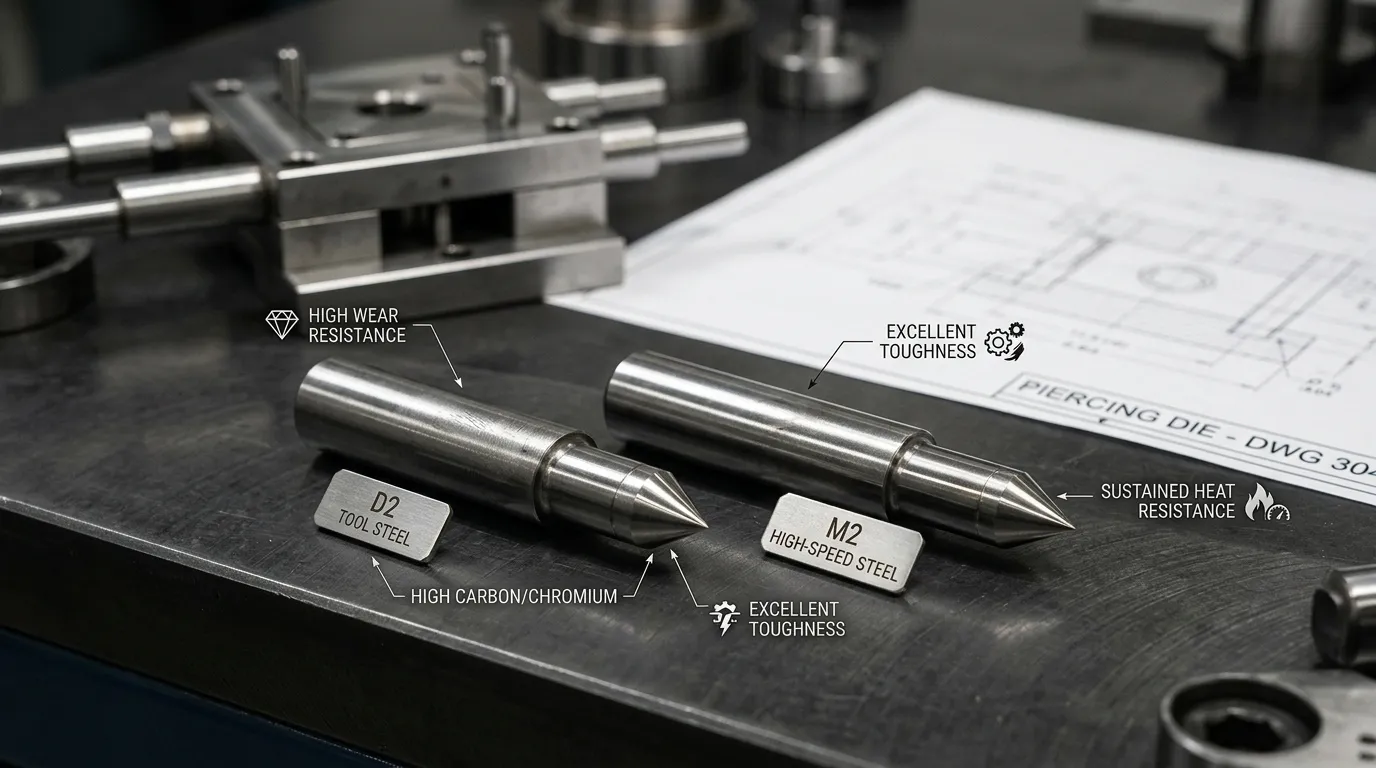
Sơ lược so sánh D2 và M2 Punch Pin
| Hệ số so sánh | Thép công cụ D2 | Thép tốc độ cao M2 |
|---|---|---|
| Gia đình thép | Thép công cụ gia công nguội | Thép tốc độ cao |
| Sức mạnh lựa chọn điển hình | Khả năng chống mài mòn mạnh trong điều kiện làm việc lạnh được kiểm soát | Balanced wear resistance, edge stability, sự cứng cáp, and hot hardness |
| Hạn chế chính | Can become vulnerable to chipping or fatigue when the hardness, hình học, or loading is too aggressive | Chi phí vật liệu và xử lý cao hơn có thể không hợp lý trong các ứng dụng nhẹ |
| Abrasive wear | Thường là một ứng cử viên sáng giá khi mài mòn dần dần chiếm ưu thế | Also wear resistant, especially where wear occurs with heat or repeated impact |
| Độ dẻo dai và sứt mẻ | Phụ thuộc vào ứng dụng; geometry and heat treatment must be controlled | Thường được coi là nơi D2 gặp phải hiện tượng sứt mẻ cạnh định kỳ trong các điều kiện ổn định khác |
| Nhiệt duy trì | Ít phù hợp hơn với các ứng dụng mà lưỡi cắt vẫn nóng trong thời gian dài | Được biết đến nhiều hơn với việc giữ độ cứng dưới nhiệt độ dịch vụ cao |
| Điều kiện phù hợp nhất | Stable alignment, suitable clearance, controlled impact, moderate thermal demand | Long runs, difficult stock, higher thermal demand, slender punches, or expensive downtime |
| Hướng chi phí | Thường được coi là điểm khởi đầu kinh tế hơn | Thường được đánh giá khi độ tin cậy được cải thiện có thể bù đắp chi phí tăng thêm |
| Yêu cầu xác minh | Độ dở chính xác, xử lý nhiệt, độ cứng, hình học, và điều kiện sản xuất | Độ dở chính xác, xử lý nhiệt, điều kiện tôi luyện, độ cứng, và điều kiện sản xuất |
These are selection tendencies, not guaranteed performance rankings. A poorly supported M2 punch can fail before a correctly designed D2 punch, while an over-hardened or misaligned D2 punch can chip before its wear resistance becomes useful.
Tại sao D2 và M2 hoạt động khác nhau trong một cú đấm
D2 is a high-carbon, high-chromium cold-work tool steel. It is commonly associated with wear resistance, compressive-load capability, and dimensional stability in tools operating without sustained high-temperature exposure. Thuộc tính Bảng dữ liệu BÖHLER K110, which covers a D2-family grade, lists punching and stamping tools among its applications.
M2 belongs to the molybdenum high-speed-steel family. Its alloy system is designed to retain hardness and cutting performance under greater thermal demand. Thuộc tính Bảng dữ liệu BÖHLER S600, covering an M2-family grade, emphasizes wear resistance, sự cứng cáp, edge stability, độ bền nén, and red hardness.
The difference cannot be reduced to a single Rockwell hardness value. Two punch pins at a similar HRC may still behave differently because of:
- Thành phần hợp kim và phân bố cacbua
- Austenit hóa, sự làm nguội, and tempering conditions
- Cấu trúc vi mô được giữ lại
- Tình trạng bề mặt mài và EDM
- Hình học và hỗ trợ đục lỗ
- Nhiệt độ trong quá trình sản xuất
- Loại mài mòn hoặc gãy xương xảy ra
The agreed material standard therefore matters. Tiêu chuẩn A681 covers alloy tool steels such as D2, trong khi Tiêu chuẩn A600 covers high-speed tool steels such as M2.
Tên cấp mà người mua không nên coi là tên tương đương tự động
Worldwide sourcing often involves several designation systems. D2 may be discussed alongside SKD11 or 1.2379, while M2 may be cross-referenced with SKH51, SKH9, or 1.3343.
These names should not be accepted as interchangeable without checking the applicable standard, Hóa học, production route, and final heat-treated condition. The drawing or purchase specification should identify the agreed grade rather than relying on a general trade name.
DC53 also should not be described as another name for standard D2. It is a separate modified cold-work steel with its own processing and performance characteristics.
Chống mài mòn: Identify the Wear Mechanism Before Choosing
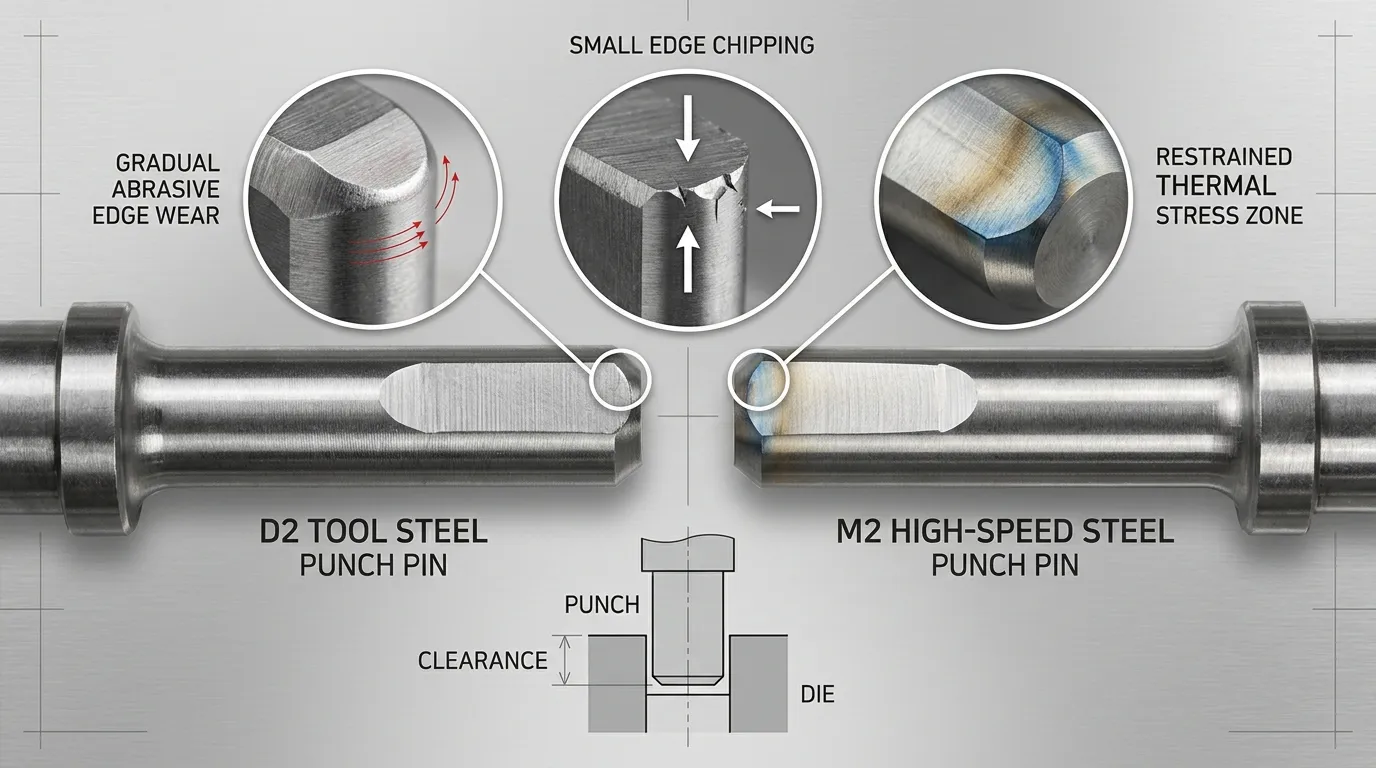
Asking which steel has “better wear resistance” is incomplete until the wear mechanism is known.
Abrasive wear gradually removes material from the punch edge or flank. It may be driven by hard particles, thang đo, an abrasive workpiece, or repeated sliding contact. D2 is often considered when this predictable, gradual wear is the primary problem and shock loading remains controlled.
Mòn và mài mòn chất kết dính involve material transfer, xe bán tải, or local seizure between the punch and workpiece. These problems are influenced heavily by workpiece material, Bề mặt hoàn thiện, sự bôi trơn, Giải phóng mặt bằng, và lớp phủ. Changing from D2 to M2 may not correct galling if friction and material adhesion remain the real causes.
Mòn kết hợp với sứt mẻ hoặc nhiệt creates a different selection problem. M2 may provide a more useful performance balance where the edge must resist abrasion while also tolerating repeated stress and sustained temperature.
Before changing steel, inspect how the existing punch is deteriorating:
| Điều kiện quan sát được | Vấn đề có thể cần điều tra | Ý nghĩa vật chất |
| Smooth, gradual edge recession | Abrasive wear | D2 may remain suitable; compare maintenance interval and total cost |
| Lấy vật liệu hoặc cặn thô | Galling, Kết thúc, sự bôi trơn, Lớp phủ | Điều kiện bề mặt chính xác trước khi đổ lỗi cho thép rời |
| Những mảnh nhỏ vỡ ra khỏi mép | Sứt mẻ, độ cứng quá mức, hình học, Giải phóng mặt bằng, tải bên | M2 có thể được xem xét sau khi các nguyên nhân của hệ thống được kiểm soát |
| Hao mòn nhanh chóng trong quá trình chạy dài không bị gián đoạn | Kết hợp mài mòn và nhiệt | Khả năng độ cứng nóng của M2 có thể trở nên phù hợp hơn |
SunshinePro’s die punch pin page lists precision grinding and TiN and TiCN coating options. These processes can support surface condition and wear control, but a coating cannot compensate for unsuitable steel, căn chỉnh kém, giấy phép không đúng, or weak punch support.
Độ dẻo dai, Sứt mẻ, and Punch Geometry
Punch toughness is not determined by the steel name alone. The final hardness, xử lý nhiệt, edge shape, chiều dài không được hỗ trợ, and loading direction all affect whether the punch bends, khoai tây chiên, or develops fatigue cracks.
A large, well-supported round punch and a long, narrow punch do not place the same demands on the material. Small-diameter punches, sharp internal features, narrow points, and long unsupported sections create greater stress concentration and bending risk.
Repeated chipping can result from:
- Độ cứng quá mức đối với hình học
- Khe hở đục lỗ không chính xác
- Hướng dẫn hoặc căn chỉnh kém
- Tải bên
- Hỗ trợ đầu hoặc cơ thể không đủ
- Thiệt hại mài
- Một lớp đúc lại EDM không được kiểm soát
- Lỗi xử lý nhiệt
- Quá tải cục bộ do biến đổi hàng tồn kho
A published failure analysis of an AISI D2 punch found that punch damage could involve fatigue, carbide cracking, excessive loading, heat-treatment issues, backup-plate wear, Giải phóng mặt bằng, and guiding conditions. The study reinforces a basic rule: changing the material without correcting the mechanical cause may only move the failure to another location. Xem nghiên cứu về mệt mỏi và hư hỏng do mài mòn trong cú đấm AISI D2.
M2 may deserve evaluation when a D2 punch repeatedly chips despite correct alignment, suitable clearance, stable heat treatment, and adequate support. It should not be treated as a substitute for investigating the die system. A more complete diagnosis of side loading, Giải phóng mặt bằng, đang hướng dẫn, and fracture causes belongs in the guide to đục lỗ đứt gãy trong khuôn dập.
Khi tốc độ nhấn làm cho độ cứng nóng của M2 có liên quan
The term “high-speed steel” often leads to an oversimplified rule: fast press equals M2. Actual punch conditions are more complicated.
Strokes per minute affect the number of loading events, but they do not directly state the cutting-edge temperature. Thermal demand also depends on:
- Thời lượng chạy liên tục
- Độ bền và độ dày phôi
- Kích thước lỗ và hình dạng đục lỗ
- Khe hở đục lỗ
- Ma sát và mài mòn
- Bôi trơn
- Tản nhiệt giữa các lần đột quỵ
- Thời gian và tần suất ngừng sản xuất
A fast press running short batches of thin, manageable stock may produce less sustained edge heat than a slower press running thick, high-strength material continuously.
M2’s hot hardness becomes more valuable when the cutting edge remains hot enough for ordinary cold-work performance to deteriorate. That condition may appear during long progressive-die runs, difficult stock punching, ma sát cao, or inadequate cooling between cycles.
D2 can still be suitable at a high numerical press speed when thermal load, tác động, and chipping risk remain controlled. M2 should therefore be selected because of the complete duty cycle, not because the press specification contains a high strokes-per-minute number.
D2 or M2? Choose by Failure Mode and Application
The following table provides a starting direction. It is not a substitute for examining the die, phôi, xử lý nhiệt, and failed punch.
| Điều kiện ứng dụng | Ứng cử viên có khả năng bắt đầu | Lý do | Kiểm tra trước khi quyết định |
| Ổn định, gradual abrasive wear | D2 | Khả năng mài mòn làm việc nguội mạnh mẽ có thể là đủ | Độ cứng, khoảng mài sắc, stock abrasiveness |
| Cạnh D2 liên tục bị sứt mẻ | M2 có thể được đánh giá | Độ dẻo dai rộng hơn và cân bằng độ ổn định cạnh có thể hữu ích | Giải phóng mặt bằng, sự căn chỉnh, hình học, xử lý nhiệt |
| Sản xuất lâu dài không bị gián đoạn với nhiệt cạnh bền vững | M2 | Độ cứng nóng trở nên phù hợp hơn | Actual temperature drivers, ma sát, sự bôi trơn |
| Cú đấm đường kính nhỏ hoặc mảnh | M2 có thể được đánh giá | Hình học có thể yêu cầu khả năng chống sứt mẻ và mỏi cao hơn | Unsupported length, đang hướng dẫn, giá đỡ đầu |
| Đục lỗ nhẹ hoặc thép cacbon thể tích vừa phải | D2 có thể là đủ | Nhu cầu nhiệt và va đập có thể không phù hợp với M2 | Stock thickness, Giải phóng mặt bằng, desired maintenance interval |
| Vật liệu không gỉ hoặc dễ bị mài mòn | Phụ thuộc vào ứng dụng | Ma sát, độ bám dính, and heat may dominate | Bôi trơn, Bề mặt hoàn thiện, Lớp phủ, Giải phóng mặt bằng |
| Tấm dày hoặc có độ bền cao hơn | M2 có thể mang lại lợi thế | Tải trọng cao hơn có thể làm tăng ứng suất cạnh và nhiệt | Đường kính đục lỗ, press force, hỗ trợ, hole geometry |
| Thời gian ngừng hoạt động đắt hơn đáng kể so với chi phí công cụ | M2 có thể hợp lý về mặt kinh tế | Chi phí ban đầu bổ sung có thể chấp nhận được nếu độ tin cậy được cải thiện | Hồ sơ sản xuất và kết quả thử nghiệm có kiểm soát |
Các điều kiện điển hình mà D2 có thể là đủ
D2 remains a reasonable candidate when the punch experiences predictable wear under stable cold-working conditions. Suitable clearance, strong guidance, adequate support, and controlled hardness allow its wear resistance to be used without excessive chipping.
It can be a practical choice for moderate production duties where current sharpening intervals are acceptable and the application does not create sustained heat or severe impact.
Các điều kiện mà M2 có thể biện minh cho chi phí cao hơn của nó
M2 becomes more attractive when a punch must maintain its edge under combined wear, repeated stress, and thermal demand. Examples include long production runs, difficult or higher-strength stock, slender punch geometry, and applications where recurring D2 chipping continues after system problems have been corrected.
The economic case is strongest when unplanned breakage or press downtime costs much more than the difference in punch material and processing.
Steel Grade Alone Will Not Fix Clearance, Căn chỉnh, or Heat-Treatment Problems
Before replacing D2 with M2, confirm that the current punch is being tested fairly. Tối thiểu, Đánh giá:
- Khe hở đục lỗ
- Độ đồng tâm và căn chỉnh của cú đấm
- Điều kiện trụ dẫn hướng và ống lót
- Hỗ trợ đục lỗ và chiều dài không được hỗ trợ
- Độ dày phôi và sự thay đổi độ cứng
- Tính nhất quán của bôi trơn
- Mài bỏng hoặc hư hỏng cạnh
- Tình trạng bề mặt EDM
- Độ cứng cuối cùng và điều kiện ủ
- Tình trạng lớp phủ
- Mẫu mòn trên lỗ đục lỗ và khuôn
Incorrect clearance can increase cutting load, sự hình thành răng cưa, edge stress, và mẻ mẻ. Misalignment can place bending loads on a punch designed mainly for compression. Grinding or EDM damage can also provide a starting point for fatigue cracks.
A punch works as part of a larger assembly. The relationship between the punch, tiền dự phòng, các hướng dẫn viên, các vòng đệm, die insert, and support components is covered more broadly in the Hướng dẫn thành phần khuôn.
Compare Cost by Downtime and Maintenance, Not Steel Price Alone
D2 may have a lower initial cost in many sourcing situations, but purchase price does not show the complete economic result. M2 may cost more to purchase, máy móc, heat-treat, or grind, yet still be worthwhile if it reduces expensive production interruptions.
A useful comparison should include:
| Yếu tố chi phí | Câu hỏi để đánh giá |
| Chi phí đục lỗ ban đầu | What is the delivered cost in the specified grade and condition? |
| Mài sắc | How many hits occur between scheduled sharpening events? |
| Vỡ ngoài kế hoạch | Does the punch wear predictably or fail without warning? |
| Thời gian ngừng hoạt động | How much production is lost during replacement and die adjustment? |
| Phế liệu | Does edge deterioration affect burrs, Kích thước, or part quality? |
| Hàng tồn kho | How many spare punches are required to protect production? |
| Nhân công bảo trì | How much toolroom time is spent inspecting, sự mài sắc, and replacing punches? |
M2 is not automatically the lower-cost choice. It becomes economically attractive only when its performance under the actual application reduces enough maintenance, failure, phế liệu, or downtime to offset the added cost.
Những gì cần chỉ định trước khi yêu cầu chốt đục lỗ D2 hoặc M2
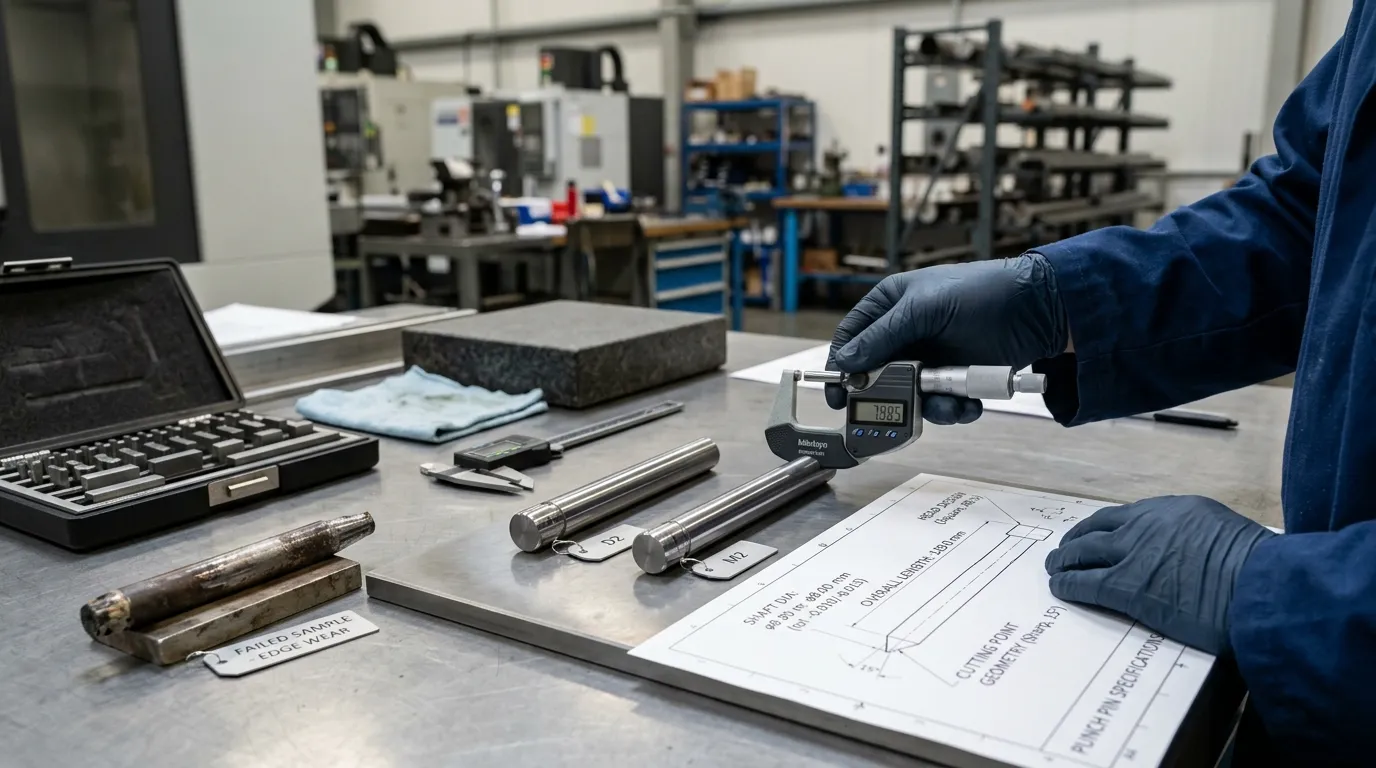
A supplier cannot make a reliable material recommendation from the punch diameter alone. The RFQ should describe both the component and its operating conditions.
Cung cấp:
- Một bản vẽ có kích thước
- Đường kính đục lỗ, chiều dài, and unsupported length
- Thiết kế đầu và bố trí hỗ trợ
- Point shape, corner radii, and special cutting features
- Vật liệu và cấp phôi
- Độ dày tấm
- Kích thước và hình dạng lỗ
- Khe hở đục lỗ
- Loại báo chí và tốc độ hoạt động
- Thời lượng chạy liên tục
- Số lần truy cập hàng năm dự kiến
- Chất bôi trơn và phương pháp thi công
- Vật liệu đục lỗ hiện có và độ cứng đo được
- Current failure symptom: mặc, gây khó chịu, mẻ, sự uốn cong, hoặc mệt mỏi
- Ảnh hoặc mẫu không thành công nếu có
- Lớp phủ bắt buộc
- Chỉ định và tiêu chuẩn vật liệu đã được thống nhất
- Giấy chứng nhận vật liệu bắt buộc
- Tài liệu xử lý nhiệt
- Yêu cầu kiểm tra độ cứng
- Tiêu chí chấp nhận thử nghiệm sản xuất
SunshinePro states that non-standard components can be produced from customer drawings. Nó Trang sản phẩm Die Punch Pin lists custom diameter, chiều dài, thiết kế đầu, Vật chất, và các tùy chọn phủ, together with SKH51, SKH9, DC53, Điểm ASP, và cacbua. The page also mentions CNC machining, mài chính xác, EDM, và xử lý nhiệt chân không.
That information does not confirm AISI D2 availability. Buyers requiring D2 should ask the supplier to confirm the exact material designation, applicable standard, điều kiện xử lý nhiệt, and documentation before ordering.
A controlled trial remains the most reliable final check. Compare D2 and M2 using the same drawing, Giải phóng mặt bằng, báo chí, workpiece batch, chất bôi trơn, tình trạng lớp phủ, và phương pháp kiểm tra. Record the hit count and actual failure mechanism rather than judging only by whether the punch still appears usable.
Khi cả D2 và M2 thông thường đều không phải là câu trả lời đúng
If both materials fail after clearance, hỗ trợ, sự căn chỉnh, sự bôi trơn, hình học, and heat treatment have been corrected, the application may require a different solution.
Possible next steps include reviewing:
- Thép tốc độ cao luyện kim bột
- Cacbua
- Một hệ thống sơn khác
- Hình dạng đục lỗ sửa đổi
- Cải thiện hướng dẫn hoặc hỗ trợ
- Thay đổi khe hở hoặc bôi trơn
SunshinePro lists ASP grades and carbide among its punch-pin material categories, but these alternatives should be evaluated against the same application data rather than treated as automatic upgrades.
For a material review or quotation, submit the punch drawing, chi tiết phôi, điều kiện sản xuất, and current failure evidence through the Trang liên hệ SunshinePro. The strongest recommendation will come from matching the steel, xử lý nhiệt, hình học, and die conditions to the failure mode the punch must actually survive.
Chia sẻ:


Được viết bởi Sunshine
Tại Sunshine, Chúng tôi là nhà sản xuất và cung cấp chuyên nghiệp các linh kiện khuôn chính xác, cung cấp một loạt sản phẩm đa dạng cho ứng dụng dập và khuôn ép. Trọng tâm chính của chúng tôi bao gồm khuôn đục lỗ, ghim và ống lót đẩy, và cọc hướng dẫn cùng các bushing. Với gia công CNC tiên tiến, Kiểm soát chất lượng nghiêm ngặt, và năng lực sản xuất mạnh mẽ, chúng tôi đảm bảo độ tin cậy, các bộ phận chính xác cao, cùng với các linh kiện tiêu chuẩn có sẵn trong kho để cung cấp nhanh chóng và hiệu quả toàn cầu.
TIN TỨC
NHẬN DỊCH VỤ
Với các bộ phận chất lượng đáp ứng mọi ngân sách và đội ngũ nhân viên thân thiện được đào tạo để giúp chuyến thăm của bạn trở nên hữu ích và thuận tiện.
